
WJEC GCSE Integrated Science (Single Award) Revision
Explore WJEC GCSE Integrated Science (Single Award) revision topics. Check the official specification for complete requirements for your exam year and route.
Qualification code: 3450QS
Course details
Assessment Two 90-minute, 72-mark written exams, each worth 45%; Unit 1 includes 24 marks linked to its pre-release Resource Folder. One external untiered Unit 3 enquiry, worth 28 marks and 10%. First full award in summer 2028.
Tick a point after revising it. Progress is saved on this device and does not measure mastery.
Reviewed course guidance
Revision points, with the explanation beside them
Open a point to read what to know, how to use it in an assessment, a plain-language explanation and a self-check. Answers stay hidden until you choose to reveal them.
Options and source
Study tier
- Foundation
- Higher
Summary of Assessment, Units 1–2; §5.3. One study toggle, not a unit entry choice.
Progress could not be saved in this browser. Your ticks will remain for this page view only.
Topic group
Unit 1: Living on Earth
- Core
Scope: Core · Unit 1, 1.1.1a, common outcomes
Open revision guidance
What to know
- Carbohydrases break carbohydrates into simple sugars; proteases break proteins into amino acids; lipases break fats into fatty acids and glycerol. The digested products cross the small-intestine wall and enter transport systems; the large intestine mainly absorbs remaining water.
- Carbohydrase is made by salivary glands, pancreas and small-intestine lining, acting in the mouth and small intestine. Protease is made in the stomach, pancreas and small-intestine lining, acting in the stomach and small intestine. Lipase is made by the pancreas and small-intestine lining and acts mainly in the small intestine. Bile is not an enzyme.
- The lock-and-key model represents a substrate fitting a complementary active site, forming an enzyme–substrate complex and releasing products. It is a simplified model, not a rigid physical lock.
- Warming initially increases reaction rate; sufficiently high temperature changes the active site's shape and denatures the enzyme. Low temperature normally slows rather than denatures it. Each enzyme has a suitable pH range; unsuitable pH can change the active site.
- Applications include biological detergents, food processing such as lactose removal, diagnostic enzyme tests, and industrial manufacture. The useful enzyme and operating conditions depend on the product, not a claim that all enzymes work at 37°C.
What to do in an assessment
- Investigate amylase breaking down starch: keep starch/amylase volumes and concentrations constant, use buffer and an equilibrated water bath, mix and start timing together, and test small samples with iodine on a spotting tile at equal intervals. Record the first sample staying brown rather than blue-black.
- Change only temperature, then conduct a separate pH investigation with temperature fixed. Use repeats and an appropriate range, report intervals and anomalies, compare time or a clearly labelled 1/time proxy for rate. Use school-approved reagents, eye protection and safe water-bath temperatures; do not ingest samples.
In plain language
Digestion breaks large food molecules into small soluble molecules that can be absorbed. Enzymes speed these reactions without being used up.
Self-check
Why does very hot amylase stop breaking down starch, whereas cold amylase usually resumes when warmed?
Show the answer
High temperature can denature the active site so starch no longer fits. Cold normally reduces the rate without permanently changing the active site.
View diagrams
Human digestive systemSimplified schematic; not to scale. - A
- B
- C
- D
- E
- F
- G
- H
- I
- J
- K
- L
- M
Show labelled key: Answer key for digestive-system
Human digestive systemSimplified schematic; not to scale. - AMouth
- BOesophagus
- CLiver
- DGall bladder
- EStomach
- FPancreas
- GDuodenum
- HIleum
- IColon
- JRectum
- KAnus
- LSalivary glands
- MBile duct
Follow the digestive route alongside the enzyme sites and products explained in the lesson. - Core
Scope: Core · Unit 1, 1.1.1b, common outcomes
Open revision guidance
What to know
- Digested carbohydrates and fats can supply substrates for respiration; fats also provide a concentrated energy store. Amino acids from proteins are used for growth, repair and protein synthesis, rather than treating protein solely as fuel.
- Potassium supports nerve signals and muscle function; calcium supports bones and muscle contraction; magnesium is needed for enzyme activity and normal muscle function. A varied diet supplies these minerals; more supplement is not automatically better.
- Sports nutritionists consider energy demand, nutrients, hydration, timing and individual needs when supporting performance and health. Classroom comparisons are not personal medical or supplement advice.
What to do in an assessment
- Measure food energy in a supervised calorimetry experiment: measure the food's mass before and after burning, a fixed water mass and starting/final water temperatures, and keep the burner–container distance constant. Repeat different foods, calculate an estimate per gram and explain heat losses; flames and hot apparatus require teacher controls.
- For given water mass 100 g, temperature rise 20°C and specific heat capacity 4.2 J g⁻¹ °C⁻¹, water gains 8400 J. If 0.50 g food burns, the measured estimate is 16.8 kJ/g, not the food's exact chemical energy.
- Compare food labels per 100 g and actual serving, checking kJ/kcal, carbohydrate, fat, protein and relevant minerals. A 50 g serving of a food labelled 1200 kJ per 100 g provides 600 kJ. Justify a meal using supplied activity and nutrition information, not a universal diet for every athlete.
In plain language
A suitable diet supplies both energy and materials for an active body. A food's calories alone do not describe its nutritional value.
Self-check
Why is comparing energy per serving without checking serving mass misleading?
Show the answer
The portions may be different sizes. Compare like masses, then calculate the nutrients and energy in the actual portion.
- Core
Scope: Core · Unit 1, 1.1.1c, common outcomes
Open revision guidance
What to know
- The respiratory system supplies oxygen and removes carbon dioxide. Ventilation and gas exchange are not the same process as cellular respiration.
- Aerobic respiration: glucose + oxygen → carbon dioxide + water, with energy transferred. Anaerobic respiration in human muscle: glucose → lactic acid, with energy transferred. It can occur when oxygen supply does not meet demand; it is not simply 'breathing without air'.
- Compare oxygen requirement and products in the two processes. Sports scientists use breathing and exercise data to monitor workload and recovery, not to diagnose health from a single reading.
What to do in an assessment
- Measure breaths per minute at rest, after a standard safe activity, and during recovery. Keep activity duration/intensity, counting interval and measurement method comparable, repeat or use an appropriate anonymous class sample, and plot recovery against time.
- Count full breaths consistently and record actual timings. Use teacher-approved gentle exercise, informed participation and suitable adaptations; stop if unwell and do not require unsafe exercise or disclosure of health information.
In plain language
Breathing moves air; the respiratory system exchanges gases. Respiration is a chemical process in cells that transfers energy for living activities.
Self-check
Why is respiration not another word for breathing?
Show the answer
Breathing ventilates the lungs; respiration consists of reactions in cells that transfer energy from substances such as glucose.
View diagrams
Human breathing systemSimplified schematic; not to scale. - A
- B
- C
- D
- E
- F
- G
- H
- I
- J
- K
Show labelled key: Answer key for breathing-system
Human breathing systemSimplified schematic; not to scale. - ALarynx
- BTrachea
- CBronchi
- DBronchioles
- EAlveoli
- FCapillaries
- GLung
- HRibs
- IIntercostal muscles
- JDiaphragm
- KNasal cavity
Alveolus and surrounding capillarySchematic, not to scale or a photograph. O₂ diffuses from alveolar air into blood; CO₂ diffuses from blood into the alveolus. Show labelled key: Answer key for alveolus-capillary
Alveolus and surrounding capillarySchematic, not to scale or a photograph. O₂ diffuses from alveolar air into blood; CO₂ diffuses from blood into the alveolus. - ATerminal bronchiole
- BAlveolar wall
- CMoist lining
- DCapillary wall
- ERed blood cell
- FPlasma
Breathing and gas exchange support respiration, but are not the same process as the reactions in cells. - Higher
Scope: Higher · Study tier: Higher · Unit 1, 1.1.1c, bold Higher addition
Open revision guidance
What to know
- ATP molecules formed during respiration provide an immediate energy-transfer system for cellular work. ATP is not a type of breathing or a permanent replacement for food stores.
- Anaerobic respiration in muscle incompletely breaks down glucose, leaving substantial chemical energy in lactic acid. Aerobic respiration breaks glucose down more fully, so supplies more ATP per glucose molecule. Do not confuse lower efficiency with an inability to transfer any energy.
What to do in an assessment
- Explain why an athlete can briefly continue vigorous activity anaerobically but cannot sustain it as efficiently. Compare energy per glucose rather than making a numerical ATP-yield claim not supplied by this course.
In plain language
Cells transfer energy through ATP, and anaerobic breakdown of glucose releases less usable energy per glucose molecule.
Self-check
Why is muscle anaerobic respiration less efficient per glucose molecule?
Show the answer
Glucose is not fully broken down; energy remains in lactic acid, so less energy is transferred through ATP than in aerobic respiration.
- Core
Scope: Core · Unit 1, 1.1.1d, common outcomes
Open revision guidance
What to know
- Red blood cells carry oxygen; plasma carries the cells and dissolved substances such as nutrients, carbon dioxide and urea; platelets initiate clotting; white blood cells defend against pathogens.
- Arteries carry blood away from the heart under relatively high pressure; veins return it and use valves to limit backflow; thin-walled capillaries allow exchange with tissues. Define vessels by direction, not a rule that every artery contains oxygenated blood.
- Coronary vessels supply the heart muscle with oxygen and nutrients. Narrowing can restrict oxygen delivery, causing chest pain and potentially a heart attack. Risk factors include smoking, inactivity, unhealthy diet, raised blood pressure and inherited factors; risk is not certainty.
- Diet and exercise contribute to cardiovascular health. Physiological readings reflect conditions and individual variation, not an automatic diagnosis or a guarantee that a fitter-looking person is healthy.
What to do in an assessment
- Measure pulse over a stated interval at rest, immediately after the same safe exercise and at fixed recovery intervals. A 15-second count of 20 beats estimates 80 beats/min; a longer interval can reduce proportional counting error.
- Keep exercise and measurement methods comparable, repeat when safe, plot heart rate against recovery time and define recovery consistently. Explain delayed counting, different exercise intensities and small samples. Use adapted activities and anonymous records rather than publishing classmates' health data.
In plain language
The muscular heart pumps blood so cells receive materials and wastes can be carried away.
Self-check
Why do coronary vessels matter when the heart is full of blood?
Show the answer
The heart muscle itself needs its own oxygen and nutrient supply from coronary vessels; chamber blood does not directly supply every muscle cell.
View diagrams
Section through the human heartSimplified schematic; not to scale. - A
- B
- C
- D
- E
- F
- G
- H
- I
- J
- K
- L
- M
- N
Show labelled key: Answer key for heart-section
Section through the human heartSimplified schematic; not to scale. - ARight atrium
- BRight ventricle
- CLeft atrium
- DLeft ventricle
- ESeptum
- FMuscular wall
- GTricuspid valve
- HBicuspid (mitral) valve
- ISemilunar valves
- JCoronary arteries
- KVena cava
- LPulmonary artery
- MPulmonary vein
- NAorta
Double circulation and major vesselsColour indicates oxygenation, not artery or vein type. Simplified schematic; not to scale. - A
- B
- C
- D
- E
- F
- G
- H
- I
- J
- K
- L
- M
- N
Show labelled key: Answer key for circulation-vessels
Double circulation and major vesselsColour indicates oxygenation, not artery or vein type. Simplified schematic; not to scale. - AHeart
- BLungs
- CPulmonary artery: heart → lungs
- DPulmonary vein: lungs → heart
- EAorta: away from heart
- FVena cava: to heart
- GGut
- HHepatic portal vein: gut → liver
- ILiver
- JHepatic artery: to liver
- KHepatic veins: from liver
- LKidney
- MRenal artery: to kidney
- NRenal vein: from kidney
Practice question
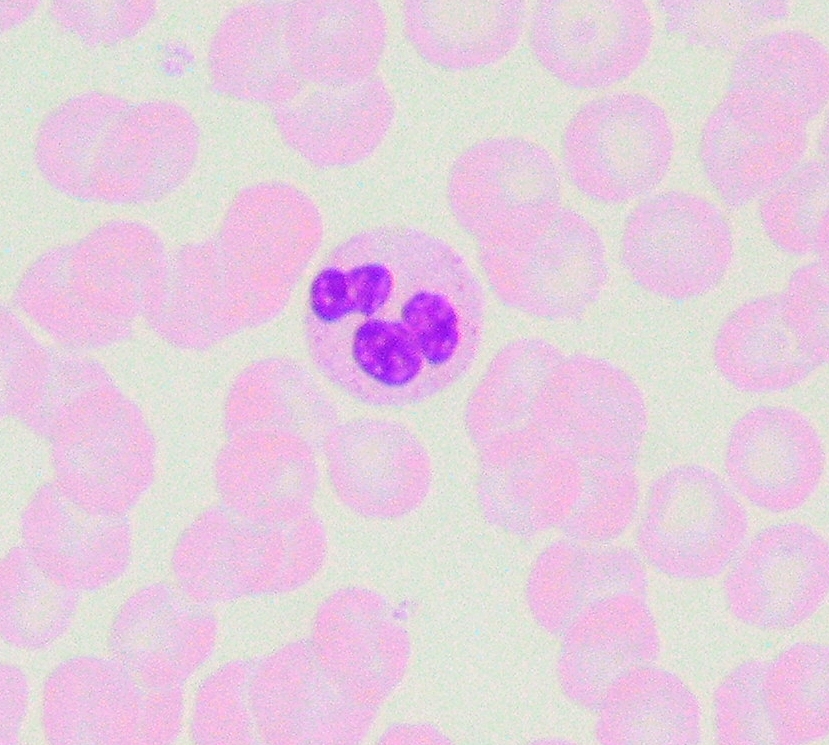
Compare the many pale disc-shaped cells with the larger purple-stained cell near the centre. Which is the red blood cell type, and what kind of white blood cell is visible?
Photograph / micrograph recognition only. This small unlabelled field contains erythrocytes and a neutrophil, not a lymphocyte. No scale bar is shown.
Photo: Blood-neutrophil1 · EchinaceapallidaWright-stained human peripheral blood smear.Show labelled key: Answer key for blood-smear-micrograph
Human blood smear
Photo key
The numerous pale cells are erythrocytes (red blood cells). The larger purple-stained cell is a neutrophil, identified by its segmented nucleus.
This small unlabelled field contains erythrocytes and a neutrophil, not a lymphocyte. No scale bar is shown.
Photo: Blood-neutrophil1 · EchinaceapallidaWright-stained human peripheral blood smear.Compare the heart and vessel models with a real blood-smear image; not all structures are equally visible in every microscope field. - Core
Scope: Core · Unit 1, 1.1.1e, common outcomes
Open revision guidance
What to know
- Speed = distance/time, using consistent units such as metres, seconds and m/s. Acceleration or deceleration = change in speed/time in m/s²; deceleration describes decreasing speed.
- On a distance-time graph, a horizontal line means stationary and a steeper upward straight line means greater constant speed. Calculate speed using changes in distance and time, not distance/time from an arbitrary non-zero graph origin.
- On a speed-time graph, a horizontal line represents constant speed; an upward or downward slope shows speeding up or slowing down. Sports scientists use measurements and graphs to analyse performance.
What to do in an assessment
- A runner covering 40 m in 8 s averages 5 m/s. A speed change from 2 to 8 m/s in 3 s gives acceleration (8−2)/3 = 2 m/s². Include units and distinguish average speed from every instantaneous speed.
- Plot labelled distance-time and speed-time axes from a supplied table. In the worked distance graph, (0 s,0 m) to (4 s,8 m) gives 2 m/s; 4–6 s is stationary; (6 s,8 m) to (8 s,16 m) gives 4 m/s.
In plain language
Describe an athlete's movement using measured distance and time, with graphs showing how movement changes.
Self-check
Does a flat distance-time graph mean the same thing as a flat speed-time graph?
Show the answer
No. Flat distance-time means stationary; flat speed-time means constant speed, which may be non-zero.
View diagrams
Distance-time and speed-time representationsConstructed idealised distance-time vertices are (0 s, 0 m), (4 s, 8 m), (6 s, 8 m) and (8 s, 16 m): speeds are 2 m/s, stationary from 4-6 s, then 4 m/s. A separate common-tier speed-time graph rises from 0 to 8 m/s over 0-4 s; it is read qualitatively, with no Higher area or gradient calculation.
Compare distance-time and speed-time graphs using their different axis quantities. - Higher
Scope: Higher · Study tier: Higher · Unit 1, 1.1.1e, bold Higher addition
Open revision guidance
What to know
- Gradient = change in speed/change in time, with units m/s². Area under a speed-time graph gives distance in metres; split compound regions into rectangles and triangles and sum them.
What to do in an assessment
- For a straight line from (0 s,0 m/s) to (4 s,8 m/s), acceleration = 8/4 = 2 m/s² and distance = ½ × 4 × 8 = 16 m.
- For a later constant 8 m/s lasting 3 s, the rectangular area adds 24 m, so those two sections total 40 m. Use the actual plotted scales, not how steep the line looks after resizing.
In plain language
Use the slope to calculate acceleration and the area to calculate distance travelled.
Self-check
Why are gradient and area different physical quantities?
Show the answer
Gradient divides m/s by s to give m/s²; area multiplies m/s by s to give metres.
View diagrams
Higher speed-time gradient and areaHigher-only: the same constructed straight speed-time line rises uniformly from 0 to 8 m/s over 4 s. Its triangle area gives distance 16 m; its gradient gives acceleration 2 m/s². This represents uniform acceleration.
Calculate speed-time gradient and areas using the labelled worked sections. - Core
Scope: Core · Unit 1, 1.1.2a, common outcomes
Open revision guidance
What to know
- Communicable examples include meningitis, influenza and athlete's foot. Non-communicable examples include cardiovascular disease, cancer, diabetes and dementia.
- Pathogens include bacteria, viruses and fungi. Not all microorganisms are pathogens; antibiotics do not treat viral infection.
- Routes include contact, aerosols, body fluids, water, insects and contaminated food. Match a plausible transmission route to the pathogen/context rather than claiming all diseases spread by all routes.
- Non-communicable disease can result from interacting genetic, environmental and lifestyle factors; a correlation alone does not establish one cause.
What to do in an assessment
- Model transmission with safe tokens or coloured water, not microbes or body fluids: exchange a fixed quantity through a recorded contact network, test/inspect the final samples and compare spread with a reduced-contact or hygiene scenario.
- State the model's limitations: real contacts differ, susceptibility varies, not every contact transmits disease, and a coloured marker does not reproduce incubation or immunity. Use the model to reason about prevention, not identify a real infected classmate.
In plain language
Disease interferes with normal body function. Distinguish transmission of pathogens from conditions that do not spread between people.
Self-check
Why is an association between a lifestyle factor and disease not enough to prove causation?
Show the answer
Other genetic, environmental or lifestyle variables may affect both, so further controlled and converging evidence is needed.
- Core
Scope: Core · Unit 1, 1.1.2b, common outcomes
Open revision guidance
What to know
- Skin forms a physical barrier; blood clots close breaks; phagocytes engulf pathogens; stomach acid kills many swallowed microbes; mucus traps particles and cilia move mucus out of the respiratory tract.
- Antigens on pathogens stimulate a specific immune response, including production of complementary antibodies. Antibodies bind particular antigens; antigens and antibodies are not interchangeable words.
- Changes such as stopping smoking, safer hygiene, appropriate activity and improved diet can affect health risk. Consider realistic evidence and barriers to change rather than blaming individuals.
What to do in an assessment
- For a given infection route, explain which barrier acts and what happens if it is breached. Distinguish a general barrier from an antigen-specific response.
In plain language
Barriers and cells protect the body, while recognition of particular antigens triggers a specific immune response.
Self-check
How do mucus and cilia work together?
Show the answer
Mucus traps particles and microorganisms, and cilia move the mucus towards removal from the respiratory tract.
- Higher
Scope: Higher · Study tier: Higher · Unit 1, 1.1.2b, bold Higher addition
Open revision guidance
What to know
- Following natural infection or vaccination, memory cells can remain and respond rapidly to the same antigen, producing a faster, stronger protective response. Protection varies with pathogen, time and person; it does not imply every vaccinated person can never become infected.
What to do in an assessment
- Explain a given first-versus-second immune-response graph using antigen recognition, the time needed for the initial response and persistent memory cells.
In plain language
A first response can leave memory cells that make a later response to the same antigen faster.
Self-check
Why can a second exposure trigger a faster response?
Show the answer
Memory cells formed after the first infection or vaccination recognise the antigen and support rapid antibody production.
- Core
Scope: Core · Unit 1, 1.1.2c, common outcomes
Open revision guidance
What to know
- Hygiene, PPE, clean water, sanitation, antibiotics and vaccination have different roles. Antibiotics act on susceptible bacteria, not viruses. Vaccination presents selected pathogen antigens without the full disease, stimulating a specific immune response in advance; this can protect against later infection.
- Vaccination decisions can be affected by personal benefits/risks, access to accurate information and social influence. Explain protection and its limitations without treating popularity as evidence.
- Antimicrobial resistance arises when resistant variants survive selection and spread; it is not the patient's body becoming resistant. Inappropriate or unnecessary antimicrobial use can increase selection pressure.
- The pH scale distinguishes acidic, neutral and alkaline solutions. A pH probe measures numerically; universal indicator is compared with its colour chart. Some medicines, including antibiotics, can cause indigestion associated with excess acid; not every side effect has that cause.
- Metal-carbonate antacids neutralise acid: acid + metal carbonate → salt + water + carbon dioxide. The acid determines the salt ending: hydrochloric acid gives chlorides, sulfuric acid sulfates and nitric acid nitrates.
What to do in an assessment
- In a teacher-controlled antimicrobial disc investigation, use an approved harmless culture, aseptic handling and discs with controlled concentration/size. Include a solvent control, space discs apart, incubate under school-approved conditions (normally no higher than 25°C), measure zones consistently and never reopen incubated plates.
- Compare repeated zones while recognising diffusion, inoculum and growth conditions affect their size; a larger zone is not clinical proof of the best antibiotic.
- Calibrate/rinse a pH probe or use a clean drop and indicator chart, avoiding cross-contamination. Write word equations, for example hydrochloric acid + magnesium carbonate → magnesium chloride + water + carbon dioxide. Use only teacher-approved small dilute samples; classroom tests are not advice on taking medicines.
In plain language
Disease management combines prevention, appropriate treatment and reliable evidence; chemistry can explain how an antacid works.
Self-check
Which salt forms when hydrochloric acid reacts with calcium carbonate?
Show the answer
Calcium chloride, with water and carbon dioxide; the chloride ending comes from hydrochloric acid.
- Higher
Scope: Higher · Study tier: Higher · Unit 1, 1.1.2c, bold Higher addition
Open revision guidance
What to know
- Compare qualified sources, dates, study design, sample size, conflicts of interest and whether a claim reports absolute or relative risk. A dramatic relative increase may still involve a small absolute risk; the context and benefits also matter.
What to do in an assessment
- Given two health claims, identify their evidence and missing context, check against an authoritative current health source and explain uncertainty. This awareness outcome does not make a student responsible for diagnosing illness or selecting a medicine.
In plain language
Reliable, up-to-date evidence helps people assess health risks without relying on alarming or reassuring headlines alone.
Self-check
What should you check before accepting a health-risk headline?
Show the answer
Its source, date, supporting evidence, relevant population, actual risk size and limitations, rather than the headline or social approval alone.
- Core
Scope: Core · Unit 1, 1.2.1a, common outcomes
Open revision guidance
What to know
- Use gravitational, kinetic, elastic, thermal, chemical and nuclear stores. Distinguish a store from a transfer process; electricity is a way to transfer energy rather than an 'electrical store' in a battery.
- For a falling object, gravitational-store energy decreases while kinetic energy increases, with some energy potentially reaching thermal stores through air resistance. For a braking vehicle, kinetic energy decreases and thermal stores of brakes and surroundings increase.
- Wasted energy still exists: it has been transferred to a store not useful for the intended purpose. Conservation applies to the whole process including the surroundings.
What to do in an assessment
- Describe initial and final stores for a given process, state which increase/decrease and account for the surroundings. Do not say that friction destroys energy.
In plain language
Energy is transferred, not created or destroyed. Some transfers are useful and others spread energy into less useful stores.
Self-check
Where does the energy go when a moving vehicle brakes?
Show the answer
Its kinetic-store energy is transferred mainly into thermal stores of brakes, tyres, road and surroundings; it is not destroyed.
- Core
Scope: Core · Unit 1, 1.2.1b, common outcomes
Open revision guidance
What to know
- Carbon dioxide + water → glucose + oxygen, using light energy. Light and chlorophyll support the process; energy is not a material atom in the word equation.
- Photosynthesis supplies organic food used through food chains, releases oxygen and removes carbon dioxide from the atmosphere. Plants also respire; they do not only photosynthesise.
- Light intensity, carbon dioxide concentration and temperature affect the measured rate. Recognise trends and plateaus in given data; detailed limiting-factor explanations are the Higher addition.
What to do in an assessment
- Use a suitable aquatic plant under teacher supervision. Change one condition, allow equilibration and measure oxygen volume per fixed time (preferable to unequal-size bubble counts); keep plant length, time and other conditions comparable, repeat and graph rate.
- Control lamp heating when changing light distance, use a safe lamp/water-bath setup and a consistent carbon dioxide supply. Compare oxygen-volume or bubble-count proxies with their limitations; not all released gas is automatically a perfect measure of total photosynthesis.
In plain language
Photosynthesis supplies food and oxygen, connecting plants to ecosystems and the carbon cycle.
Self-check
How does photosynthesis link to both food webs and atmospheric carbon?
Show the answer
It builds organic food from carbon dioxide and water, supplies oxygen and removes carbon dioxide that can later return through respiration or decomposition.
- Higher
Scope: Higher · Study tier: Higher · Unit 1, 1.2.1b, bold Higher addition
Open revision guidance
What to know
- At low light, increasing light can increase photosynthesis; a plateau may mean carbon dioxide or temperature now limits it. Increasing carbon dioxide may then help, but not if light is limiting. Temperature affects enzyme-controlled reactions; excessively high temperature can reduce rate.
What to do in an assessment
- Explain a family of rate curves by changing the named condition while considering the others. Do not infer a limiting factor from a plateau without the experimental conditions or comparison data.
In plain language
The condition in shortest effective supply restricts the rate, even when another condition is increased.
Self-check
Why might adding carbon dioxide fail to increase photosynthesis?
Show the answer
Another factor, such as insufficient light, may still be limiting the rate.
- Core
Scope: Core · Unit 1, 1.2.1c, common outcomes
Open revision guidance
What to know
- An ecosystem includes interactions among living organisms and their physical environment. A food chain represents trophic levels; a food web joins overlapping chains.
- Arrows go from food to feeder. Plants are producers; consumers obtain organic materials by feeding. Not every organism has only one food source.
- Energy transfer between levels is reduced because not all material is eaten or digested, and respiration transfers energy into thermal stores, including during movement. These transfers do not destroy energy.
- Efficiency = energy transferred usefully to the next level / energy available at the previous level × 100%. Different food chains have different efficiencies; do not assume a universal 10%.
What to do in an assessment
- Construct and interpret a web, predicting effects while allowing for alternative feeding paths. Given 10 000 kJ at producers and 800 kJ transferred to primary consumers, efficiency = 800/10 000 × 100 = 8%; retain consistent energy units.
In plain language
Food-web arrows connect organisms through feeding and show the direction of energy transfer.
Self-check
Why does a trophic-level transfer usually have efficiency below 100%?
Show the answer
Some material is uneaten or undigested, and respiration transfers energy to thermal stores rather than all energy becoming the next level's biomass.
View diagrams
Food web Food webHypothetical habitat · schematic, not to scaleTarget Organism Trophic role A ________________ ________________ B ________________ ________________ C ________________ ________________ D ________________ ________________ E ________________ ________________ F ________________ ________________ G ________________ ________________ Food → Consumer A B B C C D A E E F B G G D Show labelled key: Answer key for food-web
Food web Food webHypothetical habitat · schematic, not to scaleTarget Organism Trophic role A Grass Producer B Grasshopper Primary consumer C Frog Secondary consumer D Snake Tertiary consumer E Rabbit Primary consumer F Fox Secondary consumer G Bird Secondary consumer Food → Consumer Grass Grasshopper Grasshopper Frog Frog Snake Grass Rabbit Rabbit Fox Grasshopper Bird Bird Snake Read each feeding arrow from food to feeder; one organism can connect several chains. - Core
Scope: Core · Unit 1, 1.2.2a, common outcomes
Open revision guidance
What to know
- In a fuel-based station, combustion transfers chemical-store energy to thermal energy, steam drives a turbine and a generator transfers energy electrically. Combustion is exothermic.
- In a nuclear station, nuclear reactions release energy from the nuclear store, heating water/steam for the turbine and generator. Nuclear fuel is finite and radioactive waste needs secure long-term management.
- Fuel stations can supply controllable output but may release greenhouse gases and pollutants and use finite resources. Nuclear stations have low operational carbon emissions but construction, fuel production, waste and safety still matter.
- Renewable generation includes wind, solar, hydroelectric, tidal, wave, geothermal and sustainably replenished biomass. Compare availability, reliability, location, cost, storage and ecological impacts; renewability does not mean no environmental impact.
- Complete hydrocarbon combustion: hydrocarbon + oxygen → carbon dioxide + water. Hydrogen + oxygen → water. Alternative fuels may replace some fossil-fuel uses, but how fuels are produced and transported affects their overall impact.
What to do in an assessment
- Measure energy released by school-approved fuels using a fixed water mass, container, burner distance and starting conditions. Measure temperature rise and burner mass lost, repeat, estimate water energy and energy per gram using a supplied specific heat capacity.
- For 100 g water warming by 15°C with c=4.2 J g⁻¹ °C⁻¹, energy transferred to water is 6300 J; burning 0.50 g gives a measured estimate 12.6 kJ/g. Explain heat loss, incomplete combustion and evaporation; teacher controls cover flames, vapour and hot apparatus.
In plain language
Power generation transfers energy from a fuel or natural resource into electricity, with different benefits and costs.
Self-check
Why is a fuel calorimetry result not the exact energy stored in the fuel?
Show the answer
Some energy heats the container and surroundings, combustion may be incomplete and fuel may evaporate, so the water receives only part of the transferred energy.
- Core
Scope: Core · Unit 1, 1.2.2b, common outcomes
Open revision guidance
What to know
- The National Grid connects generators and consumers. Operators balance changing demand with generation and stored-energy output; a peak does not create electricity by itself.
- Battery systems charge at times of low demand, increasing a chemical store, and discharge to transfer energy electrically at high demand. Their use may increase with variable renewable generation; finite capacity, losses and material production matter.
- Pumped storage uses electricity to pump water uphill, increasing its gravitational store. Water flows down through turbines/generators when needed. It stores energy previously supplied; it is not a free new primary energy resource.
What to do in an assessment
- Interpret a supplied daily demand/generation graph and explain when to charge or discharge storage. Account for storage capacity and losses, not a claim that a single battery can cover any shortfall.
In plain language
Electricity supply must match changing demand; stored energy can support the system when demand rises.
Self-check
Why can pumped storage help at peak demand without being a new source of energy?
Show the answer
It releases gravitational-store energy supplied earlier when water was pumped uphill, with some energy lost to less useful transfers.
- Core
Scope: Core · Unit 1, 1.2.3a, common outcomes
Open revision guidance
What to know
- Raw materials are unprocessed natural resources. Limestone and slate can be used directly; other resources need processing. Choose a material by suitable strength, density, thermal behaviour, durability or other supplied properties.
- Crude oil is a mixture separated by fractional distillation: it is heated, vapours rise through a column cooler at the top, and fractions condense at different temperature ranges. A fraction contains hydrocarbons of similar, not identical, chain lengths.
- Longer-chain hydrocarbon fractions generally have higher boiling points and viscosity, are less volatile and are harder to ignite. The fractions are useful as fuels and feedstocks; distillation separates rather than making new molecules.
- Air is cooled to liquefy it and separated by fractional distillation because gases have different boiling points; oxygen is used medically and nitrogen in fertiliser manufacture.
- Evaporating seawater concentrates dissolved salts containing elements such as magnesium and chlorine; further chemical processing is needed to obtain the elements. Evaporation alone does not produce magnesium metal or chlorine gas.
- Earth's raw-material supplies are finite and some occur only in small quantities or a few places, affecting availability, costs and environmental decisions.
What to do in an assessment
- Select a material for a specified use from a supplied property table, explain the relevant trade-offs, and identify an appropriate separation process and the property it uses.
In plain language
Earth's raw materials can be used directly or separated and processed into useful products.
Self-check
Does fractional distillation split hydrocarbon molecules into shorter ones?
Show the answer
No. It separates existing molecules by boiling behaviour; breaking molecules into smaller ones is a chemical process, not distillation.
- Core
Scope: Core · Unit 1, 1.2.3b, common outcomes
Open revision guidance
What to know
- Most metals are obtained from ores. A reactivity series orders metals by their tendency to react; a more reactive metal can displace a less reactive metal from its compound.
- Oxygen competition can show relative reactivity: magnesium + copper oxide → magnesium oxide + copper. Magnesium gains oxygen (oxidation); copper oxide loses oxygen (reduction). These oxygen definitions are the specified scope here.
- Carbon can reduce oxides of metals below carbon in the reactivity series, for example iron oxide + carbon → iron + carbon dioxide in a simplified word equation. It cannot extract every metal by this method.
- Some oil fractions supply chemicals used to make plastics. Many oil-derived plastics have very long carbon backbones with strong bonds joining atoms along the chain; strength of a molecule is not a claim that every plastic has the same material properties.
- Smart materials change properties in response to conditions; nanoscale materials can behave differently because of their small size. New uses and potential health/environmental concerns require evidence, not the assumption that all new materials are either harmless or dangerous.
What to do in an assessment
- Compare metals in teacher-approved dilute metal-salt solutions, using clean similar metal pieces, equal solution volumes/concentrations, the same temperature and time, and separate labelled samples. Record displacement signs and compare with no-metal/control samples.
- Write word equations such as zinc + copper sulfate → zinc sulfate + copper, then justify relative reactivity. Treat metal-salt solutions as hazardous and dispose of them through teacher procedures; do not infer a complete reactivity order from one inconclusive observation.
In plain language
Chemical reactions produce new materials, and reactivity helps predict which metal can displace another.
Self-check
Why can zinc displace copper from copper sulfate?
Show the answer
Zinc is more reactive, so it forms zinc sulfate while copper is produced.
- Core
Scope: Core · Unit 1, 1.2.3c, common outcomes
Open revision guidance
What to know
- Temperature, concentration and exposed surface area affect rate. A catalyst increases rate without being used up overall. It does not automatically increase the final quantity made from the same reactants.
- Monitor a measurable change over time. A steeper product-versus-time graph indicates a faster rate; the reaction normally slows as reactants are used up and ends when a limiting reactant is exhausted.
- Exothermic reactions transfer heat to the surroundings; endothermic reactions take heat from the surroundings. Industrial decisions balance rate with energy use, cost, safety and product quality.
What to do in an assessment
- Measure gas volume at fixed times with a leak-tight gas syringe; alternatively measure loss of mass as gas escapes, or time a standard visibility endpoint in an approved precipitation reaction. Keep other reactant amounts, apparatus and mixing comparable, start timing consistently and repeat.
- Change one named condition; for surface area use the same mass of solid in different-sized pieces. Do not close off the gas outlet or use a rigid sealed vessel; precipitation reactions require the teacher's ventilation and safety controls.
- Plot the actual measured quantity and time with units. Compare slopes qualitatively and recognise plateaus and uncertainty; numerical straight-line rates and collision-theory explanation are the Higher additions.
In plain language
Industrial reactions need suitable rates, costs and conditions; practical measurements show how quickly a reaction proceeds.
Self-check
Why does a reaction producing gas usually slow before its graph becomes flat?
Show the answer
Reactants are being used up, reducing the rate; a flat cumulative gas-volume curve means no further measured gas is being produced.
- Higher
Scope: Higher · Study tier: Higher · Unit 1, 1.2.3c, bold Higher addition
Open revision guidance
What to know
- Increasing concentration puts more reacting particles in a given volume; increasing solid surface area exposes more reaction sites. Both can increase collision frequency.
- Increasing temperature increases particle speed and the proportion of collisions with enough energy to react. More collisions alone is an incomplete explanation of temperature's effect.
- Rate from a straight line = change in measured quantity/change in time. Keep the units appropriate to the measurement, such as cm³/s or g/s.
What to do in an assessment
- A straight gas-volume section rising from 10 to 40 cm³ between 5 and 15 s has rate (40−10)/(15−5) = 3 cm³/s. Use the interval changes, not 40/15. Explain each experimental condition using the relevant collision mechanism.
In plain language
Explain rate changes through successful particle collisions and calculate a rate from a straight graph section.
Self-check
How does crushing a fixed mass of solid increase rate?
Show the answer
It exposes more surface sites to reacting particles, increasing opportunities for successful collisions without changing the total solid mass.
- Core
Scope: Core · Unit 1, 1.3.1a, common outcomes
Open revision guidance
What to know
- Burning petrol and diesel transfers heat and produces carbon dioxide and water in complete combustion. Increasing atmospheric carbon dioxide is a main cause of current climate change.
- Fuel impurities can produce pollutants such as sulfur dioxide; incomplete combustion can also produce carbon monoxide and particulates. Air pollution can contribute to asthma, COPD, heart disease, high blood pressure and cancers; individual outcomes have several influences.
- Hydrogen produces water when burned, but production, energy source, storage and transport affect its environmental impact. Bioethanol can be replenished from crops, but land use, cultivation, processing and transport matter; neither is automatically impact-free.
- Lichens are sensitive indicator species for many forms of air pollution. Different species have different tolerances, and absence alone is not proof of one pollutant concentration.
What to do in an assessment
- Compare lichen abundance/types at several sites using the same sampled trunk area/height, a reference key and a stated sampling strategy. Record repeat samples, tree type, aspect and other relevant environmental variables.
- Use the results as an estimate alongside other evidence, not a precise chemical pollution measurement. Do not damage lichens, work at unsafe roadside locations or ignore habitat and moisture differences.
In plain language
Transport choices affect emissions, climate and health; compare the whole fuel pathway as well as the exhaust.
Self-check
Why does hydrogen fuel not automatically have zero overall carbon footprint?
Show the answer
Producing, compressing and transporting hydrogen may use energy from carbon-emitting sources, even though its combustion product is water.
- Core
Scope: Core · Unit 1, 1.3.1b, common outcomes
Open revision guidance
What to know
- Electric vehicles were developed to reduce reliance on directly burned fuel and improve aspects of efficiency and emissions. Changing their share affects electricity demand, generation, charging and battery-material impacts.
- Power = energy transferred/time, in watts when energy is in joules and time in seconds. The equivalent energy = power × time form connects energy use to duration. For billing, units used (kWh) = power (kW) × time (hours); cost = units used × price per unit.
- Payback time compares extra upfront cost with a stated saving per period. It depends on the supplied usage, tariffs and costs, not a guaranteed future saving for every vehicle.
What to do in an assessment
- Transferring 6000 J in 3 s gives power 2000 W. A 2 kW device used for 3 h consumes 6 kWh; at a given £0.30/kWh, cost is £1.80. Alternatively, 2000 W × 10 s = 20 000 J; do not confuse these energy units.
- With extra purchase cost £1200 and stated annual saving £300, simple payback is 4 years. Identify which assumptions exclude maintenance, financing, changes in price or resale value before comparing options.
In plain language
Electric vehicles reduce tailpipe emissions, but generation, batteries and costs still need comparison.
Self-check
Why must time be in hours in the kWh billing calculation?
Show the answer
kW multiplied by hours gives kWh; using seconds without conversion gives a different unit and an incorrect numerical bill.
- Core
Scope: Core · Unit 1, 1.3.2a, common outcomes
Open revision guidance
What to know
- A more efficient device transfers a larger fraction of input energy into its intended useful output. Efficiency = useful energy output/total energy input × 100%, or useful power output/total power input × 100%.
- Friction, air resistance and drag act against movement and transfer energy into thermal stores. Streamlining can reduce drag; this does not mean removing every source of friction.
- Sankey widths represent amounts of energy: total incoming width must equal total outgoing widths. Identify the useful output for the stated purpose before calculating.
What to do in an assessment
- For 1000 J input, 800 J useful output and 200 J thermal output, efficiency is 80%. Complete a missing branch by subtraction and check conservation; do not infer amounts from a schematic explicitly labelled not to scale.
In plain language
Efficiency compares useful output with total input, including losses to less useful transfers.
Self-check
Does 80% efficiency mean the other 20% of energy disappeared?
Show the answer
No. It was transferred to stores not useful for the device's intended purpose, such as thermal stores of the surroundings.
View diagrams
Worked energy transfers and efficiencyAn illustrative motor transfers 800 J usefully from 1000 J electrical input; 200 J heats its surroundings. Arrow shafts have proportional widths 100, 80 and 20. Efficiency is 80%.
The proportional widths account for the whole input. Use the values shown in this model, which are separate from the numerical example in the lesson. - Core
Scope: Core · Unit 1, 1.3.2b, common outcomes
Open revision guidance
What to know
- Thinking time is the time before braking; thinking distance is distance travelled during that time. Braking distance is distance travelled after braking begins. Overall stopping distance = thinking distance + braking distance.
- Thinking distance depends on speed and reaction time, affected by tiredness, alcohol, drugs and distractions. Braking distance depends on speed, brakes/tyres, road/weather conditions and load; these factors do not all change reaction time.
- For approximately constant speed while reacting, thinking distance = speed × thinking time. Greater speed affects both thinking and braking, so do not assume stopping distance always doubles when speed doubles.
What to do in an assessment
- At 20 m/s with reaction time 0.50 s, thinking distance is 10 m. Given braking distance 30 m, overall stopping distance is 40 m. Use the supplied conditions rather than memorising this example as a road rule.
- Use a safe ruler-drop experiment: hold the ruler vertically with its zero by the catcher's fingers, release without warning, read the drop distance, repeat and use a provided distance-to-time conversion table. Standardise hand position and instructions; anticipation and practice affect the result. Do not test reaction times by driving or using alcohol/drugs.
In plain language
A vehicle moves while the driver reacts and while the brakes act, so stopping distance includes both stages.
Self-check
Which stopping stage is directly increased by a distracted driver's slower response?
Show the answer
Thinking time and therefore thinking distance; overall stopping distance increases even if braking conditions are unchanged.
Topic group
Unit 2: Science in a Changing World
- Core
Scope: Core · Unit 2, 2.1.1a, common outcomes
Open revision guidance
What to know
- One measure considers the variety of species and the numbers of individuals within each species in an area. Two habitats with the same total number of organisms need not have the same biodiversity.
- Fertilisers supply mineral nutrients and can increase crop yield; runoff can enrich water, causing eutrophication: algal growth, shading and increased decomposition that consumes dissolved oxygen. Untreated sewage also increases decomposer activity and oxygen demand.
- Pesticides can reduce crop losses but may harm non-target organisms. Some persistent pollutants from industrial waste or pesticides enter food chains and accumulate; whether concentrations increase along a chain depends on the pollutant, not a rule for every substance.
- Invasive non-native species can outcompete, prey on or bring diseases to native species. Not every non-native species becomes invasive.
- Legislation can protect habitats/species and regulate damaging activity but needs enforcement and can conflict with other land uses. NGOs can conserve habitats, monitor populations, educate and support restoration; compare evidence for outcomes and costs.
What to do in an assessment
- Use random quadrats to estimate abundance in a defined area, with enough repeat samples and a consistent count/cover method. Use a transect with regularly spaced quadrats to investigate distribution along an environmental gradient.
- For mean 8 plants per 0.25 m² quadrat over a 100 m² habitat, estimated population = 8 × 100/0.25 = 3200. State assumptions about representative sampling and patchiness; the estimate is not an exact census.
- Compare farming/conservation choices using yields, biodiversity and water-quality evidence. Avoid damaging habitats and work only in teacher-approved safe areas.
In plain language
Biodiversity describes both the variety of species and their abundance. Evaluate how human activities change ecosystems.
Self-check
Why is one conveniently chosen quadrat insufficient to estimate a whole habitat's population reliably?
Show the answer
Its patch may not represent the habitat. A suitable sampling strategy, several samples and a consistent area/counting method reduce sampling bias.
- Core
Scope: Core · Unit 2, 2.1.1b, common outcomes
Open revision guidance
What to know
- Use five stages: extracting raw materials; processing/manufacturing; transport/distribution; use; and end-of-life disposal, reuse or recycling. Include energy, emissions, water, waste and resource demand at the relevant stages.
- Limestone quarrying and metal-ore mining can affect habitats, landscape, dust, noise, water and communities, while providing useful materials and employment. Evaluate human and environmental impacts together.
- Typical conventional plastics do not readily react with natural environmental substances and are not readily biodegradable. They can fragment into microplastics found worldwide; exposure and persistence raise concerns while detailed impacts depend on evidence.
- Landfill uses space and leaves persistent waste; burning can recover energy but releases emissions requiring control; recycling needs sorting, transport and processing. Reuse can avoid new production but may require cleaning/transport and eventual replacement.
- Compare a power station's construction, fuel supply, operation and decommissioning/waste, not only its operational emissions. LCA is complex: boundaries, assumptions and weighting of different impacts make judgements uncertain.
What to do in an assessment
- Compare supplied LCAs on the same functional basis, such as providing the same number of uses. State boundaries, missing stages, differences in lifetime/energy sources and whether recycling assumptions are realistic. Do not label one option 'best' by ignoring inconvenient categories.
In plain language
Compare a product's environmental effects from raw materials through its use and end of life, rather than judging one stage alone.
Self-check
Why might a reusable product need several uses before having a lower overall impact?
Show the answer
Its production may have a higher initial impact, which must be compared across enough equivalent uses, including cleaning, transport and disposal.
- Core
Scope: Core · Unit 2, 2.1.2, common outcomes
Open revision guidance
What to know
- Carbon dioxide and methane are greenhouse gases. Each gas has a Global Warming Potential for a stated comparison period; a kg of one gas does not necessarily have the same warming effect as a kg of another.
- Photosynthesis moves atmospheric carbon into organic material; respiration and decomposition return carbon dioxide; combustion transfers carbon from fuels to the atmosphere; burial and fossilisation store some carbon over long timescales. Include living and non-living parts of the cycle.
- Climate change is a long-term change in climate patterns, not one unusual day's weather. Global risks include changed rainfall and extremes, sea-level rise, habitat/species changes and effects on food, water and health; impacts differ by place and population.
- A carbon footprint sums greenhouse-gas emissions linked to actions. Express comparable totals as kgCO₂eq using given mass and GWP values.
- Measures include reducing energy demand, lower-emission travel, appropriate low-carbon energy and reducing waste. Net zero balances remaining emissions with removals after reductions; offsets need credible additional, verified and durable benefits, not an automatic cancellation of any emission.
- Climate is complex and partial evidence can mislead. Global techniques to reduce emissions, such as low-carbon generation and carbon capture, develop continually and have costs, limitations and uncertainties.
What to do in an assessment
- With a supplied GWP of 28 for methane over the stated period, 2 kg methane contributes 56 kgCO₂eq. Adding 10 kg carbon dioxide gives 66 kgCO₂eq. Use the supplied period/factor, identify boundaries and avoid double-counting the same emission.
In plain language
Follow carbon through ecosystems and compare greenhouse-gas emissions using supplied warming-potential data.
Self-check
Why cannot you simply add kilograms of methane and carbon dioxide to compare warming?
Show the answer
They have different warming potentials; convert each mass using the given GWP to a common CO₂-equivalent basis.
- Higher
Scope: Higher · Study tier: Higher · Unit 2, 2.1.2, bold Higher addition
Open revision guidance
What to know
- For an ice–albedo example: warming melts reflective ice, darker surfaces absorb more incoming energy, and this promotes further warming. The loop amplifies change; 'positive' does not mean beneficial. Feedback operates alongside other climate processes, not as an explanation of every temperature change.
What to do in an assessment
- Draw the causal loop with correctly directed links and distinguish the original driver from the subsequent amplification. Use a supplied example rather than assuming every environmental response is positive feedback.
In plain language
A positive feedback amplifies an initial warming rather than restoring the original conditions.
Self-check
Why does reduced ice cover amplify warming in this example?
Show the answer
Less incoming energy is reflected, more is absorbed by darker surfaces, and the resulting warming can melt further ice.
- Core
Scope: Core · Unit 2, 2.2.1a, common outcomes
Open revision guidance
What to know
- Recognise gravity/weight, normal contact force, friction/drag, tension, thrust, spring/elastic forces and magnetic/electrostatic forces where relevant. Mass is measured in kg; weight is a force measured in N.
- Weight = mass × gravitational field strength, with g in N/kg. Use given planetary/moon values; weightlessness in an orbiting spacecraft does not mean Earth exerts no gravity.
- Astronauts use exercise and suitable restraints/routines to limit muscle and bone effects of living in low-gravity conditions. The ISS is in continuing free fall; it is not outside Earth's gravitational influence.
What to do in an assessment
- For a 60 kg object and given g values 10 N/kg and 1.6 N/kg, weights are 600 N and 96 N, with the same mass. Compare data for different bodies rather than assuming a universal g.
In plain language
Mass stays the same when an object changes location, while its weight depends on gravitational field strength.
Self-check
Would a 60 kg astronaut have a smaller mass on the Moon?
Show the answer
No. Their mass remains 60 kg; weight changes because the Moon's gravitational field strength is different.
- Core
Scope: Core · Unit 2, 2.2.1b, common outcomes
Open revision guidance
What to know
- Balanced forces mean zero resultant force: an object remains at rest or moves at constant speed in a straight line. An unbalanced resultant causes acceleration, which can change speed or direction.
- During a fall through air, weight acts down and drag up. Initially weight exceeds drag; increasing speed increases drag until forces balance at terminal speed. In a vacuum there is no air-drag terminal speed.
- Very little friction in space allows motion to continue for a long time, but gravity and other forces may still act. A rocket initially needs upward thrust greater than weight to accelerate upwards; weight, drag and thrust can change during ascent.
- Resultant force = mass × acceleration. Add forces in the same direction and subtract opposing forces, stating the resultant's direction.
What to do in an assessment
- For 10 N right and 4 N left, resultant is 6 N right; with mass 3 kg, acceleration is 2 m/s² right. Balanced forces do not imply the object must stop.
- Investigate falling cake cases from a safe height: vary a stated property, keep shape/release method and measuring interval comparable, measure travel time over a known later section, repeat and estimate speed. Check whether speed has stabilised rather than assuming every fall has already reached terminal speed.
In plain language
It is the resultant force, not simply the presence of a force, that changes an object's motion.
Self-check
Why can a falling object move at terminal speed when gravity still acts?
Show the answer
Upward drag balances downward weight, so the resultant and acceleration are zero even though the object is moving.
View diagrams
Free-body diagram and resultant forceA free-body diagram for one body shows only its external forces: equal vertical normal contact force and weight, 20 N applied driving force right and proportionally shorter 5 N friction left. A separate panel shows the 15 N rightward resultant, not as an additional external force. For a 3 kg body the acceleration is 5 m/s².
Identify forces and their directions before finding the resultant; balanced forces need not mean stationary. - Core
Scope: Core · Unit 2, 2.2.1c, common outcomes
Open revision guidance
What to know
- DNA occurs in chromosomes in the nuclei of plant and animal cells. A DNA molecule is a double helix; complementary bases pair A with T and C with G.
- A gene is a section of DNA associated with a functional product, commonly a particular protein. Different proteins influence cell structures and activities.
- A mutation is a change in genetic material. It can arise from copying errors or exposure to mutagens, and may have no detectable effect, a harmful effect or occasionally a beneficial effect. A mutation does not automatically mean disease.
- The 1953 DNA-structure discovery changed biological models by relating structure to information and copying. Evidence from several scientists and methods contributed, rather than science progressing by an unsupported guess.
What to do in an assessment
- Complete a complementary sequence: for A–C–T–G, the partner is T–G–A–C. Explain a given mutation and its possible consequences without assuming every changed base alters a protein.
In plain language
DNA carries instructions used in making proteins; changes to the sequence can have different effects.
Self-check
Which bases complement A and C?
Show the answer
T complements A, and G complements C.
View diagrams
Use the double-helix model to identify complementary pairs and distinguish a base from the whole DNA molecule.
DNA: complementary base pairs
DNA is found in chromosomes in the nucleus. A gene is one section of DNA, not a complete chromosome or the whole DNA sequence. The short double-helix section is a schematic model, not a measured micrograph. - Higher
Scope: Higher · Study tier: Higher · Unit 2, 2.2.1c, bold Higher addition
Open revision guidance
What to know
- The order of base triplets codes for amino-acid order in proteins; protein structure affects its function and control of cellular processes. Use a supplied code rather than assuming every triplet codes for a different amino acid.
- Increased cosmic-radiation exposure in space can damage DNA, influence gene expression and change immune function. Effects depend on exposure, shielding and biological responses; this awareness does not require predicting an individual astronaut's illness.
What to do in an assessment
- Use a supplied triplet table to compare original and changed sequences, identifying whether the encoded amino-acid sequence changes. Distinguish damage to DNA sequence from changed expression of an existing gene.
In plain language
Base triplets encode protein sequence, and increased cosmic-radiation exposure in space can affect DNA and cell behaviour.
Self-check
Why might a base change fail to alter a protein's amino-acid sequence?
Show the answer
Different triplets can encode the same amino acid; the result must be checked against the supplied coding information.
- Core
Scope: Core · Unit 2, 2.2.2a, common outcomes
Open revision guidance
What to know
- Outward planet order is Mercury, Venus, Earth, Mars, Jupiter, Saturn, Uranus, Neptune. The Sun is much larger and is mainly hot hydrogen/helium; inner planets are relatively small and rocky, giant planets much larger with differing gas/ice-rich compositions.
- Moons orbit planets or other bodies; dwarf planets such as Pluto have not cleared their orbital neighbourhood. The main asteroid belt lies between Mars and Jupiter; the Kuiper belt beyond Neptune contains icy bodies; the much more distant Oort cloud is a reservoir of cometary bodies.
- Comets contain ice and dust and can develop tails when near the Sun. Compare relative sizes and compositions rather than interpreting an unscaled classroom diagram as true orbital spacing.
- Earth's atmosphere supplies gases, moderates temperature and pressure and provides shielding. Other worlds can have unsuitable composition, pressure or temperature; a lack of breathable air or stable liquid-water conditions presents life-support challenges.
What to do in an assessment
- Use supplied planetary data to compare radius, temperature, atmosphere and other relevant properties, draw a supported conclusion and state what the data cannot show. A large planet is not necessarily suitable for human habitation.
In plain language
Compare objects and environments using size, composition and atmosphere rather than treating every planet as a second Earth.
Self-check
Where are the asteroid and Kuiper belts relative to the planets?
Show the answer
The main asteroid belt is between Mars and Jupiter; the Kuiper belt is beyond Neptune.
- Core
Scope: Core · Unit 2, 2.2.2b, common outcomes
Open revision guidance
What to know
- Mission planners consider astronauts' energy needs together with taste, texture and variety, because poor acceptance can reduce intake. Individual needs and mission conditions vary; one energy value does not fit every astronaut.
- Dehydration and freeze-drying remove water that microorganisms need; heating/canning reduces microbes and sealed packaging reduces recontamination; cooling slows microbial activity where practical. Methods have trade-offs in texture, mass, storage, energy and rehydration needs.
- Preservation does not make every food permanently safe. Select methods and packaging appropriate to the food, mission length and available equipment.
What to do in an assessment
- Compare given menus/preservation methods for nutrition, acceptance, storage mass and lifetime. Explain the mechanism rather than simply naming a method.
In plain language
Space food must meet energy and nutrient needs while remaining safe and acceptable during long missions.
Self-check
Why does dried space food still require suitable packaging?
Show the answer
Packaging helps prevent moisture uptake and contamination, maintaining the conditions that limit microbial growth.
- Core
Scope: Core · Unit 2, 2.2.2c, common outcomes
Open revision guidance
What to know
- Low-gravity environments can lead to muscle loss, reduced bone strength and altered body-fluid distribution. Exercise and monitoring help but do not erase all risks.
- Food security requires a reliable, safe and nutritionally adequate supply. Other planets and the Moon may lack suitable soil, temperature, water, pressure, light and protection; stored supplies have finite mass and lifetime.
- Consider equipment failures, transport delays, limited resources and varied food needs when evaluating a proposed mission.
What to do in an assessment
- Use a supplied mission scenario to identify constraints and compare stored food with production proposals. Do not assume an Earth crop can grow outdoors unchanged on the Moon.
In plain language
Long stays in low gravity and remote locations create health and reliable-food-supply challenges.
Self-check
Why is food security more than having enough food on launch day?
Show the answer
The mission needs a continuing safe and nutritionally adequate supply despite storage limits, failures and possible resupply delays.
- Higher
Scope: Higher · Study tier: Higher · Unit 2, 2.2.2c, bold Higher addition
Open revision guidance
What to know
- Controlled ecological life-support systems link organisms and recycling of water, gases and nutrients; plants use light and carbon dioxide and can supply food and oxygen. Control temperature, lighting, gas composition, water and waste processing.
- Hydroponics grows plants without soil using a controlled mineral-nutrient solution. Roots still need oxygen, suitable nutrients and pH; removing soil does not remove all biological needs.
- Systems need energy, equipment and reliable control and are vulnerable to disease or component failure. Self-sufficiency is a design aim, not perpetual production without inputs.
What to do in an assessment
- Explain how a proposed growing system addresses the stated environmental constraints and identify a failure that could interrupt food production.
In plain language
Controlled life-support systems can recycle resources and grow food, but they still need inputs and monitoring.
Self-check
Why does hydroponics require more than plain water?
Show the answer
Plants need appropriate mineral nutrients, oxygen at roots and controlled conditions including pH, light and temperature.
- Core
Scope: Core · Unit 2, 2.2.2d, common outcomes
Open revision guidance
What to know
- Space technologies use metal alloys, glasses, polymers, ceramics and composites. No single family is ideal for every purpose; properties can be engineered by composition and structure.
- Materials must cope with high/low temperatures, radiation and vacuum where relevant. Structures need strength with appropriate mass; propulsion parts may need heat resistance; life-support parts must maintain suitable conditions and reliability.
- Material science continues to develop new products for space exploration; compare their tested properties and limitations rather than assuming 'new' means better in every way.
What to do in an assessment
- Select a material from given data for a structure, propulsion component or life-support system, justify the relevant properties and identify a trade-off such as mass, cost, insulation or durability.
In plain language
Choose materials whose properties suit the extreme conditions and job of a spacecraft component.
Self-check
Why might the best heat-shield material be unsuitable for a transparent window?
Show the answer
The components have different requirements: heat resistance alone does not provide transparency, strength or the other necessary properties.
- Core
Scope: Core · Unit 2, 2.2.3a, common outcomes
Open revision guidance
What to know
- Amplitude is maximum displacement from equilibrium, not crest-to-trough distance. Wavelength is the distance between corresponding points on consecutive cycles. Frequency is cycles per second in hertz.
- Wave speed = frequency × wavelength with consistent units: Hz × m gives m/s. A wave diagram represents a stated property; distance and time graphs must not be confused.
What to do in an assessment
- Draw a wave with given amplitude 2 cm and wavelength 4 cm: crests are 2 cm above equilibrium and 4 cm apart, with troughs 2 cm below. Label the axes and scale. For f=5 Hz and wavelength 0.40 m, speed = 2.0 m/s.
In plain language
Use amplitude, wavelength and frequency precisely, and connect them through wave speed.
Self-check
Is a wave with 2 cm amplitude 2 cm from crest to trough?
Show the answer
No. Crest-to-trough displacement is 4 cm; amplitude is measured from equilibrium.
View diagrams
Wave profile, wavefronts and frequencyMeasure amplitude from equilibrium and wavelength between corresponding points, with the stated scale. - Core
Scope: Core · Unit 2, 2.2.3b, common outcomes
Open revision guidance
What to know
- Sound is a mechanical disturbance and needs a medium such as air, liquid or solid. It cannot travel through a vacuum.
- Electromagnetic waves can travel through a vacuum and carry signals between spacecraft, satellites and ground stations. Radio communication is not sound travelling directly through empty space.
What to do in an assessment
- Explain why a microphone can capture speech inside a spacecraft but a radio link is needed to send its encoded information through space.
In plain language
Different wave types have different requirements for travel, affecting how we communicate through space.
Self-check
Can astronauts communicate across a vacuum by shouting directly?
Show the answer
No. Sound needs a medium; electromagnetic signals can carry encoded speech through the vacuum.
- Core
Scope: Core · Unit 2, 2.2.3c, common outcomes
Open revision guidance
What to know
- A geostationary satellite follows an equatorial orbit with Earth's rotation period and direction, remaining above the same surface position. It is orbiting, not motionless in space, and provides continuous links to its covered region.
- Signals can be relayed via ground stations between satellites and users; choose the path appropriate to the given system rather than assuming every satellite has an identical link.
- Space telescopes avoid atmospheric blurring and absorption but are expensive to launch, operate and service. Ground telescopes face light pollution, atmospheric blurring and limits on wavelengths that pass through the atmosphere.
- Astronomers use both approaches; high-altitude ground sites can reduce some atmospheric and local-light effects without eliminating the atmosphere.
What to do in an assessment
- Compare a supplied telescope or communication scenario using wavelength, coverage, location, cost and access. Distinguish a geostationary orbit from all other satellite orbits.
In plain language
Orbit and observing location determine what communication or astronomy equipment can do.
Self-check
Why can a space telescope observe wavelengths inaccessible to many ground telescopes?
Show the answer
It is above the atmosphere that absorbs some wavelengths, although its own detectors and design still limit what it can observe.
- Core
Scope: Core · Unit 2, 2.3.1a, common outcomes
Open revision guidance
What to know
- Filtration separates an insoluble solid from liquid; evaporation obtains a dissolved solid; distillation condenses a vaporised component; chromatography separates components with different behaviour between stationary and moving phases.
- A pure substance has a characteristic sharp melting point at stated conditions; impurities commonly broaden and lower the melting range. Compare with a reference using a calibrated measurement, not appearance alone.
- Rf = distance moved by a spot from the baseline / distance moved by the solvent front from that baseline. Compare runs under matching solvent/stationary-phase conditions; one matching Rf is supporting evidence, not absolute proof.
- Carbon dioxide turns limewater milky; hydrogen gives a squeaky pop with a lit splint; oxygen relights a glowing splint. Use teacher-controlled small samples and do not put a flame into an unknown bulk gas mixture.
- Lithium ions give a crimson flame, sodium yellow and potassium lilac. Clean the test loop and use controls; contamination, especially sodium, can mask results.
- For halide ions, acidify a fresh solution with dilute nitric acid before silver nitrate: chloride gives white, bromide cream and iodide yellow precipitate. Do not use hydrochloric acid, which introduces chloride ions.
- Other separation methods and chemical tests exist; identification depends on a suitable combination of evidence, not memorising this small set as every possible test.
What to do in an assessment
- Plan a sequence for a given mixture, for example filter insoluble sand, then evaporate the filtrate to obtain dissolved salt, or distil to recover water. State what is collected at each stage and keep samples labelled.
- Draw a pencil baseline above solvent level, apply small spots, allow solvent to rise and mark its front immediately. For a spot 4.8 cm from baseline and solvent front 8.0 cm away, Rf=0.60. Measure each from the same baseline and compare with references.
- Use fresh aliquots and teacher-approved dilute reagents, eye protection and controlled heating. Report the observed colour or gas result before the proposed identity.
In plain language
Separate mixtures using physical differences, then combine suitable tests rather than guessing identity from one appearance.
Self-check
Why is hydrochloric acid inappropriate before a silver-nitrate test for chloride?
Show the answer
It adds chloride ions itself, potentially creating the precipitate even if the original sample did not contain chloride.
View diagrams
The constructed distances share one baseline and solvent front. Match conditions and consider the whole pattern.
Chromatography: compare the whole pattern
Rf = distance moved by a spot ÷ distance moved by the solvent front. Reference B and the upper mixture spot both give 4.8 ÷ 8.0 = 0.60. Compare under matching solvent and stationary-phase conditions; a match supports an identification, but does not prove it with certainty. - Higher
Scope: Higher · Study tier: Higher · Unit 2, 2.3.1a, bold Higher addition
Open revision guidance
What to know
- Copper(II) gives a blue precipitate, iron(II) green and iron(III) brown with sodium hydroxide. Observe the initial result; an iron(II) precipitate can change on standing in air. The colour is evidence for the tested ions under the stated conditions, not proof that a complex mixture contains nothing else.
What to do in an assessment
- Add approved dilute sodium hydroxide to separate labelled aliquots, compare reference samples, record colour and use appropriate chemical disposal. Never taste or handle unidentified solutions directly.
In plain language
Sodium hydroxide produces characteristic precipitates with the specified metal ions.
Self-check
Which initial precipitate suggests iron(II) rather than iron(III)?
Show the answer
Green suggests iron(II); brown suggests iron(III), using the specified sodium-hydroxide test.
- Core
Scope: Core · Unit 2, 2.3.1b, common outcomes
Open revision guidance
What to know
- DNA profiling compares variable regions and patterns, not a person's complete visible genetic code. Uses include criminal investigations, paternity testing, identifying victims and medical/genetic research.
- A matching sample supports identity but must be interpreted with sampling quality, contamination, statistical evidence and context. A parent–child comparison is not expected to match every band exactly.
- Microscopy can compare pollen shapes, sizes and surface features with a suitable reference key; pollen on clothing can be compared with samples from a scene. Biochemical tests help characterise unknown biological material, for example detecting protein or reducing sugars. Both can contribute to forensic investigations without proving an entire case by themselves.
What to do in an assessment
- Prepare a teacher-approved pollen slide with a coverslip, begin at low power, focus safely, then increase magnification. Record labelled observations and a scale where available, compare multiple grains with a reference key and distinguish genuine features from debris or air bubbles. Do not confuse a schematic reference with a measured micrograph.
- Test starch with iodine (blue-black positive); test glucose/reducing sugar with Benedict's reagent and a controlled hot-water bath (colour change/precipitate, compared with controls); test protein with Biuret reagent (lilac/purple positive). Use clean equal sample volumes, positive/negative controls and school safety procedures.
- Do not infer the exact glucose concentration or identity from an uncalibrated colour alone; Benedict's responds to reducing sugars, so further context is needed to attribute the result to glucose.
In plain language
Microscopy, biochemical tests and DNA profiles provide different kinds of evidence in identification.
Self-check
Why can a positive Benedict's result not by itself prove that glucose is the only sugar present?
Show the answer
Benedict's detects reducing sugars, so other reducing sugars can also give a positive result.
View diagrams
Completed hypothetical model: compare the two bands in each profile and calculate Rf from migration distance ÷ dye-front distance. The example and any data are constructed for teaching. Show labelled key: Answer key for gel-fingerprint-interpretation
Answer key: profiles Sample A and Reference match at this model locus. That supports consistency, but does not prove identity. The example and any data are constructed for teaching. The DNA profile and fictional pollen schematics are practice evidence, not real personal genetic data, measured pollen images or proof of a complete forensic case. The DNA profile and fictional pollen schematics are practice evidence, not real personal genetic data, measured pollen images or proof of a complete forensic case.
Pollen: compare observable features
Compare overall shape, apertures and surface details with a reference, using several grains where possible. These fictional reference forms are schematics, not micrographs or named-species evidence; no measured scale is implied. - Higher
Scope: Higher · Study tier: Higher · Unit 2, 2.3.1b, bold Higher addition
Open revision guidance
What to know
- Consider informed consent, legitimate purpose, who can access data, accuracy, security, retention/deletion, possible discrimination and implications for relatives. Criminal identification and medical research can provide benefits, but sensitive genetic information should not be stored or shared without appropriate authority and protection.
What to do in an assessment
- Evaluate a supplied database scenario from more than one perspective, balancing benefits with safeguards and uncertainty. Use fictional profiles rather than collecting classmates' genetic information.
In plain language
Identification databases create benefits and privacy risks that require justified limits and safeguards.
Self-check
Why does a genetic-profile database raise issues beyond the original sample donor?
Show the answer
Genetic information can reveal relationships and information relevant to relatives, alongside the donor's own privacy and possible misuse.
- Core
Scope: Core · Unit 2, 2.3.1c, common outcomes
Open revision guidance
What to know
- Density = mass/volume. Use consistent units such as g/cm³ or kg/m³; a larger object can have greater mass without greater density.
- Measure mass on a zeroed balance. Obtain a regular solid's volume from its measured dimensions; obtain an irregular solid's volume by water displacement if it is non-absorbent, does not dissolve and can be submerged safely.
- Compare measured density with a supplied reference table and allow for uncertainty. Density alone may not uniquely identify a material, especially for alloys or mixed objects.
What to do in an assessment
- A rectangular block 5.0×2.0×1.0 cm has volume 10.0 cm³; mass 78 g gives density 7.8 g/cm³. Read dimensions carefully and repeat where appropriate; errors in dimensions affect the calculated volume.
- For an irregular sample of mass 27 g, water rises from 20 to 30 cm³: displaced volume 10 cm³ and density 2.7 g/cm³. Read the meniscus at eye level, remove air bubbles, fully submerge the sample and do not count the container's volume.
- Use controlled immersion or a displacement vessel for suitable samples. Choose another stated method for floating, porous or water-reactive materials rather than applying this procedure unsafely.
In plain language
Density compares mass with volume and can help identify a material when suitable reference data are supplied.
Self-check
Why must you subtract the initial water reading from the final reading?
Show the answer
The increase is the sample's displaced volume; the final reading also includes the water already present.
View diagrams
Use the measured dimensions or displacement, not the size of the drawing or container.
Density: two solid samples
For a regular solid, calculate volume from its dimensions. For an irregular solid, use the rise in water level: 30 − 20 = 10 mL, equivalent to 10 cm³. The cylinder readings are water volumes, not the container’s capacity.
Topic group
Scientific skills across both units
- Core
Scope: Core · Scientific Enquiry SE1–SE8 and Appendices B–C
Open revision guidance
What to know
- SE1–SE3: question the benefits and limits of enquiry; compare models, predictions and evidence, including how models change over time; evaluate ethical, personal, social, economic and environmental implications. Consider perceived risk alongside actual data and consequences, peer review and clear communication to different audiences.
- SE4: build a testable hypothesis from a scientific explanation; choose suitable methods, apparatus and a representative sample. Set up correctly, control relevant variables and identify hazards, risky steps and effective controls.
- SE5: collect and record primary observations with quantities, units, suitable resolution and comparable conditions. SE6: evaluate secondary sources by method, date, population, uncertainty and possible bias, not merely whether a table looks professional.
- SE7: present tables, graphs and distributions, translate between them, perform appropriate calculations, identify patterns/trends and discuss uncertainty. SE8: link evidence to the hypothesis, form a supported conclusion, evaluate the method and propose specific improvements and further investigation. Correlation alone does not establish causation.
- Independent variable: what you change. Dependent variable: what you measure. Controlled variable: a relevant factor kept constant. A control experiment supplies a comparison, usually without the tested independent-variable treatment while other methods remain the same.
- A hypothesis is a testable idea; a range gives the lowest/highest independent-variable values. A valid experimental design answers the question with appropriate controls; a valid conclusion is supported by the resulting data and sound science.
- Resolution is the smallest observable instrument step, not automatically its uncertainty. An anomaly is a result unlike the others; investigate its cause rather than deleting it to improve a graph. The true value is the value under ideal conditions; uncertainty describes the expected range around a measurement.
- Measurement error is the difference from the true value. A systematic error can shift all readings in a consistent way and is not removed by more repeats; random errors cause unpredictable variation and their effect on a mean can be reduced with more measurements.
- Accuracy means closeness to the true value; inaccuracy means being far from it. Precision means small spread, so a systematically offset set can be precise but inaccurate.
- Repeatability is the precision of repeats by the same learner/group; repeatable results are similar when the same method/apparatus is used again. Reproducibility concerns repeats by different learners/groups; reproducible results remain similar with appropriate independent methods/apparatus.
- A hazard can cause harm; describe the risky step involving it and the possible consequence. A control measure reduces or prevents that risk while allowing the investigation: for example, suitable eye protection and controlled pouring of a dilute irritating reagent.
What to do in an assessment
- For each topic-local practical, state question, hypothesis, variables, range, sample/repeats, apparatus/resolution, setup, safety and a recording table before collecting data. Explain each chosen control rather than using a generic 'fair test' sentence.
- Report actual observations, units and anomalies honestly; choose graphs by variable type, relate the pattern to the hypothesis and identify limits of the conclusion. Suggest an improvement tied to a named weakness and a feasible next question.
- Keep an original scientific record and communicate the rationale and method so another group can evaluate and reproduce it. Do not invent data or use classroom practice as answers to a confidential official assessment.
In plain language
Use scientific enquiry throughout both written units: plan, measure, analyse and evaluate, not just carry out the separate practical assessment.
Self-check
Can repeated close measurements still be inaccurate?
Show the answer
Yes. They can be precise but systematically shifted from the true value; additional repeats alone do not remove that offset.
- Core
Scope: Core · Appendix D, common skills
Open revision guidance
What to know
- Read decimals and SI prefixes: 500 mm = 0.500 m; 250 cm³ = 0.250 dm³; 2 kW = 2000 W; 3 min = 180 s. For electrical billing use hours, not seconds, with kW.
- Use ratios, fractions and percentages: a 2:3 split gives 2/5 = 40% for the first share; 12 out of 20 gives 60%. Choose appropriate significant figures and avoid premature rounding: 6.283 rounded to two significant figures is 6.3.
- Arithmetic mean = sum/number of readings. Readings 10.2, 10.4 and 10.3 have mean 10.3; investigate anomalies and state any justified exclusion rather than silently changing data.
- Substitute into a supplied equation and solve with consistent units, for example 27 g/10 cm³ = 2.7 g/cm³. General changing of an equation's subject is the Higher addition, but use the specific equations required by a topic in that topic's stated tier.
- Construct labelled tables and diagrams; move between numerical and graphical information; plot two variables with sensible scales and units. Distance-time speed calculation is explicitly common in 1.1.1e even though general linear-gradient skills have Higher additions.
- Use angles in degrees. Rectangle area = length×width; square area = side²; triangle area = ½×base×perpendicular height. A 4×3 rectangle has area 12; a triangle with base 4 and perpendicular height 3 has area 6, in the corresponding square units.
- Cube volume = side³ and surface area = 6×side²: a 2 cm cube has volume 8 cm³ and surface area 24 cm². Circle area = πr² and circumference = 2πr: for r=3 cm, approximately 28.3 cm² and 18.8 cm. Use radius, not diameter, in these forms.
What to do in an assessment
- Identify the required quantity, select the stated equation, convert units, substitute, calculate and check the unit and reasonable size of the answer. Preserve unrounded working until the final answer; label each graph axis and use the actual scale.
- Measure an angle by placing a protractor's centre on the vertex, aligning its zero line with one arm and reading the scale beginning at that zero. Use the perpendicular height for a triangle, not its sloping side.
In plain language
Use units and scales consistently, showing calculations in the scientific context.
Self-check
What is wrong with using a circle's 6 cm diameter as r in πr²?
Show the answer
The equation requires radius, so r is 3 cm. Using 6 cm gives an area four times too large.
- Higher
Scope: Higher · Study tier: Higher · Appendix D, bold Higher additions
Open revision guidance
What to know
- Standard form is a×10ⁿ with 1≤a<10: 0.0005 = 5×10⁻⁴ and 6000 = 6×10³. Check the exponent's sign and retain appropriate significant figures.
- Change the subject by applying the same operation to both sides: F=ma gives a=F/m, and v=fλ gives λ=v/f. Track units after rearrangement and do not change only one side.
- A linear gradient is Δy/Δx, not necessarily y/x. Interpret gradient and y-intercept in the graph's context and units; a non-zero intercept can have a physical meaning or reflect a systematic offset depending on the investigation.
What to do in an assessment
- For points (0,2) and (4,14), gradient = (14−2)/(4−0) = 3 and y-intercept = 2. State what those values represent using the actual axis quantities. Apply the topic-specific speed-time area and straight-line rate methods in their Higher lessons.
In plain language
Express extreme quantities compactly and interpret linear mathematical relationships.
Self-check
Why is 14/4 not the gradient of the line through (0,2) and (4,14)?
Show the answer
The line does not pass through the origin; use differences, (14−2)/(4−0)=3.
Topic group
Separate assessment guidance
- Your assessments and the separate enquiryScientific enquiry assessment guidanceUntiered assessment
Scope: Untiered assessment · Summary of Assessment; §§2.3, 3–5
This is separate official assessment guidance, not a written-content checkbox. Reading it does not complete or grade Unit 3.
Open revision guidance
What to know
- Unit 1 Living on Earth and Unit 2 Science in a Changing World are tiered written examinations, each 90 minutes, 72 marks and 45%. They are not on-screen examinations in this specification.
- Unit 1 has a pre-release Resource Folder released to entered centres one month before the assessment. A clean copy is supplied in the examination; 24 of the 72 marks link to it. Practise interpreting unfamiliar evidence, not guessing the unreleased folder's contents.
- Unit 3 is one enquiry chosen by the centre from two. It is externally assessed and marked by WJEC, untiered, and worth 28 marks/10%; it is not NEA and not another ordinary written-content unit.
- Task 1 is a one-hour practical using a given method, worth 6 marks, with groups of no more than three. Task 2 is a one-hour written task, worth 22 marks, completed independently in high-controlled conditions with access to the completed practical record under the official arrangements.
- Use the series-specific WJEC Assessment Arrangement Pack and your centre's instructions. Practising these skills or ticking a guide does not complete, grade or substitute for the official assessment.
- Unit 1 is first available in summer 2027, Unit 2 in summer 2028 and Unit 3 in spring 2028. First full award is summer 2028. There is no prescribed hierarchy between the written units; take Unit 3 in the final year.
- Written Foundation tier is C–G and Higher A*–D, with mixed unit-tier entry possible. The guide toggle changes study content, not your exam registration. The full single award is A*–G or U, with raw marks converted to UMS; do not mistake UMS grade boundaries for raw-paper percentages.
- AO1 knowledge/understanding is 25%, AO2 application 50% and AO3 analysis/interpretation/evaluation 25%. Prepare to apply ideas to new evidence, not only recall definitions.
- For the centre's pre-16 entry category, at least 55% must be assessed in the cash-in series. A unit may be resat once, with the better UMS used only subject to the terminal rule; a new terminal assessment result counts even if an earlier result was higher. A third attempt requires a fresh start in all units and no earlier results can be carried into that new award.
- For the centre's post-16 category there is no terminal rule, no limit on unit resits and no fresh-start rule; the better of the two most recent attempts counts. An absence is not an attempt, although a previously entered absent candidate can qualify for the final resit series. Confirm the applicable entry category and current procedures with the centre rather than classifying yourself from this guide.
- Unit UMS maxima are 180, 180 and 40, giving 400 overall; these are not the raw marks 72, 72 and 28. Foundation written units have a 125-UMS cap; Unit 3 is explicitly untiered. Verify current official paper/resource and exam-year aid arrangements; this guide does not promise every formula will be supplied in 2028.
- Visits, careers, engagement with scientists, learning beyond the classroom and collaboration are valuable learning experiences, not directly assessed outcomes by themselves. The single award has less content than Double Award and is not designed as the progression route to AS/A-level sciences; ask the school about future course entry requirements.
What to do in an assessment
- Prepare by practising the enquiry skills, topic-local methods and interpretation of supplied resources. During official tasks follow the centre's rules, use your own legitimate practical record and do not seek outside answers to confidential assessment material.
In plain language
Know what each assessment involves. This information is separate from counted written-content lessons.
Self-check
Does ticking this section complete Unit 3 or add another written-content requirement?
Show the answer
No. Unit 3 is a separate official external enquiry assessment; this guidance is non-counting.
Previous revision ticks
These are your ticks from the earlier guide. They do not count towards the new lessons, and the old content is not current teaching.
Earlier topic checklist
These earlier topic ticks are separate from the reviewed points above and do not count towards that progress.
Integrated Science (Single Award) · teaching from 2026, first award 2028 topic list
Tick each item off as you revise. Ticks are saved on this device only.
These ticks keep your earlier topic checklist. They do not count towards the new reviewed requirements above. Its numbering may be internal; use the linked references above for the exact reviewed source requirements.
How OmniStudy helps you revise
- Answer exam-style questions on any topic below and get marked in seconds, with feedback on how to win more marks.
- Flashcards, quizzes and revision games generated for every topic.
- Practise real past papers with mark schemes.
- A study planner with an exam countdown, built around your weakest topics.
- Everything works in English and Welsh.
Ready to start?
Free to start. Pick your subject, answer a question, and see your first mark in minutes.
Start revising free