
WJEC A-Level Biology Revision
Explore WJEC A-Level Biology revision topics. Check the official specification for complete requirements for your exam year and route.
Course details
Assessment Four written units plus a separate practical examination worth 10%. Unit 4 includes one of three options. Unit 5 is not an NEA or endorsement; ask your centre for the annual topic notice.
Tick a point after revising it. Progress is saved on this device and does not measure mastery.
Reviewed course guidance
Revision points, with the explanation beside them
Open a point to read what to know, how to use it in an assessment, a plain-language explanation and a self-check. Answers stay hidden until you choose to reveal them.
Options and source
A2 Unit 4 option
- Immunology and Disease
- Human Musculoskeletal Anatomy
- Neurobiology and Behaviour
Progress could not be saved in this browser. Your ticks will remain for this page view only.
Topic group
AS Unit 1: biochemistry and cells
- Core
Scope: Core · AS Unit 1; printed p. 11 (a, b)
Open revision guidance
What to know
- A water molecule has a slightly negative oxygen atom and slightly positive hydrogen atoms. Hydrogen bonds form between molecules. Water dissolves ions and other polar solutes, so cytoplasm, blood plasma and the transpiration stream can carry dissolved substances. Non-polar lipids do not dissolve readily.
- Hydrogen bonding gives water a high specific heat capacity: a large energy transfer causes a relatively small temperature change. Its high latent heat of vaporisation means evaporation removes much energy, cooling a sweating animal or transpiring leaf. Cohesion holds a column of water together in xylem; adhesion helps it contact the walls. Cohesion at a surface gives surface tension, supporting small surface-dwelling organisms.
- Water is also a metabolite, not merely a solvent. Hydrolysis uses water to split bonds; condensation releases water. Water supplies electrons and hydrogen ions during photolysis in photosynthesis.
- Mg²⁺ forms part of chlorophyll; Fe²⁺ in haem groups binds oxygen in haemoglobin; Ca²⁺ contributes to bones and teeth and also participates in muscle contraction, synaptic signalling and blood clotting. Phosphate ions are used in ATP, nucleic acids and phospholipids. Link each ion to the relevant molecule or process rather than saying that all ions supply energy.
What to do in an assessment
- For an unfamiliar organism, identify the water property, explain its molecular cause, then link it to survival. For example, surface tension arises from cohesive hydrogen bonding and helps a pond skater remain at the water surface.
In plain language
Water's polarity and hydrogen bonding explain its transport, temperature-control and structural roles. Different inorganic ions have specific functions.
Self-check
Why does evaporating a small amount of sweat remove considerable heat?
Show the answer
Water has a high latent heat of vaporisation. Energy is needed to overcome attractions between water molecules; evaporation takes this energy from the skin.
- Core
Scope: Core · AS Unit 1; printed p. 11 (c, d, e)
Open revision guidance
What to know
- Monosaccharides have one sugar unit. A triose has three carbons, a pentose five and a hexose six. Triose phosphate is an intermediate in respiration and photosynthesis; ribose and deoxyribose are pentoses in nucleic acids; glucose is a hexose used in respiration. Two monosaccharides join by condensation to form a disaccharide and a glycosidic bond. Maltose contains two glucose units, sucrose glucose and fructose, and lactose glucose and galactose.
- Alpha and beta glucose are anomers: they have the same bond connectivity but differ in the orientation of the hydroxyl group on carbon 1. On the usual glucose ring drawing, alpha has this –OH below the ring and beta above it. In alpha-glucose units, alpha-1,4 bonds produce coiled amylose. Amylopectin and glycogen also have alpha-1,6 branch points. Starch stores carbohydrate in plants; glycogen stores it in animals and fungi. Their insolubility limits osmotic effects, their compact structures suit storage, and their many chain ends allow rapid hydrolysis, especially in highly branched glycogen.
- Cellulose contains beta-glucose joined by beta-1,4 bonds, with alternate units inverted. Straight chains form hydrogen bonds with neighbouring chains, making strong microfibrils in plant cell walls. Chitin has a similar beta-linked structural chain but its sugar units contain nitrogen; it strengthens arthropod exoskeletons and fungal walls. Do not describe chitin as a polymer of unmodified glucose.
- In a supplied structural formula, condensation removes an –OH from one sugar and an –H from another to release H₂O and leave a glycosidic linkage. Hydrolysis adds water to break that bond and restore the groups. The specification asks you to recognise and interpret supplied structures, not reproduce every structural formula from memory.
What to do in an assessment
- Compare storage and structural carbohydrates using solubility, branching or straight chains, bond orientation and function. 'Cellulose is strong' needs the explanation that hydrogen bonds join adjacent chains into microfibrils.
In plain language
Sugar units can build soluble transport molecules, compact stores or strong fibres. Bond orientation and branching determine the polymer's properties.
Self-check
Why is glycogen better suited to rapid glucose release than an unbranched chain of the same size?
Show the answer
Its many branches provide many terminal sites for enzyme action, so glucose can be released from several ends simultaneously.
- Core
Scope: Core · AS Unit 1; printed p. 12 (f, g)
Open revision guidance
What to know
- A triglyceride consists of glycerol joined to three fatty acids by ester bonds. Each bond forms by condensation between a glycerol hydroxyl group and a fatty-acid carboxyl group, releasing water; forming one triglyceride releases three water molecules. Hydrolysis breaks the ester bonds using water. Triglycerides are non-polar and insoluble, so they do not greatly lower the water potential of a cell's aqueous contents.
- Triglycerides store much energy per unit mass because they contain many carbon–hydrogen bonds that can be oxidised. Fat also provides insulation, cushioning and a source of metabolic water during oxidation. A phospholipid has two fatty-acid tails and a phosphate-containing head attached to glycerol. Its hydrophilic head and hydrophobic tails explain why phospholipids arrange into membrane bilayers in water.
- Saturated fatty acids have no carbon–carbon double bonds. Unsaturated fatty acids have one or more; cis double bonds create bends that prevent close packing and often lower melting points. Use the supplied structures to locate C=C bonds, rather than assuming all plant fats are unsaturated and all animal fats saturated.
- Diets high in saturated fat can raise LDL cholesterol and increase cardiovascular risk. Replacing some saturated fat with unsaturated fat can reduce that risk, but an association does not prove that one nutrient alone caused disease. Consider total diet, smoking, activity and study design. A large randomised intervention with appropriate controls supports causal inference better than a small uncontrolled dietary survey.
What to do in an assessment
- When comparing a triglyceride and a phospholipid, count tails and identify the phosphate-containing head. In a health-data question, distinguish measured association from a supported causal conclusion and state relevant confounding variables.
In plain language
Triglycerides are energy stores; phospholipids make membranes. Fatty-acid bonds influence packing, physical properties and health-related evidence.
Self-check
How many ester bonds are hydrolysed when a triglyceride is completely broken into glycerol and fatty acids?
Show the answer
Three ester bonds. Three water molecules are consumed, producing glycerol and three fatty acids.
View diagrams
Completed structural model: trace the carbon chain and identify the bond that makes the second chain unsaturated. The example and any data are constructed for teaching. Show labelled key: Answer key for fatty-acid-structures
Answer key: the C=C bond is the unsaturation; its cis geometry bends the chain. Both examples have a carboxyl end. The example and any data are constructed for teaching. Use the practice and labelled views with the explanation. Photographs show only the structures identified in their visibility notes; constructed models are not micrographs. - Core
Scope: Core · AS Unit 1; printed p. 12 (h, i, j)
Open revision guidance
What to know
- An amino acid has a central carbon attached to an amino group, a carboxyl group, hydrogen and a variable R group. Condensation between the amino group of one and the carboxyl group of another forms a peptide bond and releases water. Hydrolysis consumes water to split the bond. A chain of n amino acids has n−1 peptide bonds before any further joining or modification.
- Primary structure is the amino-acid sequence. Secondary structure includes alpha helices and beta pleated sheets held by hydrogen bonds between backbone groups. Tertiary structure is the overall folding of one polypeptide, stabilised by interactions between R groups: hydrogen bonds, ionic interactions, disulfide bonds and hydrophobic interactions. Quaternary structure is the association of more than one polypeptide, sometimes with non-protein groups.
- A globular protein is folded into a compact shape, often with hydrophilic groups outside and hydrophobic groups inside. An enzyme's active site binds particular substrates; haemoglobin has four polypeptides and haem groups for oxygen transport. Fibrous proteins form long structural molecules. Collagen has three polypeptide chains wound together with cross-links between molecules, giving tensile strength to tendons and connective tissues.
- A changed amino-acid sequence can change R-group interactions and therefore shape and function. Heating or extreme pH can disrupt interactions maintaining the three-dimensional structure, causing denaturation. Denaturation does not normally mean that all peptide bonds have been hydrolysed; distinguish unfolding from digestion into amino acids.
What to do in an assessment
- For a supplied structure, identify the level of organisation and the bonds responsible. Worked example: a linear chain of 25 amino acids has 24 peptide bonds; complete hydrolysis of those bonds uses 24 water molecules.
In plain language
A protein's sequence controls its folding. Its shape, binding sites and strength make it suited to its function.
Self-check
Why can a denatured enzyme stop working while retaining its primary structure?
Show the answer
Interactions maintaining tertiary structure have been disrupted, changing the active-site shape. The peptide bonds and amino-acid sequence may remain intact.
- Core
Scope: Core · AS Unit 1; specified practical work; associated specified practical or unlettered clause
Open revision guidance
What to know
- Condensation joins molecules while releasing water; hydrolysis splits the resulting linkage by adding water. Identify the groups on either side of the new bond in a supplied structure rather than merely counting molecules.
- Peptide example using two glycine molecules: H₂N–CH₂–COOH + H₂N–CH₂–COOH → H₂N–CH₂–CO–NH–CH₂–COOH + H₂O. The peptide linkage is –CO–NH–, formed between a carboxyl group and an amino group. Hydrolysis adds –OH to the carbonyl-containing side and –H to the nitrogen-containing side, restoring two amino acids.
- Glycosidic example: an –OH on carbon 1 of one alpha-glucose and an –OH on carbon 4 of another can form an alpha-1,4 linkage, releasing H₂O and producing maltose. Read the carbon labels and alpha/beta orientation from the supplied ring structures. The connecting oxygen remains in the linkage; hydrolysis restores hydroxyl groups.
- Ester example: R–COOH + HO–CH₂–… → R–COO–CH₂–… + H₂O. Here the fatty-acid carboxyl group reacts with a glycerol hydroxyl group. Repeating this at glycerol's three hydroxyls makes a triglyceride with three ester bonds. Complete hydrolysis consumes three waters and releases glycerol and three fatty acids.
- The specification requires recognition and interpretation of supplied protein, carbohydrate and triglyceride formulae, not memorised reproduction of all those structures. Check conservation of atoms: water lost during condensation must reappear as groups on the products of hydrolysis.
What to do in an assessment
- Mark the bond being broken and put the water-derived H and OH on the correct products. A protein digest requires peptide-bond hydrolysis, not ester-bond hydrolysis.
In plain language
The reacting functional groups determine whether a bond is peptide, glycosidic or ester. Water links condensation and hydrolysis.
Self-check
Which linkage is formed between a fatty-acid carboxyl group and a glycerol hydroxyl group, and what small molecule is released?
Show the answer
An ester linkage is formed and water is released.
- Core
Scope: Core · AS Unit 1; specified practical work; associated specified practical or unlettered clause
Open revision guidance
What to know
- For starch, add iodine–potassium iodide solution: a positive result is blue-black rather than yellow-brown. For reducing sugars, add Benedict's reagent and heat in a hot-water bath: the blue solution forms a green, yellow, orange or brick-red precipitate depending on concentration and conditions. These are qualitative or semi-quantitative observations, not an exact glucose concentration without calibration.
- For a non-reducing sugar, first test an untreated aliquot with Benedict's reagent. On a fresh aliquot, hydrolyse with dilute acid and heat, cool, then neutralise before adding Benedict's and heating again. A negative initial test followed by a positive test after hydrolysis supports the presence of non-reducing sugar such as sucrose. If reducing sugar was already present, a later positive test alone cannot establish that non-reducing sugar was also present.
- For protein, add biuret reagent: peptide bonds give a lilac/purple colour rather than blue. For lipid, mix the sample with ethanol to dissolve any lipid, then add the ethanolic extract to water. A white cloudy emulsion is positive. Ethanol is flammable, so keep it away from flames; use a water bath for heating sugar tests and follow the centre's risk assessment for hot liquids, alkali and dilute acid.
- Use distilled water as a negative control and known starch, sugar, protein and oil samples as positive controls. Keep sample volume, reagent volume and heating conditions consistent. Record the reagent, treatment, observed colour or precipitate and conclusion in separate table columns; do not record only the expected answer.
What to do in an assessment
- A constructed unknown gives a negative direct Benedict's test but an orange precipitate after acid hydrolysis and neutralisation. This supports a non-reducing sugar; it does not identify a particular sugar without further evidence.
In plain language
Each test detects a particular chemical feature. Controls and the correct treatment sequence make the conclusion meaningful.
Self-check
Why must the acid-treated sample be neutralised before the second Benedict's test?
Show the answer
Benedict's reagent needs alkaline conditions. Residual acid would change the test conditions and could prevent a valid result.
- Core
Scope: Core · AS Unit 1; printed p. 13 (a)
Open revision guidance
What to know
- The nucleus contains chromatin, DNA associated with proteins. Its double nuclear envelope has pores controlling exchange; the nucleolus makes ribosomal RNA and assembles ribosomal subunits. Ribosomes translate mRNA into polypeptides. Rough endoplasmic reticulum bears ribosomes and processes proteins for export or membranes; smooth endoplasmic reticulum makes lipids and participates in detoxification.
- The Golgi body is a stack of flattened membrane sacs that modifies and sorts proteins into vesicles. Lysosomes are single-membrane sacs containing hydrolytic enzymes for intracellular digestion. Centrioles are cylinders of nine microtubule triplets that organise microtubules in many animal cells. Ribosomes have a large and a small subunit made from RNA and protein. A mitochondrion has two membranes, with the inner folded into cristae; the matrix and inner membrane support stages of aerobic respiration.
- Chloroplasts have a double envelope and internal thylakoid membranes stacked into grana, surrounded by stroma. Light-dependent reactions occur on thylakoid membranes; carbon fixation occurs in the stroma. A large plant vacuole contains cell sap within a tonoplast and contributes to turgor. Plasmodesmata are cytoplasmic connections through adjacent plant cell walls.
- In an electron micrograph, identify structures from membranes, shape and position, not from colour: most electron images are naturally greyscale. Mitochondria show cristae; chloroplasts show thylakoid stacks; rough ER has small ribosomal dots. A light micrograph can show walls, chloroplasts and nuclei but generally cannot resolve individual ribosomes or membrane bilayers. One section may miss an organelle even when the cell contains it.
What to do in an assessment
- Compare the labelled teaching models with the actual plant, animal and bacterial electron images. Use the image-specific visibility notes: a model can show a structure that a particular photograph cannot resolve. Identify at least two visible features before classifying an unfamiliar image.
In plain language
Cell structures work together to make proteins, transfer energy and control the internal environment. Match each visible structure to a function.
Self-check
Why does a protein-secreting cell often contain much rough ER and a prominent Golgi body?
Show the answer
Rough ER supports production and processing of exported proteins; the Golgi modifies, sorts and packages them into secretion vesicles.
View diagrams
Plant and animal eukaryotic cellsFollow the numbered anchors and identify each structure. Compare which structures are plant-specific and which are animal-specific.Schematic models · not to scale · not electron micrographs Show labelled key: Answer key for alevel-cell-organelles
Plant and animal eukaryotic cellsThe plant model includes a cellulose wall, chloroplasts, a large permanent vacuole bounded by the tonoplast, and plasmodesmata. The animal model shows a centriole and lysosome. Both models show the shared eukaryotic structures. These are schematic teaching models, not electron micrographs.Schematic models · not to scale · not electron micrographs - 1Nucleus: chromatin, nuclear envelope and nucleolus
- 2Mitochondrion with folded inner membrane (cristae)
- 3Rough endoplasmic reticulum and ribosomes
- 4Smooth endoplasmic reticulum
- 5Golgi body: flattened sacs
- 6Free ribosomes
- 7Lysosome (animal cell)
- 8Centriole (animal cell)
- 9Chloroplast: grana and stroma (plant cell)
- 10Large vacuole and surrounding tonoplast (plant cell)
- 11Plasmodesmata through adjacent plant cell walls
- 12Cellulose cell wall (plant cell)
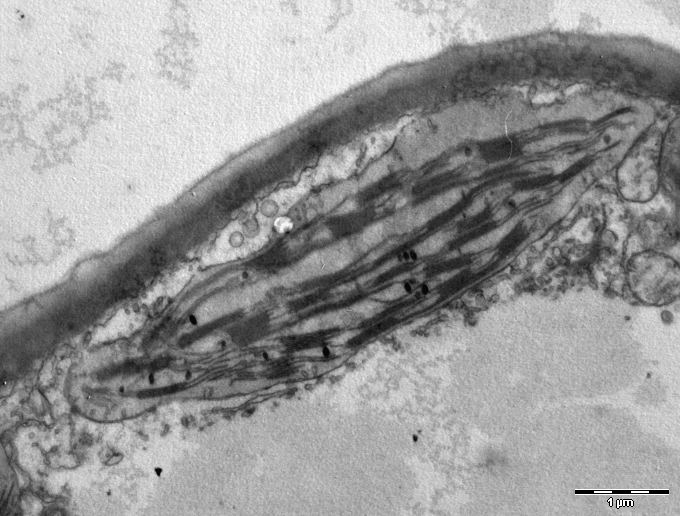
Practice question
In this TEM detail, identify the organelle outline and the repeated internal membrane stacks. What scale is shown?
Photograph / micrograph recognition only. The source names Anemone only as sp.; no exact species is identified. This image does not show a whole cell, cell wall, nucleus, or broad cytoplasm. Individual membrane bilayers are not resolved.
Photo: Chloroplast in leaf of Anemone sp TEM 12000x · And3k and Caper437TEM source page gives 12,000× magnification and a 1 µm scale bar.Show labelled key: Answer key for plant-chloroplast-tem
Chloroplast TEM
Photo key
This is a chloroplast from an Anemone sp. leaf cell. The organelle outline and internal membrane stacks are visible; the scale bar is 1 µm. The image shows an organelle detail, not a whole cell.
The source names Anemone only as sp.; no exact species is identified. This image does not show a whole cell, cell wall, nucleus, or broad cytoplasm. Individual membrane bilayers are not resolved.
Photo: Chloroplast in leaf of Anemone sp TEM 12000x · And3k and Caper437TEM source page gives 12,000× magnification and a 1 µm scale bar.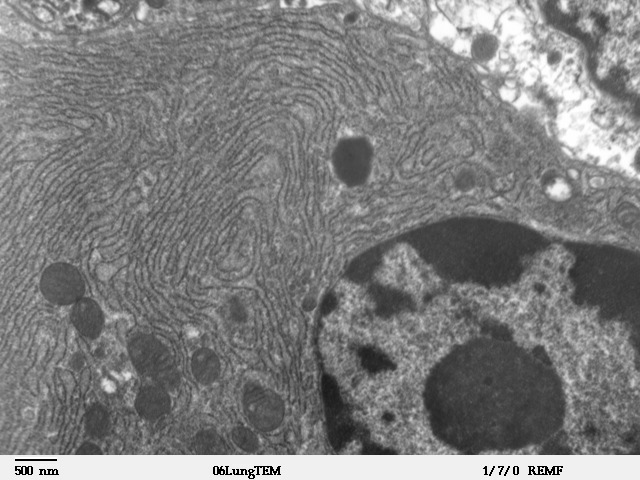
Practice question
Use relative position and appearance in this thin section to identify the visible part of the nucleus, rough endoplasmic reticulum, and mitochondria.
Photograph / micrograph recognition only. The source does not identify the mammal or establish donor health status. Only part of the cell is shown; the complete cell outline and surface membrane are not present.
Photo: Clara cell lung - TEM · Louisa Howard; Dartmouth Electron Microscope FacilityMammalian lung TEM collection.Source provenance: Dartmouth Electron Microscope FacilityShow labelled key: Answer key for animal-cell-tem
Mammalian bronchiolar club-cell TEM
Photo key
The source identifies part of the nucleus, rough endoplasmic reticulum, and mitochondria in the cytoplasm of a mammalian bronchiolar club (Clara) cell. A 500 nm scale bar is visible; the full cell boundary is outside this frame.
The source does not identify the mammal or establish donor health status. Only part of the cell is shown; the complete cell outline and surface membrane are not present.
Photo: Clara cell lung - TEM · Louisa Howard; Dartmouth Electron Microscope FacilityMammalian lung TEM collection.Source provenance: Dartmouth Electron Microscope Facility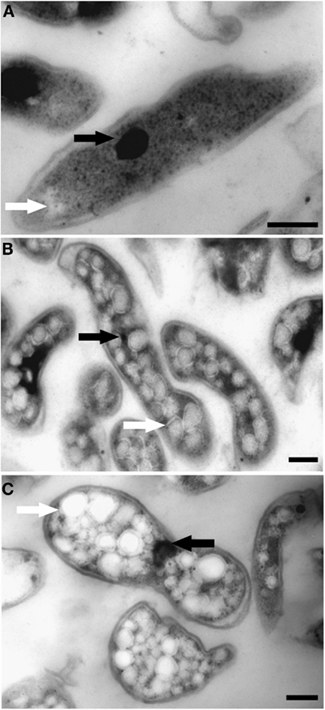
Practice question
Compare the cell outlines and internal contrast across panels A-C. What can be said about the arrow-marked regions without assigning them an organelle identity?
Photograph / micrograph recognition only. This is a different bacterium from E. coli. Do not use its arrows to claim that DNA, plasmids, or ribosomes are resolved. The source panels show cells under differing growth conditions.
Photo: Fmicb-03-00345-g005 · Ahmad F. Khadem, Muriel C. F. van Teeseling, Laura van Niftrik, Mike S. M. Jetten, Huub J. M. Op den Camp, and Arjan PolThree TEM panels with 200 nm scale bars.Show labelled key: Answer key for bacterial-cell-tem
Methylacidiphilum fumariolicum TEM panels
Photo key
These are chemically fixed, thin-sectioned Methylacidiphilum fumariolicum cells from different growth phases. Cell outlines and cytoplasm are visible; the arrows mark electron-light and electron-dense particles. The source does not identify these particles as DNA, plasmids, ribosomes, or other specific structures.
This is a different bacterium from E. coli. Do not use its arrows to claim that DNA, plasmids, or ribosomes are resolved. The source panels show cells under differing growth conditions.
Photo: Fmicb-03-00345-g005 · Ahmad F. Khadem, Muriel C. F. van Teeseling, Laura van Niftrik, Mike S. M. Jetten, Huub J. M. Op den Camp, and Arjan PolThree TEM panels with 200 nm scale bars.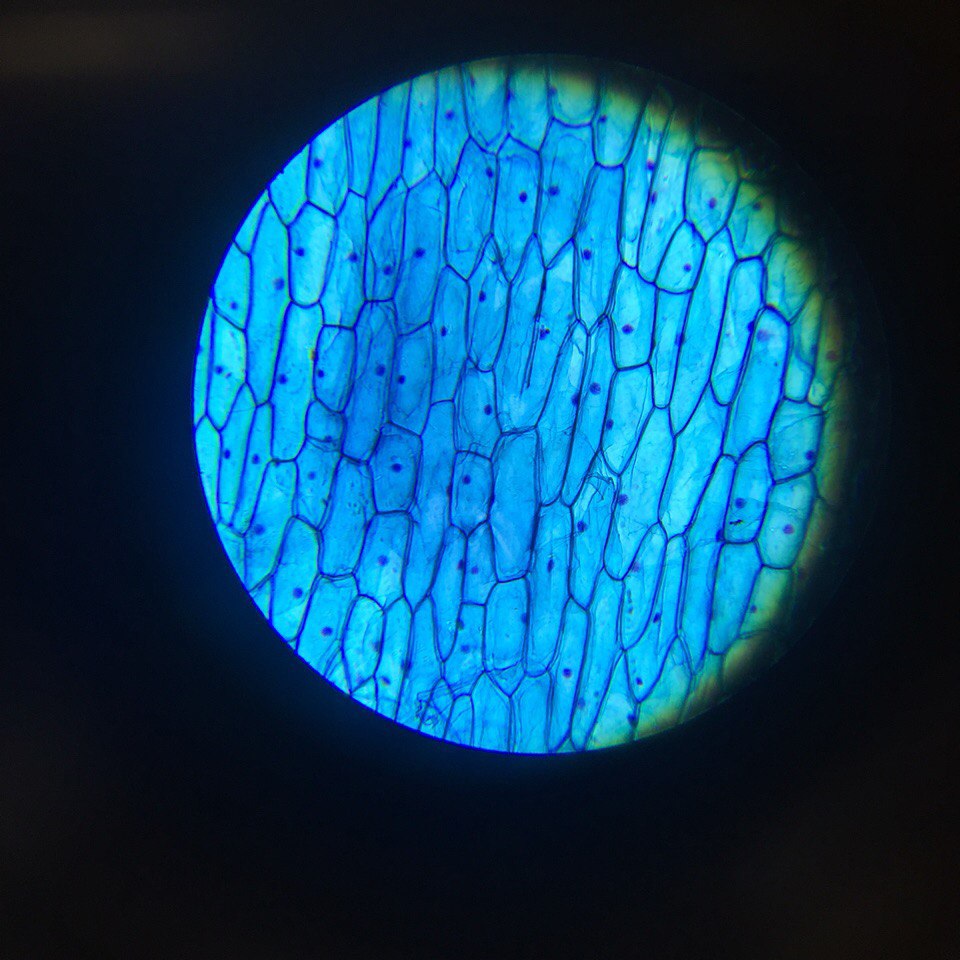
Companion photograph
Practice question
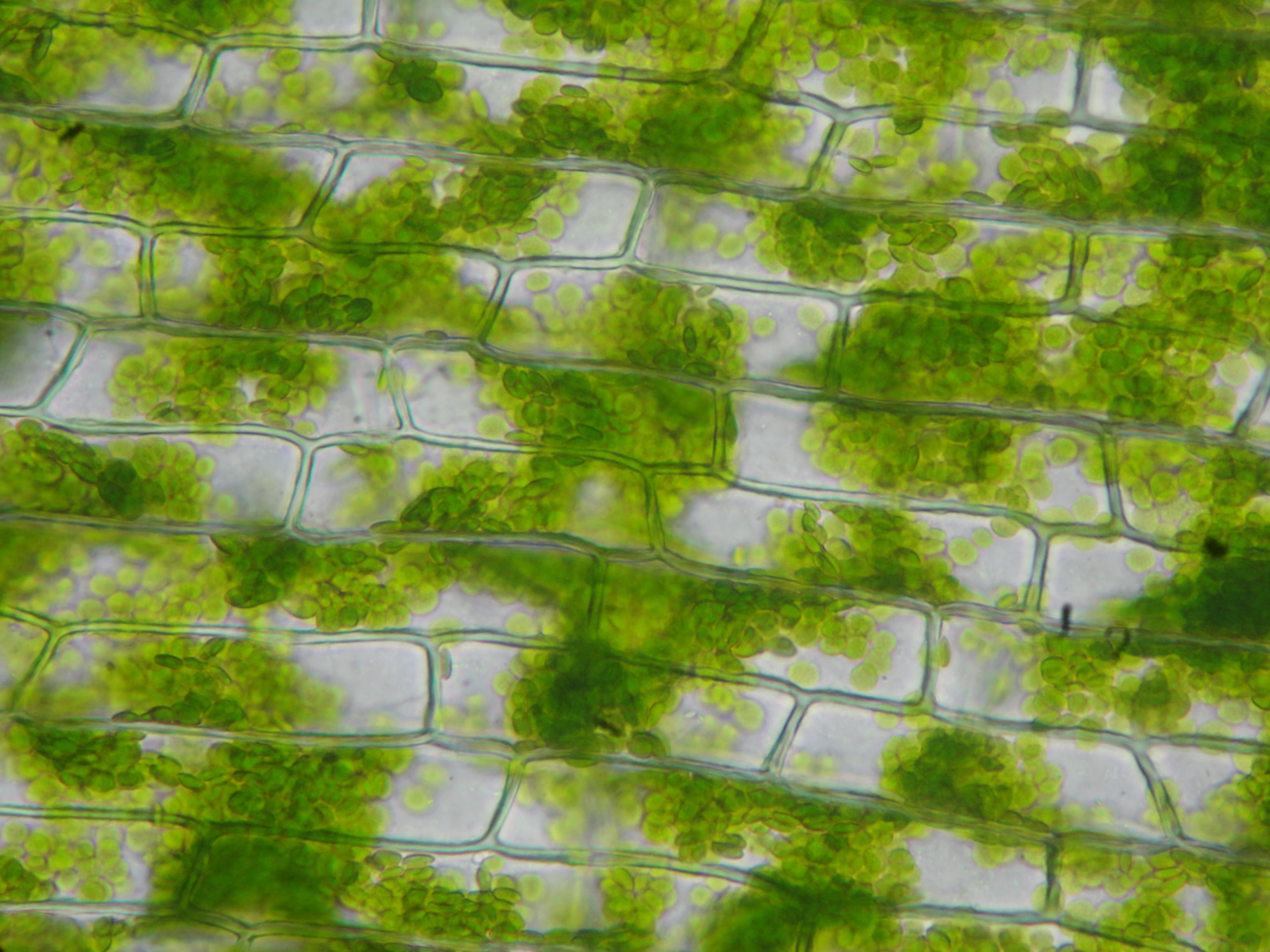
Compare the two plant-cell micrographs. In the onion epidermis, what are the clear outer boundaries and dark spots? In the Elodea leaf cells, what are the many green bodies, and what do the broad clear central regions resemble?
Photograph / micrograph recognition only. Neither image separately resolves the plasma membrane from the cell wall. Onion cytoplasm and vacuole are not distinguishable here; the Elodea cytoplasm and any nucleus are not clearly resolved. Do not claim the Elodea photo shows a nucleus.
Photo: Onion skin cells under a microscope · Katekor1Stained Allium cepa (onion) epidermis light micrograph.Photo: Chloroplasts - Microscopic view of Elodea canadensis · Juan Carlos Fonseca MataElodea canadensis leaf cells; source identifies chloroplasts.Show labelled key: Answer key for plant-cell-micrographs
Plant cells: onion epidermis and Elodea leaf
Chloroplasts - Microscopic view of Elodea canadensis
Photo key
The onion epidermis shows cell walls and nuclei. The Elodea leaf micrograph shows cell walls, many chloroplasts, and broad clear central regions consistent with vacuoles. The onion bulb epidermis does not normally contain chloroplasts. A nucleus is not clearly resolved in the Elodea image.
Neither image separately resolves the plasma membrane from the cell wall. Onion cytoplasm and vacuole are not distinguishable here; the Elodea cytoplasm and any nucleus are not clearly resolved. Do not claim the Elodea photo shows a nucleus.
Photo: Onion skin cells under a microscope · Katekor1Stained Allium cepa (onion) epidermis light micrograph.Photo: Chloroplasts - Microscopic view of Elodea canadensis · Juan Carlos Fonseca MataElodea canadensis leaf cells; source identifies chloroplasts.Use the practice and labelled views with the explanation. Photographs show only the structures identified in their visibility notes; constructed models are not micrographs. - Core
Scope: Core · AS Unit 1; printed p. 13 (b, c, d)
Open revision guidance
What to know
- Cell theory states that organisms consist of cells, the cell is the basic unit of structure and function, and new cells arise from existing cells. Improved microscopes and repeated observations strengthened the theory. Viruses are acellular and depend on host cells for replication, so they are not examples of autonomous cells.
- Eukaryotic animal and plant cells have a nucleus, membrane-bound organelles, cytoplasm, ribosomes and a cell-surface membrane. Plant cells additionally usually have a cellulose wall, a large permanent vacuole and, in photosynthetic tissues, chloroplasts. An onion bulb epidermal cell need not contain chloroplasts. Prokaryotes lack a membrane-bound nucleus and the characteristic membrane-bound organelles of eukaryotes; their DNA is usually circular, and they have smaller ribosomes. Some have plasmids, a capsule or flagella; a typical bacterial wall contains peptidoglycan.
- A virus contains DNA or RNA within a protein capsid; some have a lipid envelope with attachment proteins. It has no cytoplasm or ribosomes of its own. Its small size and simpler structure distinguish it from a bacterium. Electron microscopy can resolve viral particles and bacterial ultrastructure beyond the resolving power of a light microscope.
- Similar specialised cells form a tissue; different tissues cooperate in an organ; organs cooperate in an organ system. Epithelial tissue forms tightly packed sheets lining surfaces, for example the intestine. Muscle tissue has contractile cells, with conspicuous striations in skeletal muscle. Connective tissue has cells embedded in an extracellular matrix, as in collagen-rich tendons, cartilage or blood. Examine prepared slides for cell arrangement, nuclei, fibres or striations, then relate the observed pattern to protection, contraction or support.
- Compare the real tissue photographs with the constructed reference. The gut lining shows adjacent columnar cells, while skeletal muscle has long fibres with repeated transverse striations. Teased smooth muscle shows tapered fibres without those striations. Fibrocartilage shows cells separated by substantial fibrous matrix: it is a specialised connective tissue, not an epithelial sheet. Section direction, preparation and staining affect appearance; no scale bar in these particular examples allows a reliable size calculation.
What to do in an assessment
- For a comparison, use the same feature on both sides: 'bacterium has no membrane-bound nucleus; animal cell has one' is better than two unrelated lists. In tissue slides, use the supplied scale and orientation rather than assuming a cross-section is a whole cell.
In plain language
A cell is not the same as a virus. Cells specialise and cooperate at tissue, organ and system levels.
Self-check
A particle contains RNA and a capsid but no ribosomes. Can it make its own viral proteins independently?
Show the answer
No. It is consistent with a virus and must use the host cell's protein-synthesis machinery.
View diagrams
Tissue reference drawingsIdentify each tissue from the visible arrangement of cells, nuclei, striations and matrix.Constructed comparison diagrams · compare with actual prepared slides Show labelled key: Answer key for alevel-tissue-reference
Tissue reference drawingsEpithelium is a tightly packed sheet resting on a basement membrane. Skeletal muscle has long, parallel striated fibres with peripheral nuclei. Smooth muscle cells are spindle-shaped with central nuclei. Connective tissue has dispersed cells in a collagen-containing matrix. These drawings support comparison with actual prepared slides; they are not real micrographs and do not certify practical slide-identification skills.Constructed comparison diagrams · compare with actual prepared slides - 1Epithelium
- 2Skeletal muscle
- 3Smooth muscle
- 4Connective tissue
Real tissue micrographs
Study each image before opening the key. Describe the arrangement of cells, visible nuclei, fibres and surrounding material; compare the features you can actually see.
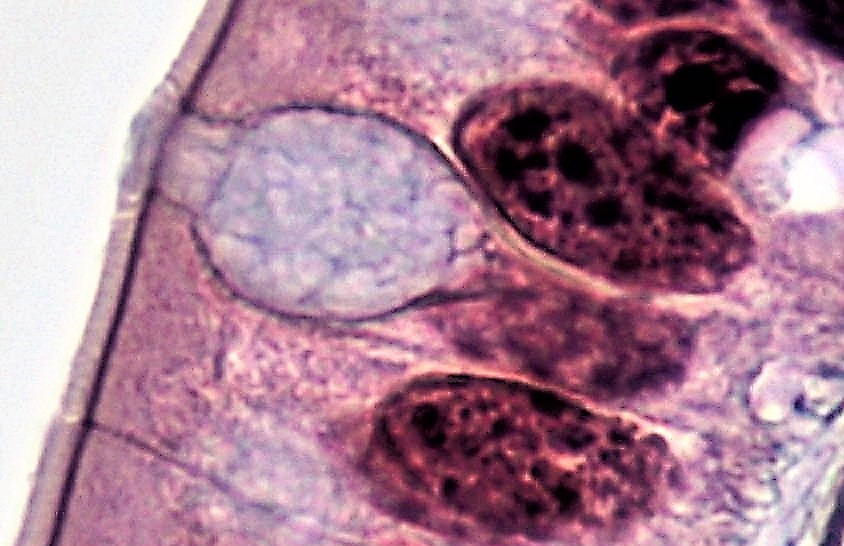
Specimen A Describe the cell lining and compare the darker nuclei with the paler region.
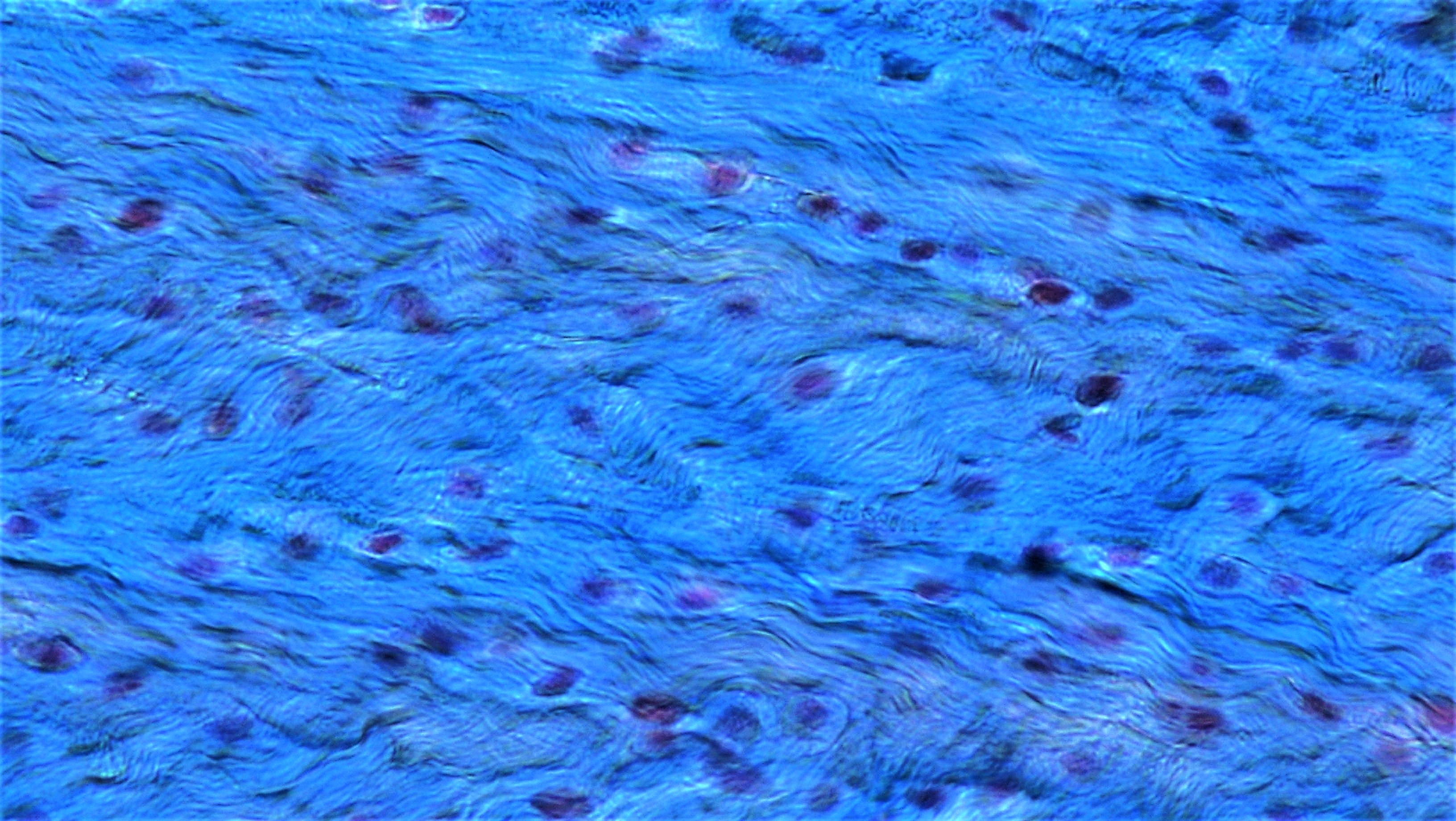
Specimen B Look for the relationship between darker cell profiles and the fibrous-looking background.
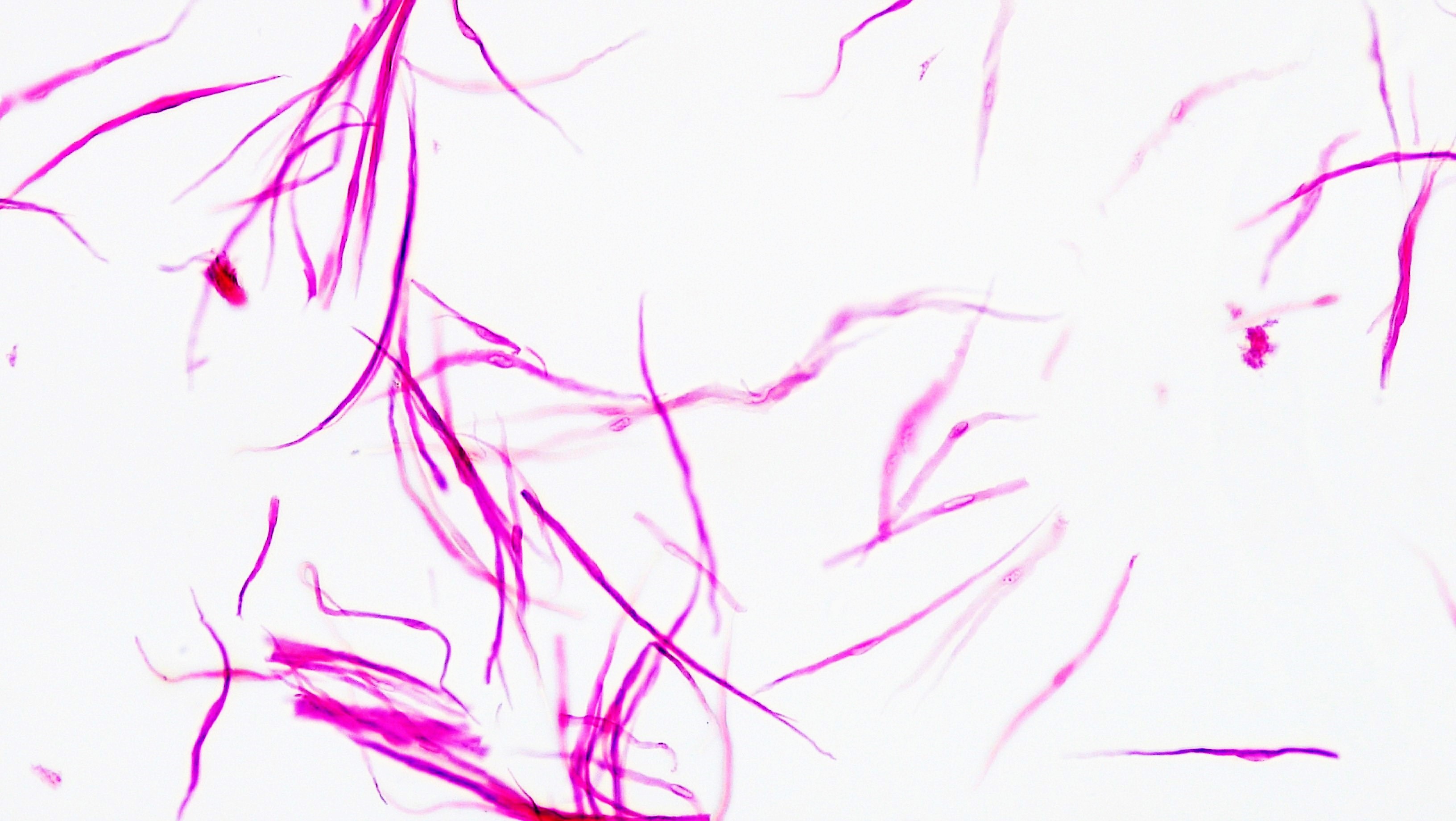
Specimen C Follow the outlines of individual fibres. Are repeated transverse bands visible?
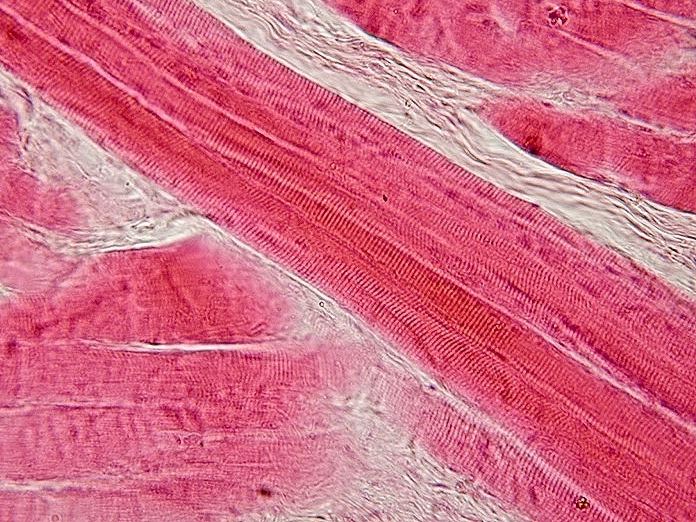
Specimen D Compare the repeated bands across the fibres with the fibre outlines in the previous image.
Courtesy: Department of Histology, Jagiellonian University Medical College · uploader: Reytan · CC BY-SA 3.0Wikimedia Commons sourceCC BY-SA 3.0These are real source photographs, not constructed drawings. They support visual recognition but do not certify supervised practical slide-identification skills. None has a scale bar; do not infer magnification or physical dimensions. Show labelled key: Answer key for alevel-tissue-micrographs
Real tissue micrographs
Four unmodified tissue photographs show features useful for comparing epithelial, connective and muscle tissues.
Simple columnar epithelium A mammalian gut micrograph with a columnar lining at left, oval nuclei and a pale goblet-cell region. The supplied crop does not establish a particular gut region or species. Individual microvilli and basement-membrane molecular structure are not resolved here.
Fibrocartilage Fibrocartilage is a specialised connective tissue. The photograph shows a blue fibrous matrix and darker cell profiles in lacunae; this is not a generic epithelium or smooth muscle.
Smooth muscle · teased whole mount This is a teased smooth-muscle whole mount, not an intact organ section. The pink fibres are thin and tapered, with occasional bulges; no transverse striations are visible. Do not assume every nucleus is clearly resolved.
Skeletal muscle · longitudinal section The longitudinal section shows parallel skeletal-muscle fibres with clear transverse striations and paler inter-fibre tissue. There is no scale bar, so the image cannot support a magnification or physical-dimension estimate.
Courtesy: Department of Histology, Jagiellonian University Medical College · uploader: Reytan · CC BY-SA 3.0Wikimedia Commons sourceCC BY-SA 3.0These are real source photographs, not constructed drawings. They support visual recognition but do not certify supervised practical slide-identification skills. None has a scale bar; do not infer magnification or physical dimensions. Practice question
Use relative position and appearance in this thin section to identify the visible part of the nucleus, rough endoplasmic reticulum, and mitochondria.
Photograph / micrograph recognition only. The source does not identify the mammal or establish donor health status. Only part of the cell is shown; the complete cell outline and surface membrane are not present.
Photo: Clara cell lung - TEM · Louisa Howard; Dartmouth Electron Microscope FacilityMammalian lung TEM collection.Source provenance: Dartmouth Electron Microscope FacilityShow labelled key: Answer key for animal-cell-tem
Mammalian bronchiolar club-cell TEM
Photo key
The source identifies part of the nucleus, rough endoplasmic reticulum, and mitochondria in the cytoplasm of a mammalian bronchiolar club (Clara) cell. A 500 nm scale bar is visible; the full cell boundary is outside this frame.
The source does not identify the mammal or establish donor health status. Only part of the cell is shown; the complete cell outline and surface membrane are not present.
Photo: Clara cell lung - TEM · Louisa Howard; Dartmouth Electron Microscope FacilityMammalian lung TEM collection.Source provenance: Dartmouth Electron Microscope FacilityPractice question
Compare the cell outlines and internal contrast across panels A-C. What can be said about the arrow-marked regions without assigning them an organelle identity?
Photograph / micrograph recognition only. This is a different bacterium from E. coli. Do not use its arrows to claim that DNA, plasmids, or ribosomes are resolved. The source panels show cells under differing growth conditions.
Photo: Fmicb-03-00345-g005 · Ahmad F. Khadem, Muriel C. F. van Teeseling, Laura van Niftrik, Mike S. M. Jetten, Huub J. M. Op den Camp, and Arjan PolThree TEM panels with 200 nm scale bars.Show labelled key: Answer key for bacterial-cell-tem
Methylacidiphilum fumariolicum TEM panels
Photo key
These are chemically fixed, thin-sectioned Methylacidiphilum fumariolicum cells from different growth phases. Cell outlines and cytoplasm are visible; the arrows mark electron-light and electron-dense particles. The source does not identify these particles as DNA, plasmids, ribosomes, or other specific structures.
This is a different bacterium from E. coli. Do not use its arrows to claim that DNA, plasmids, or ribosomes are resolved. The source panels show cells under differing growth conditions.
Photo: Fmicb-03-00345-g005 · Ahmad F. Khadem, Muriel C. F. van Teeseling, Laura van Niftrik, Mike S. M. Jetten, Huub J. M. Op den Camp, and Arjan PolThree TEM panels with 200 nm scale bars.Companion photograph
Practice question
Compare the two plant-cell micrographs. In the onion epidermis, what are the clear outer boundaries and dark spots? In the Elodea leaf cells, what are the many green bodies, and what do the broad clear central regions resemble?
Photograph / micrograph recognition only. Neither image separately resolves the plasma membrane from the cell wall. Onion cytoplasm and vacuole are not distinguishable here; the Elodea cytoplasm and any nucleus are not clearly resolved. Do not claim the Elodea photo shows a nucleus.
Photo: Onion skin cells under a microscope · Katekor1Stained Allium cepa (onion) epidermis light micrograph.Photo: Chloroplasts - Microscopic view of Elodea canadensis · Juan Carlos Fonseca MataElodea canadensis leaf cells; source identifies chloroplasts.Show labelled key: Answer key for plant-cell-micrographs
Plant cells: onion epidermis and Elodea leaf
Chloroplasts - Microscopic view of Elodea canadensis
Photo key
The onion epidermis shows cell walls and nuclei. The Elodea leaf micrograph shows cell walls, many chloroplasts, and broad clear central regions consistent with vacuoles. The onion bulb epidermis does not normally contain chloroplasts. A nucleus is not clearly resolved in the Elodea image.
Neither image separately resolves the plasma membrane from the cell wall. Onion cytoplasm and vacuole are not distinguishable here; the Elodea cytoplasm and any nucleus are not clearly resolved. Do not claim the Elodea photo shows a nucleus.
Photo: Onion skin cells under a microscope · Katekor1Stained Allium cepa (onion) epidermis light micrograph.Photo: Chloroplasts - Microscopic view of Elodea canadensis · Juan Carlos Fonseca MataElodea canadensis leaf cells; source identifies chloroplasts.Use the practice and labelled views with the explanation. Photographs show only the structures identified in their visibility notes; constructed models are not micrographs. - Core
Scope: Core · AS Unit 1; specified practical work; associated specified practical or unlettered clause
Open revision guidance
What to know
- Begin with the lowest-power objective, centre the specimen and focus before moving to higher power. An eyepiece graticule has arbitrary divisions. Calibrate it against a stage micrometer at each objective magnification: changing the objective changes the length represented by each eyepiece division.
- Constructed calibration: 40 eyepiece divisions align with 0.10 mm on a stage micrometer. Convert 0.10 mm to 100 μm; one eyepiece division is 100÷40 = 2.5 μm. A structure spanning 12 divisions is 30 μm long. A drawing 60 mm long therefore has magnification 60,000 μm÷30 μm = ×2000. Always convert image and actual size to the same units before division.
- For an onion epidermal wet mount, peel a thin layer, place it in a drop of water, add a suitable stain if directed, and lower a coverslip at an angle to reduce trapped air. Use forceps and handle glass carefully. A rhubarb preparation or live Amoeba provides another living-cell observation; choose the preparation specified by the teacher and do not confuse a stain-induced appearance with a natural colour.
- Draw what is visible with clear single lines, correct relative proportions and no decorative shading. Give a title, ruled non-crossing label lines and scale or calculated magnification. State specimen and viewing conditions. A cell drawing shows individual cell features; a low-power plan shows tissue outlines rather than invented detail. Magnification enlarges an image; resolution determines whether nearby points can be distinguished.
What to do in an assessment
- If a 100 μm scale bar measures 25 mm on an image, its magnification is 25,000÷100 = ×250. A cell 10 mm long on that same image is 10,000÷250 = 40 μm. Use the scale bar, not the displayed screen size, when images are resized.
In plain language
Calibration converts microscope divisions into real lengths. Scientific drawings record evidence, not an idealised cell copied from memory.
Self-check
Why can't a low-power eyepiece calibration be reused unchanged at high power?
Show the answer
The objective magnification changes, so each eyepiece division represents a different actual length. Recalibrate for the new objective.
- Core
Scope: Core · AS Unit 1; printed p. 15 (a, b, c)
Open revision guidance
What to know
- The fluid-mosaic model describes a mobile phospholipid bilayer with proteins embedded in or attached to it. Hydrophilic heads face aqueous surroundings and hydrophobic tails face inward. Channel and carrier proteins provide selective routes; glycoproteins and glycolipids participate in recognition; cholesterol modifies fluidity and stability in animal membranes. The model is not a rigid protein coat around the lipids.
- Diffusion is net movement down a concentration gradient due to random motion. A steeper gradient, larger surface area, higher temperature and shorter diffusion distance generally increase rate. Small non-polar molecules can diffuse through the bilayer. Facilitated diffusion uses channels or carriers down a gradient and does not directly require ATP; carrier saturation can limit its rate.
- Osmosis is net water movement through a partially permeable membrane from higher to lower water potential. Pure water has water potential zero under standard reference conditions; adding solute makes solute potential more negative. A turgid plant cell develops pressure potential. Use Ψ = Ψs + Ψp when those quantities are supplied; do not equate water potential with solute concentration alone.
- Active transport uses energy to move substances against a gradient. Respiratory inhibition by cyanide can reduce ATP supply and hence ATP-dependent transport; it does not directly stop all diffusion. Pinocytosis takes in fluid in small vesicles, while phagocytosis engulfs larger particles; both are forms of endocytosis. Exocytosis fuses a vesicle with the membrane to release its contents, as in secretion of enzymes.
- Heating increases membrane fluidity; sufficiently high temperatures disrupt the bilayer and denature proteins. Organic solvents can disrupt lipids. Either may increase leakage, but the effect depends on temperature, solvent and membrane composition. A permeability experiment measures the consequence, not the membrane's molecular structure directly.
What to do in an assessment
- Describe gradient direction, the route through the membrane and any energy requirement. A glucose carrier operating down a gradient is facilitated diffusion even though a protein is involved.
In plain language
The bilayer is a selective barrier. Gradients, proteins and vesicles determine how different substances cross it.
Self-check
A solute moves from a dilute external solution into a cell where its concentration is higher, and uptake decreases with cyanide. What mechanism is supported?
Show the answer
Active transport is supported: movement is against the concentration gradient and depends on ATP supplied by respiration. The observations alone do not identify a particular carrier.
- Core
Scope: Core · AS Unit 1; specified practical work; associated specified practical or unlettered clause
Open revision guidance
What to know
- For a mass or length investigation, cut equal-sized plant tissue pieces and place them in a range of known solute concentrations. Control tissue source, temperature, immersion time and solution volume. Measure initial mass, then blot consistently before final weighing. Use repeats at each concentration.
- Percentage mass change = (final−initial)÷initial ×100. Constructed example: a 2.00 g sample becomes 2.14 g; its change is +7.0%. Plot mean percentage change against concentration and find the zero-change intercept. At that point there is no net water movement, so the solution's water potential estimates the tissue's initial water potential. Convert concentration to water potential using supplied calibration data; concentration alone is not a water-potential value in kPa.
- Incipient plasmolysis is the point at which the protoplast just begins to pull away from the cell wall as water leaves. At that threshold pressure potential is approximately zero, so cell water potential is approximately its solute potential. Observe comparable epidermal cells in different solutions, count cells at the threshold, and use the concentration at which approximately half are just plasmolysed to estimate a representative solute potential, using an appropriate conversion table or supplied equation.
- Damaged cells, inconsistent blotting, unequal sample dimensions and differing original sap concentrations can affect the estimates. Repeats show variation but do not correct a consistently miscalibrated balance. Use forceps and follow the teacher's instructions when cutting tissue or handling microscope glass.
What to do in an assessment
- A constructed graph crosses zero mass change at 0.30 mol dm⁻³. If the supplied table gives −750 kPa at that concentration and temperature, estimate tissue water potential as −750 kPa; do not report +750 or 0 kPa.
In plain language
No net mass change locates an equal-water-potential solution. At incipient plasmolysis, negligible pressure allows solute potential to be estimated.
Self-check
At incipient plasmolysis Ψs is −600 kPa and Ψp is approximately zero. What is Ψ?
Show the answer
Ψ = Ψs + Ψp = −600 + 0 = approximately −600 kPa.
- Core
Scope: Core · AS Unit 1; specified practical work; associated specified practical or unlettered clause
Open revision guidance
What to know
- Beetroot pigment is stored in vacuoles. For it to reach the surrounding water it must pass the tonoplast and the cell-surface membrane. Greater absorbance of the surrounding solution indicates more pigment release under controlled conditions; it is not a direct count of membrane pores.
- Cut equal discs from a similar region, rinse away pigment released by cutting, and immerse them in equal water volumes at a range of temperatures for equal times. Keep disc dimensions, number, pH and handling constant. Use thermostatically controlled water baths, allow solutions to reach their target temperature, and repeat each condition.
- After removing the tissue, measure absorbance with a colorimeter using an appropriate filter and a blank containing the solvent without pigment. Keep cuvette orientation consistent and avoid fingerprints and bubbles. Plot mean absorbance against temperature. A sharp increase can be explained by disruption of membrane lipids and denaturation of membrane proteins.
- Hot water can scald and cutting tools can injure. Use suitable tools, handle baths carefully and follow the centre's risk assessment. Rinsing controls the effect of damage during preparation but cannot restore cells already destroyed by cutting.
What to do in an assessment
- Constructed readings of 0.10, 0.12 and 0.11 absorbance units have mean 0.11. Compare repeat means and spread before claiming a meaningful temperature effect; a single anomalous tube may reflect tissue damage.
In plain language
Pigment leakage provides a practical indicator of membrane disruption when tissue size, time and measurement conditions are controlled.
Self-check
Why rinse cut beetroot discs before beginning the temperature treatments?
Show the answer
To remove pigment already released from cells damaged during cutting, so the later colour is less affected by preparation damage.
- Core
Scope: Core · AS Unit 1; printed p. 17 (a, b, c, d, e, f)
Open revision guidance
What to know
- Metabolism consists of sequences of enzyme-controlled reactions. Each enzyme catalyses a particular step by lowering its activation energy, so more collisions can lead to reaction at the same temperature. It is not used up and does not change the overall energy difference between reactants and products.
- Enzymes are proteins with a three-dimensional active site whose shape and chemical groups bind particular substrates. In induced fit, substrate binding changes the active site's shape, positioning reacting groups and straining bonds. Lysozyme illustrates induced fit: binding distorts a sugar unit in its bacterial cell-wall substrate, making bond cleavage easier.
- Intracellular enzymes act inside cells, for example enzymes of glycolysis in the cytoplasm. Extracellular enzymes are secreted and act outside the cells that produced them, for example amylase in the digestive tract. 'Extracellular' does not mean the enzyme acts outside the whole organism.
- An enzyme–substrate complex forms, a reaction produces products, and products leave the active site. The enzyme is available again. A change in tertiary structure can alter specificity even when the amino-acid sequence is unchanged; therefore explain activity using active-site shape, not simply the presence of a protein.
What to do in an assessment
- On an energy profile, show the same reactant and product levels for catalysed and uncatalysed reactions, but a lower activation-energy peak for the catalysed route. Lower activation energy is not the same as supplying extra energy.
In plain language
An enzyme provides a lower-activation-energy route. Substrate binding and active-site structure explain its specificity.
Self-check
Does an enzyme make an energetically uphill reaction release energy simply by lowering activation energy?
Show the answer
No. It changes the reaction pathway and activation energy, not the overall energy difference between reactants and products.
- Core
Scope: Core · AS Unit 1; printed p. 18 (g, h, i)
Open revision guidance
What to know
- As temperature rises initially, molecules gain kinetic energy and successful collisions become more frequent. Above a suitable temperature, disruption of protein interactions changes the active site and the rate falls. Low temperature reduces rate but is not normally denaturation. pH changes the charges on groups that maintain structure or bind substrate; extreme pH can denature the enzyme. A buffer keeps pH approximately constant during a test.
- Increasing substrate concentration increases rate while free active sites are available. Rate levels off when enzymes are saturated, provided other conditions remain suitable. Increasing enzyme concentration increases rate if enough substrate is present; substrate depletion or another limiting factor prevents an indefinite proportional increase.
- A competitive inhibitor binds at the active site and competes with substrate; increasing substrate concentration can reduce its effect. A non-competitive inhibitor binds elsewhere and reduces activity, for example by altering active-site shape; increasing substrate does not simply overcome it. Compare curves using the inhibitor mechanism rather than assuming every reduced rate means denaturation.
- Immobilised enzymes are attached to a support or trapped in a material such as alginate beads. Products can be collected without mixing them with free enzyme, and the enzyme can be reused. Immobilisation can improve stability and enable continuous production, but the support may limit substrate diffusion or make preparation expensive. Reuse does not mean an enzyme will never lose activity.
What to do in an assessment
- In a constructed substrate-concentration graph, an inhibited curve approaches the uninhibited maximum at high substrate concentration. That pattern supports competitive inhibition. A lower maximum not restored by substrate is consistent with non-competitive inhibition.
In plain language
Rates depend on collisions, active-site availability and protein structure. Inhibitors and immobilisation affect enzymes in different ways.
Self-check
Why can adding more substrate reduce the effect of a competitive inhibitor?
Show the answer
Substrate and inhibitor compete for the same active site. A higher substrate concentration increases the proportion of active sites occupied by substrate.
- Core
Scope: Core · AS Unit 1; specified practical work; associated specified practical or unlettered clause
Open revision guidance
What to know
- To investigate temperature, use amylase and starch with constant enzyme concentration, substrate concentration, pH and volumes. Equilibrate solutions in a water bath before mixing. Sample at regular intervals onto iodine and record when starch is no longer detected. To investigate pH instead, use different buffers while keeping temperature and concentrations fixed.
- For an endpoint test with a fixed amount of substrate, 1÷time is an estimate of relative reaction rate, not an exact amount of product per second. Constructed example: disappearance in 40 s gives 0.025 s⁻¹; disappearance in 20 s gives 0.050 s⁻¹. The second is twice the estimated rate under otherwise identical conditions. Sample timing limits the precision of the endpoint.
- To investigate enzyme concentration, use serial dilutions of the enzyme stock and keep substrate concentration and final reaction volume constant. Mixing equal volumes of stock and diluent halves concentration at each step: 1.0, 0.50, 0.25 and 0.125 arbitrary stock units. For a substrate-concentration investigation, dilute substrate instead and keep enzyme constant.
- If product is measured continuously, calculate initial rate from a tangent near time zero. Constructed tangent points (10 s, 2 cm³) and (30 s, 8 cm³) give gradient (8−2)÷(30−10) = 0.30 cm³ s⁻¹. Later slopes may fall because substrate is used up. Repeat conditions, show variation, and use an enzyme-free control where suitable. Handle hot baths, reagents and glassware under the centre's risk assessment.
What to do in an assessment
- Change only the named independent variable. When increasing enzyme concentration, adding a larger volume without balancing the diluent would also change total volume and substrate dilution.
In plain language
A valid investigation controls other rate factors. Distinguish a relative endpoint rate from a measured product-rate gradient.
Self-check
A fixed-substrate endpoint takes 50 s. What relative rate is obtained from 1÷time, and what is its unit?
Show the answer
1÷50 = 0.020 s⁻¹. It is an inverse-time estimate for that fixed endpoint, not a direct mass of product per second.
- Core
Scope: Core · AS Unit 1; printed p. 19 (a, b, c, d, e, f, g)
Open revision guidance
What to know
- A nucleotide contains a pentose sugar, phosphate and a nitrogenous base. DNA nucleotides contain deoxyribose; RNA nucleotides contain ribose. DNA uses adenine, guanine, cytosine and thymine; RNA uses uracil instead of thymine. Adenine and guanine are purines; cytosine and thymine are pyrimidines.
- DNA has two strands with sugar–phosphate backbones, held together by hydrogen bonds between complementary bases: A pairs with T and G with C. The strands run antiparallel, one 5′ to 3′ and the other 3′ to 5′, and form a double helix. Complementarity allows DNA to store a sequence and copy it. RNA is usually single-stranded, shorter and able to fold into functional shapes.
- ATP consists of adenine, ribose and three phosphate groups. Hydrolysis to ADP and inorganic phosphate can be coupled to energy-requiring processes such as active transport, muscle contraction and biosynthesis; phosphorylation can change another molecule's reactivity. The overall hydrolysis reaction releases usable energy: do not say that simply breaking a bond releases energy, because bond breaking itself requires energy.
- ATP is continually regenerated from ADP and phosphate using energy from respiration or photosynthesis. It is an immediate transferable energy carrier, not a long-term store like fat. DNA has two central roles: replication passes information to new cells, while the base sequence supplies information for protein synthesis.
What to do in an assessment
- Constructed sequence: 5′-AGTC-3′ pairs with 3′-TCAG-5′. Preserve strand direction; writing both strands in the same direction with these bases would not show an antiparallel pair.
In plain language
Nucleotides build information-carrying DNA and RNA. ATP is a nucleotide-based carrier connecting energy-releasing and energy-requiring reactions.
Self-check
Which features distinguish an RNA nucleotide containing uracil from a DNA nucleotide?
Show the answer
It contains ribose rather than deoxyribose and uracil rather than thymine; both have a phosphate group and an organic base.
- Core
Scope: Core · AS Unit 1; printed p. 19 (h)
Open revision guidance
What to know
- In semi-conservative replication, each daughter DNA molecule contains one parental strand and one newly synthesised strand. Helicase separates the strands by breaking the hydrogen bonds between bases. Each exposed strand acts as a template; complementary free nucleotides pair with it, and DNA polymerase joins nucleotides into a new sugar–phosphate backbone.
- Meselson and Stahl grew bacteria with heavy nitrogen, ¹⁵N, then transferred them to ¹⁴N medium. Nitrogen is incorporated into DNA bases. Density-gradient centrifugation separated DNA according to density. After one replication, DNA formed one intermediate band, consistent with hybrid strands rather than separate all-heavy and all-light molecules.
- After a second replication in ¹⁴N, two bands appeared: intermediate and light. This supports semi-conservative replication and rejects the simple dispersive prediction of a single progressively lighter band. The first generation alone distinguishes conservative replication but not semi-conservative from dispersive replication.
- Track the strands to check the prediction: one heavy–heavy molecule makes two heavy–light molecules after one cycle; these make two heavy–light and two light–light molecules after the second. The number of molecules doubles at each cycle while the original heavy strands remain in two molecules.
What to do in an assessment
- Use the observed band pattern to compare alternative models. Do not call an intermediate-density band 'half the DNA has been destroyed'; density reflects isotope composition, not the amount of surviving DNA.
In plain language
Complementary templates copy DNA. The isotope-band evidence tests how parental and new strands are distributed.
Self-check
After three replication cycles in light nitrogen, what fraction of DNA molecules still contain an original heavy strand?
Show the answer
Two of eight molecules, or 1/4, are heavy–light; six of eight are light–light, assuming all molecules replicate each cycle.
- Core
Scope: Core · AS Unit 1; printed p. 19 (i, j, k); printed p. 20 (l, m, n, o)
Open revision guidance
What to know
- The genetic code connects a nucleotide sequence with an amino-acid sequence. A triplet of DNA bases corresponds to an mRNA codon of three bases. The code is degenerate because more than one codon can specify the same amino acid. Start and stop signals determine translation boundaries; a stop codon does not code for an amino acid.
- During transcription, a DNA strand acts as a template for complementary RNA. In a eukaryotic gene, exons contribute to mature RNA while intervening introns are removed by splicing. The processed mRNA leaves the nucleus through a pore. Exons may contain protein-coding sequence and untranslated regions; a diagram of a gene should not treat every retained base as an amino-acid code.
- A ribosome reads mRNA codons. A tRNA has an anticodon complementary to the codon and carries the corresponding amino acid at its attachment site. Appropriate tRNAs bind, peptide bonds form and the ribosome moves along the mRNA. At a stop codon the completed polypeptide is released.
- Constructed coding example: DNA template 3′-TAC GAA CCT ACT-5′ gives mRNA 5′-AUG CUU GGA UGA-3′. Using a supplied codon table, AUG specifies methionine, CUU leucine, GGA glycine, and UGA stop. The peptide is Met–Leu–Gly, not four amino acids. The tRNA anticodon pairing with AUG is 3′-UAC-5′.
- The 'one gene–one polypeptide' hypothesis links a gene with its product but is a useful simplification. Some genes specify functional RNA, and alternative splicing can yield different products. Polypeptides may be cleaved, folded, joined to other chains or modified with carbohydrate or non-protein groups. Haemoglobin assembles several polypeptides with haem groups; insulin is processed from a larger precursor.
What to do in an assessment
- Identify whether a supplied DNA strand is template or coding before transcription. Copying a coding strand means replacing T with U; copying a template means complementary pairing, with antiparallel directions.
In plain language
Transcription produces an RNA message; translation reads its codons. Processing and modification turn polypeptides into functional products.
Self-check
Using the template 3′-TAC-5′, what is the mRNA codon and why is it not UAC?
Show the answer
The codon is 5′-AUG-3′. RNA is complementary to the template; UAC would be an incorrect direct copying of the template sequence.
- Core
Scope: Core · AS Unit 1; specified practical work; associated specified practical or unlettered clause
Open revision guidance
What to know
- Crush suitable plant material such as strawberry to break up tissue and increase the exposed surface. Mix gently with an extraction solution containing detergent and salt. Detergent disrupts lipid membranes, releasing cellular contents; salt helps DNA aggregate by reducing repulsion between charged groups.
- Filter to remove large cell fragments. Protease may be used to break down proteins associated with DNA. Add cold ethanol carefully as a layer: DNA is relatively insoluble in the alcohol-rich conditions and forms pale strands that can be collected. Avoid vigorous mixing if it would shear long strands or create foam.
- The visible precipitate is a crude extract, not proof of chemically pure DNA or an individual chromosome. It can contain other substances. Follow the centre's specified method, volumes and temperatures; ethanol is flammable and must be kept away from flames.
What to do in an assessment
- Explain the purpose of each treatment rather than merely listing the sequence. A comparison omitting detergent tests the importance of membrane disruption only if other treatments remain the same.
In plain language
Disrupt cells, separate debris and precipitate nucleic acid. The visible strands are a crude extract, not a purified genetic fingerprint.
Self-check
Why is detergent included before the cold ethanol is added?
Show the answer
It disrupts cell-surface and internal lipid membranes to release DNA; ethanol then helps precipitate DNA from the extract.
- Core
Scope: Core · AS Unit 1; printed p. 21 (a, b, c); associated specified practical or unlettered clause
Open revision guidance
What to know
- During interphase a cell grows, duplicates organelles and replicates DNA before division. Interphase is not a stage of mitosis. In prophase, chromosomes condense, the spindle forms and the nuclear envelope breaks down. In metaphase, chromosomes line up at the equator. In anaphase, sister chromatids separate and move to opposite poles. In telophase, nuclear envelopes reform and chromosomes become less condensed.
- Cytokinesis divides the cytoplasm: an animal cell constricts, while a plant cell builds a cell plate between daughter cells. Mitosis usually provides daughter nuclei with the same chromosome number and genetic information as the parent nucleus, unless a mutation or segregation error occurs.
- Mitosis enables growth, repeated renewal and repair, for example replacing damaged skin cells. Normal cell-cycle controls prevent unchecked division. Their failure can produce a tumour; cancer involves uncontrolled growth and may include invasion and spread, rather than simply any tissue with a high normal division rate.
- A root-tip preparation contains actively dividing meristem cells. Observe supplied slides or a teacher-directed squash preparation, identify stages from visible chromosome arrangement, and draw several observed cells with labels. Metaphase has a central line of duplicated chromosomes; anaphase has separating groups. Do not identify a stage from cell position alone.
- Constructed mitotic-index example: 36 out of 180 observed cells are in mitosis, giving 36÷180 = 0.20, or 20%. Estimating stage duration from proportions assumes cells are sampled representatively from an asynchronously dividing population; the count is not a direct stopwatch measurement.
What to do in an assessment
- Describe chromosome behaviour before naming the stage. A chromosome count is conventionally based on centromeres: DNA replication doubles chromatids, not chromosome number before they separate.
In plain language
Mitosis distributes duplicated DNA into equivalent nuclei. Controlled division supports repair; loss of control can cause disease.
Self-check
Before mitosis a diploid cell has 4 replicated chromosomes. How many chromosomes does each daughter nucleus normally receive?
Show the answer
Four. Sister chromatids separate so each daughter nucleus receives one copy of each chromosome; chromosome number is maintained.
- Core
Scope: Core · AS Unit 1; printed p. 21 (d, e); associated specified practical or unlettered clause
Open revision guidance
What to know
- DNA replicates once before meiosis, followed by two nuclear divisions. In prophase I homologous chromosomes pair and crossing over can exchange corresponding sections between non-sister chromatids. Homologous pairs line up independently at metaphase I; in anaphase I homologous chromosomes separate, while sister chromatids remain joined.
- After the first division each nucleus has one chromosome from each homologous pair, so the chromosome set is haploid although each chromosome still has two chromatids. No second DNA replication occurs before meiosis II. Chromosomes line up at metaphase II and sister chromatids separate at anaphase II. Telophase and cytokinesis produce haploid cells.
- Crossing over and independent assortment make meiotic products genetically non-identical. Mitosis normally yields two genetically equivalent nuclei with the original chromosome number; meiosis typically yields four haploid products from a diploid starting cell. In oogenesis the cytoplasm is divided unequally, so not all four products become functional eggs.
- Worked model with 2n = 4: before replication there are 4 chromosomes and 4 chromatids; after replication, 4 chromosomes and 8 chromatids. After meiosis I each nucleus has 2 chromosomes and 4 chromatids; after meiosis II each has 2 chromosomes and 2 chromatids. DNA amount falls from 4C before meiosis I to 2C after I and 1C after II, where C is one unreplicated haploid genome.
- On prepared slides of developing anthers, locate pollen mother cells and identify pairing or chromosome separation where visible. Draw observed stages with clear chromosome groups and labels. Prophase I subdivision names are not required by this specification; understanding homologous pairing, crossing over and reduction division is.
What to do in an assessment
- Use the worked chromosome model to follow homologues and chromatids through both divisions. A reduction in DNA amount is not always a reduction in chromosome number: distinguish what the question asks you to count.
In plain language
Meiosis halves the chromosome set and generates variation. One replication is followed by separation of homologues, then sister chromatids.
Self-check
In the 2n = 4 model, how many chromosomes and chromatids are in one nucleus immediately after meiosis I?
Show the answer
Two chromosomes, each still made of two chromatids: 2 chromosomes and 4 chromatids. The nucleus is haploid.
View diagrams
Completed model: follow one homologous pair and check chromosome, chromatid and DNA counts at each stage. The example and any data are constructed for teaching. Show labelled key: Answer key for meiosis-counts-2n4
Answer key: homologues separate in meiosis I; sister chromatids separate in meiosis II. There is no replication between the divisions. The example and any data are constructed for teaching. Use the practice and labelled views with the explanation. Photographs show only the structures identified in their visibility notes; constructed models are not micrographs.
Topic group
AS Unit 2: biodiversity and body systems
- Core
Scope: Core · AS Unit 2; printed p. 23 (a, b); printed p. 24 (c, d, e, f, g)
Open revision guidance
What to know
- Classification places organisms in discrete, hierarchical groups: domain, kingdom, phylum, class, order, family, genus and species. Smaller groups contain more closely related organisms. Classification helps identification and communication, but it is tentative: new molecular evidence may change a group's boundaries or relationships.
- The five-kingdom system distinguishes Prokaryotae (prokaryotic cells with no nucleus, small ribosomes and typically circular DNA), Protoctista (diverse eukaryotes, often unicellular, with photosynthetic or heterotrophic nutrition), Plantae (multicellular, usually photosynthetic, with cellulose walls), Fungi (chitin walls, hyphae in many species and absorptive heterotrophic nutrition), and Animalia (multicellular heterotrophs without cell walls, usually ingesting food). The three-domain system separates Bacteria and Archaea from Eukarya using evidence such as ribosomal RNA sequences. Archaea are prokaryotes but differ from bacteria in important molecular and biochemical features; Eukarya contains the eukaryotic kingdoms.
- Physical features can suggest relatedness, but convergent evolution produces similar structures in unrelated lineages under similar selection pressures. Compare DNA sequences or patterns and enzyme amino-acid sequences as additional evidence: more matching homologous sequences usually support a more recent common ancestor. A similar function alone is not proof of close ancestry.
- A biological species is commonly defined as organisms capable of interbreeding to produce fertile offspring. This definition has limitations for asexual organisms, fossils and geographically separated populations. In binomial naming, the genus begins with a capital letter and the species epithet is lower case, both italicised or separately underlined when handwritten: Homo sapiens. The epithet alone is not the complete species name.
What to do in an assessment
- A dolphin and a fish have streamlined bodies but different ancestry. Their shape may reflect convergence; compare homologous molecular sequences before concluding they share a particularly recent ancestor.
In plain language
Classification is an evidence-based hierarchy, not a fixed list. Molecular evidence helps distinguish shared ancestry from similar adaptations.
Self-check
Why does the three-domain system separate Archaea from Bacteria even though both lack a nucleus?
Show the answer
Cell organisation alone is insufficient: molecular and biochemical evidence, including ribosomal RNA differences, supports their separation into different domains.
- Core
Scope: Core · AS Unit 2; printed p. 24 (h, i, j, k, l, m, n)
Open revision guidance
What to know
- Biodiversity includes the number and variety of organisms in a region, with species richness and relative abundance both important. It varies between habitats and through time as climate, disturbance, colonisation, extinction and human activities change conditions. Within a species, genetic diversity includes the range of alleles in the population's gene pool. The proportion of polymorphic loci measures how many sampled loci have more than one allele, not how many individual organisms have different names.
- DNA sequencing can compare variation directly; genetic fingerprint patterns provide evidence at selected variable regions. A sample from one family may underestimate a whole population's diversity. Distinguish a measure of molecular differences from a complete count of species in a habitat.
- For a habitat investigation, use random coordinates and equal-area quadrats for suitable stationary organisms. Count identifiable species consistently and calculate diversity from abundance data. Constructed example using D = 1 − Σ[n(n−1)]/[N(N−1)]: two species with 4 and 2 individuals give N = 6, Σ = 12+2 = 14, so D = 1−14/30 ≈ 0.533. State the supplied index definition because different Simpson-index forms have different numerical interpretations.
- Natural selection acts on heritable variation: organisms with traits improving survival or reproductive success in that environment leave more offspring; relevant alleles can become more frequent. New mutations are not directed by a need. Anatomical adaptations concern structure, such as a streamlined body; physiological adaptations concern function, such as producing concentrated urine; behavioural adaptations concern actions, such as seasonal migration.
- Repeat sampling across the habitat and, when studying change over time, use comparable season, area and effort. Do not remove rare organisms unnecessarily, trample fragile sites or sample unsafe water. Record the method, identification uncertainty and limitations in the lab book.
What to do in an assessment
- Two habitats can have equal species richness but different diversity if one is dominated by a single species. Explain using abundance, not only the count of species. Random quadrats reduce selection bias; more quadrats improve precision but do not eliminate misidentification.
In plain language
Biodiversity can be measured at species, genetic and molecular levels. Sampling design and the index definition affect the result.
Self-check
At 20 sampled loci, 7 have more than one allele. What proportion and percentage are polymorphic?
Show the answer
7÷20 = 0.35, or 35%. This describes the sampled loci, not the percentage of organisms that belong to different species.
- Core
Scope: Core · AS Unit 2; printed p. 25 (a, b, c); printed p. 26 (d, e, f)
Open revision guidance
What to know
- As size increases, surface area does not increase as quickly as volume, so the surface-area-to-volume ratio falls. Diffusion distances become longer while active tissue requires more oxygen. Large active animals therefore need specialised exchange surfaces and ventilation to maintain gradients. Effective surfaces have a large area, a short diffusion path, moisture and a means of maintaining concentration differences.
- Amoeba exchanges gases across its cell surface and has short intracellular distances. A flatworm's flattened body provides a relatively large area and short diffusion path without a specialised respiratory organ. An earthworm exchanges gases across moist skin; capillaries and circulating blood help transport gases to and from internal tissues.
- Fish gill arches bear filaments with many lamellae, giving a large area with thin exchange surfaces. Buccal and opercular movements maintain water flow: increasing buccal volume lowers pressure and draws water in; coordinated pressure changes then move water over the gills and out beneath the operculum. Water and lamellar blood flow in opposite directions in a countercurrent system.
- Countercurrent flow keeps water at a higher oxygen concentration than the adjacent blood along the exchange surface, so oxygen continues to diffuse into blood. In parallel flow, water and blood move together and approach equilibrium, reducing the gradient. Do not say that countercurrent flow reverses the direction of oxygen diffusion.
- In a teacher-supervised fish-head dissection, lift the operculum, locate gill arches and inspect filaments with a hand lens. Handle scissors and biological material safely; use an ethically sourced specimen and follow disposal instructions. A gross dissection reveals arches and filaments but not every microscopic lamella in detail.
What to do in an assessment
- A constructed cube with side 1 cm has area 6 cm², volume 1 cm³ and ratio 6:1; at side 3 cm the ratio is 54:27 = 2:1. Use this change to explain why simple diffusion across the external surface becomes insufficient.
In plain language
Increasing size and metabolic demand require specialised surfaces. Fish maintain oxygen uptake with thin lamellae, ventilation and countercurrent flow.
Self-check
Why is countercurrent flow more effective than parallel flow in a fish gill?
Show the answer
Opposite flow directions maintain an oxygen concentration gradient from water to blood along the lamella rather than allowing the two streams to reach equilibrium early.
View diagrams
Countercurrent exchange at a fish gillTrace both flow arrows along the same lamella. Explain how a short diffusion path, large exchange area and maintained gradient support oxygen uptake.Qualitative flow model · arrows show direction, not measured rate Show labelled key: Answer key for alevel-fish-countercurrent
Countercurrent exchange at a fish gillWater passes over the gill lamellae while blood flows the opposite way within them. The large area and short diffusion path support diffusion; opposite flow maintains a concentration gradient along the exchange surface. With parallel flow, the two fluids approach equilibrium along the lamella, so the gradient becomes smaller. The drawing is qualitative and includes no invented measurements or graph.Qualitative flow model · arrows show direction, not measured rate Use the practice and labelled views with the explanation. Photographs show only the structures identified in their visibility notes; constructed models are not micrographs. - Core
Scope: Core · AS Unit 2; printed p. 26 (g, h, i)
Open revision guidance
What to know
- Air passes through trachea, bronchi and bronchioles to alveoli. Cartilage supports the trachea and major bronchi; mucus traps particles and cilia move it towards the throat. Bronchioles contain smooth muscle controlling airway diameter. Alveoli have a large combined area, a moist lining, thin squamous epithelium and a capillary supply, making a short diffusion path between air and blood.
- During normal inspiration the diaphragm contracts and flattens while external intercostals raise the ribs. Thoracic volume increases, lung pressure falls below atmospheric pressure and air enters. During quiet expiration the muscles relax and elastic recoil reduces volume, raising pressure and expelling air. Forced expiration also uses muscles such as internal intercostals and abdominal muscles.
- Ventilation refreshes alveolar air, while circulation brings relatively deoxygenated blood and removes oxygenated blood. Oxygen diffuses into blood and carbon dioxide in the opposite direction down their partial-pressure gradients. Ventilation, gas exchange and cellular respiration are different processes.
- On trachea sections, look for a supported airway lumen and the epithelial lining; on lung sections look for many small air spaces with thin septa. A visible space is not automatically a blood vessel: use its wall structure and relation to surrounding tissue. Tissue-processing artefacts can enlarge or distort spaces.
- Insects take air through spiracles into branching tracheae and fine tracheoles that deliver gases close to respiring cells. A large active insect may ventilate by body movements. Closing spiracles reduces water loss, while the waterproof cuticle limits evaporation. Oxygen is normally delivered directly by the tracheal system rather than transported in insect blood.
What to do in an assessment
- Explain a pressure change as the consequence of a volume change, then state flow direction. For insects, do not copy the mammalian explanation of haemoglobin carrying oxygen from a lung.
In plain language
Human lungs exchange gases with blood; insect tracheoles deliver gases close to cells. Both need gradients but their transport arrangements differ.
Self-check
What happens to thoracic volume and lung pressure during normal inspiration?
Show the answer
Thoracic volume increases and lung pressure falls below atmospheric pressure, drawing air into the lungs.
View diagrams
Human breathing systemSimplified schematic; not to scale. - A
- B
- C
- D
- E
- F
- G
- H
- I
- J
- K
Show labelled key: Answer key for breathing-system
Human breathing systemSimplified schematic; not to scale. - ALarynx
- BTrachea
- CBronchi
- DBronchioles
- EAlveoli
- FCapillaries
- GLung
- HRibs
- IIntercostal muscles
- JDiaphragm
- KNasal cavity
Intercostal muscles between two ribsSimplified schematic; not to scale. - A
- B
- C
- D
- E
- F
Show labelled key: Answer key for intercostal-muscles
Intercostal muscles between two ribsSimplified schematic; not to scale. - ARib above
- BRib below
- CExternal intercostal: fibres down and forwards
- DInternal intercostal: fibres down and backwards
- ESternum (front)
- FVertebra (back)
Alveolus and surrounding capillarySchematic, not to scale or a photograph. O₂ diffuses from alveolar air into blood; CO₂ diffuses from blood into the alveolus. Show labelled key: Answer key for alveolus-capillary
Alveolus and surrounding capillarySchematic, not to scale or a photograph. O₂ diffuses from alveolar air into blood; CO₂ diffuses from blood into the alveolus. - ATerminal bronchiole
- BAlveolar wall
- CMoist lining
- DCapillary wall
- ERed blood cell
- FPlasma
Animal tissues · observed micrographs
Compare the open spaces and curved supporting band; then inspect the thicker and thinner vessel walls, tall lining cells and repeated round profiles. Which tissue patterns can you recognise from visible organisation alone?
Specimen A
Compare the large dense region, layered membrane profiles and rounded bodies. Which structures can you identify in this thin section?
Louisa Howard; Dartmouth Electron Microscope FacilityWikimedia Commons source · Public domain (author released)Specimen B
Compare the many pale disc-shaped cells with the larger purple-stained cell near the centre. What red blood cell type and white blood cell are visible?
EchinaceapallidaWikimedia Commons source · CC BY-SA 4.0Specimen C
Inspect the prominent purple-stained white blood cell. What shape does its dark-stained nucleus have?
Original image: hematologist (Segmented_neutrophils.jpg); derivative work: patient-docWikimedia Commons source · CC BY-SA 3.0Specimen D
Compare the prominent cell with the surrounding red blood cells. What can you observe about its dark central region and the amount of cytoplasm around it?
El*FalafWikimedia Commons source · CC BY 4.0Specimen E
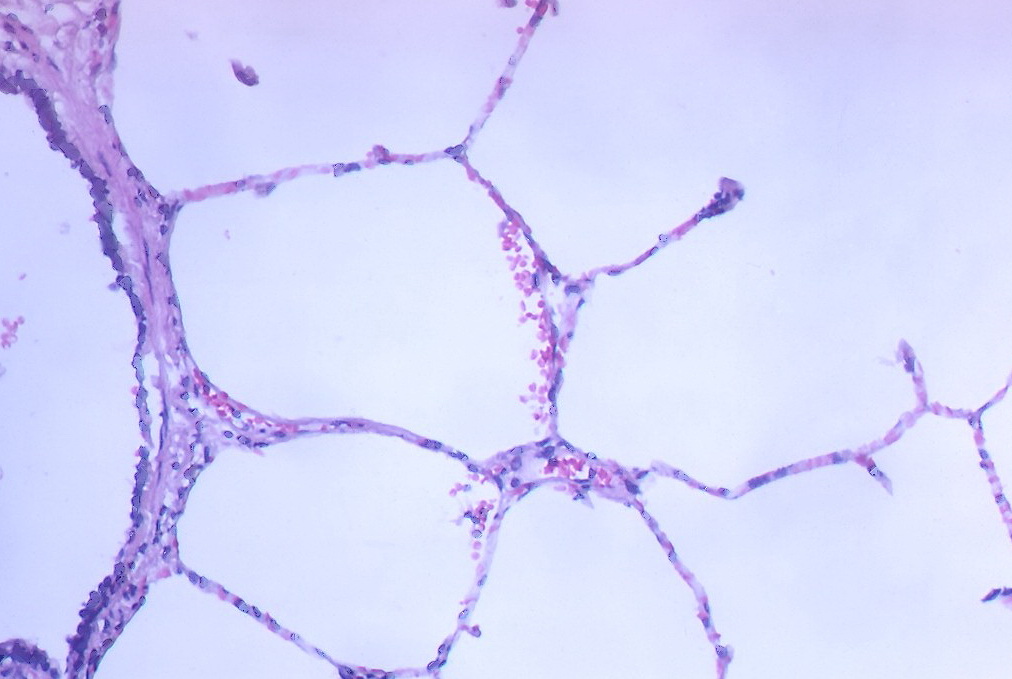
Look for the repeated air spaces and the larger airway profile within them. Which features suggest a gas-exchange region?
Yale Rosen; uploaded to Wikimedia Commons by CFCFWikimedia Commons source · CC BY-SA 2.0Specimen F
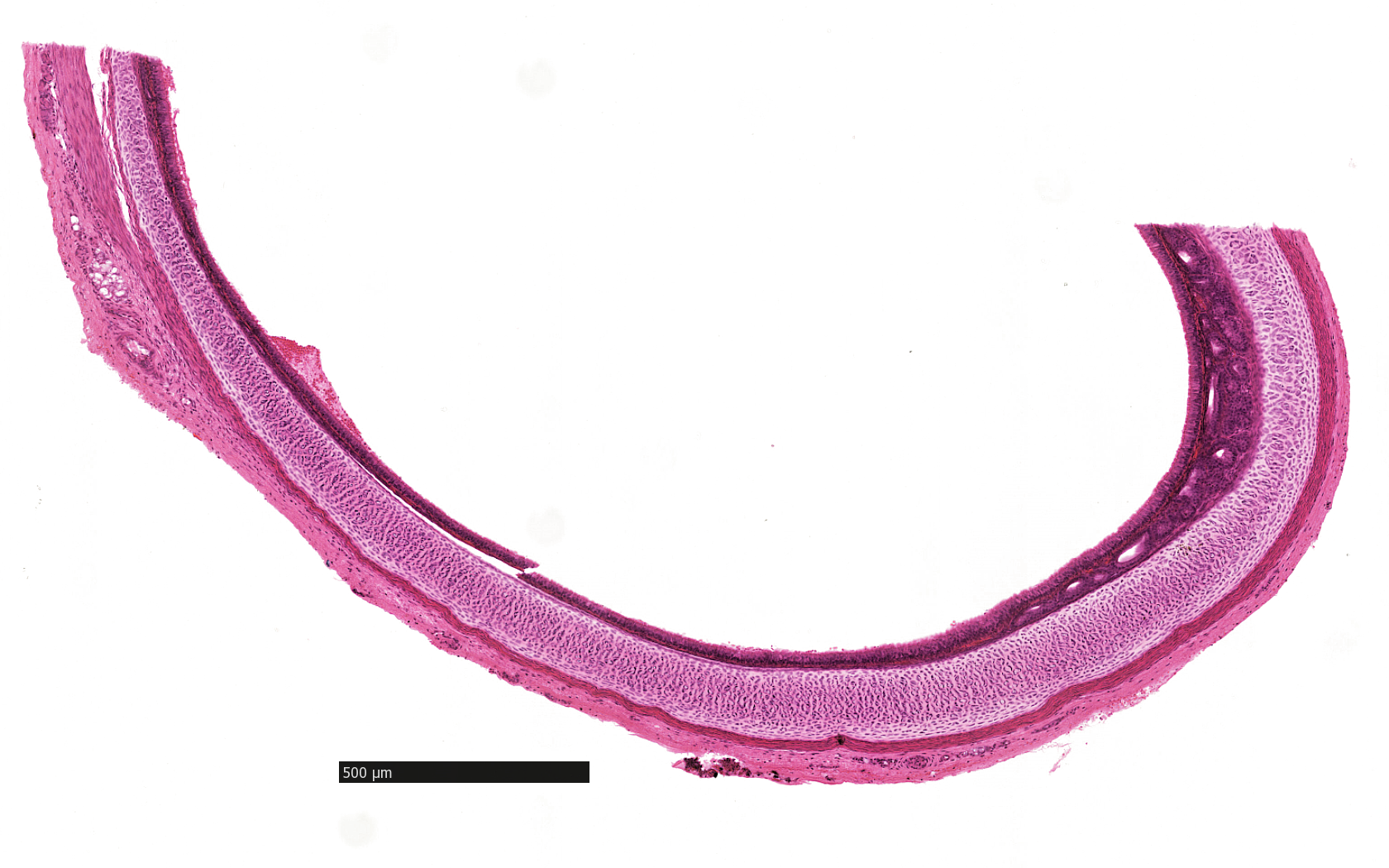
Trace the curved supporting wall and the inner lining. What combination of tissues helps identify this airway section?
MagscopeWikimedia Commons source · CC BY-SA 4.0Specimen G
Compare the two adjacent vessel profiles. Which wall is thicker and more circular, and which lumen appears less regularly open?
FishtailBobWikimedia Commons source · CC BY-SA 4.0Specimen H
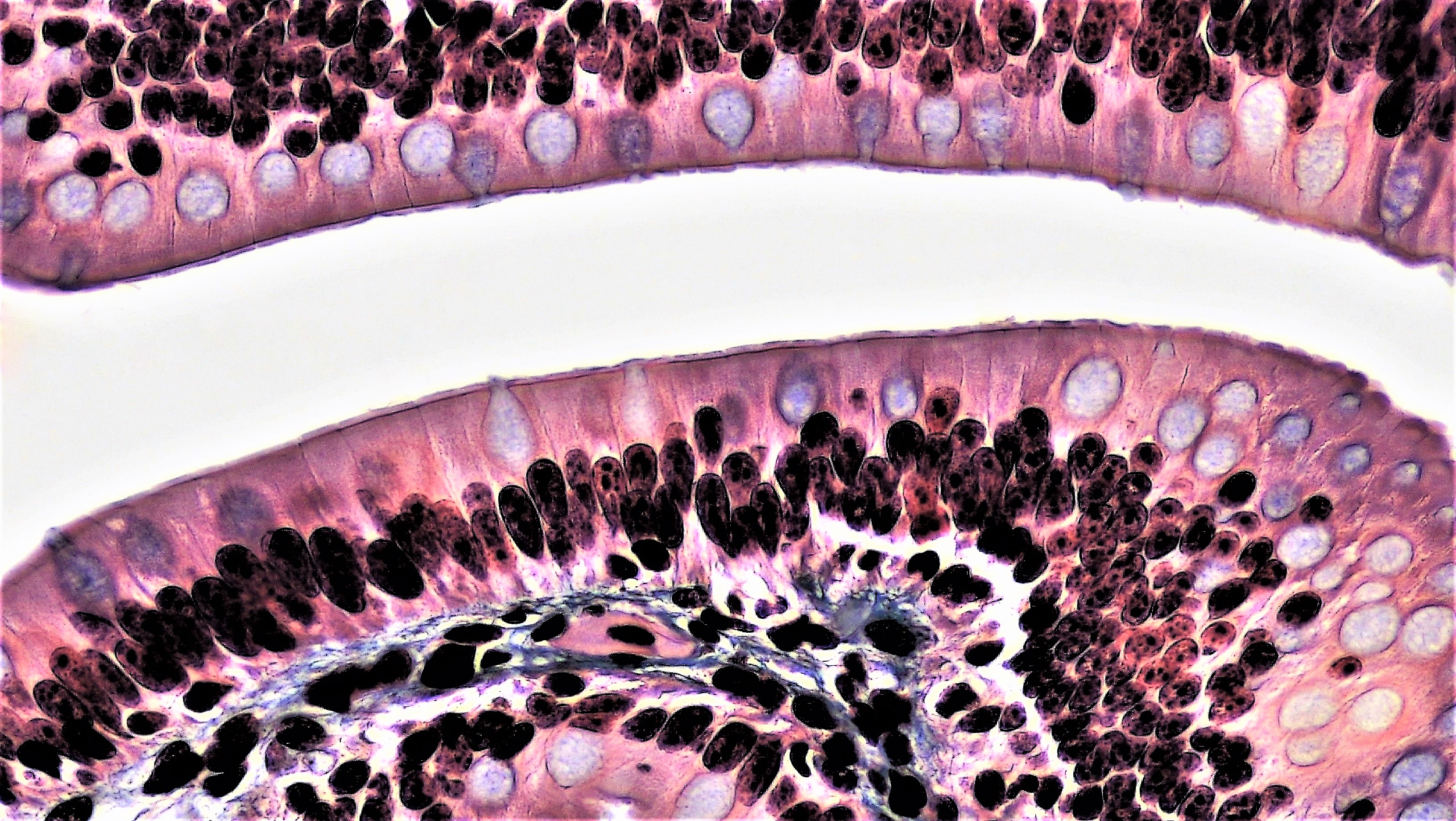
Inspect the tall lining cells, their oval nuclei and one pale region in the lining. Which epithelial arrangement is represented?
Berkshire Community College Bioscience Image LibraryBerkshire CC0 image source · CC0Specimen I
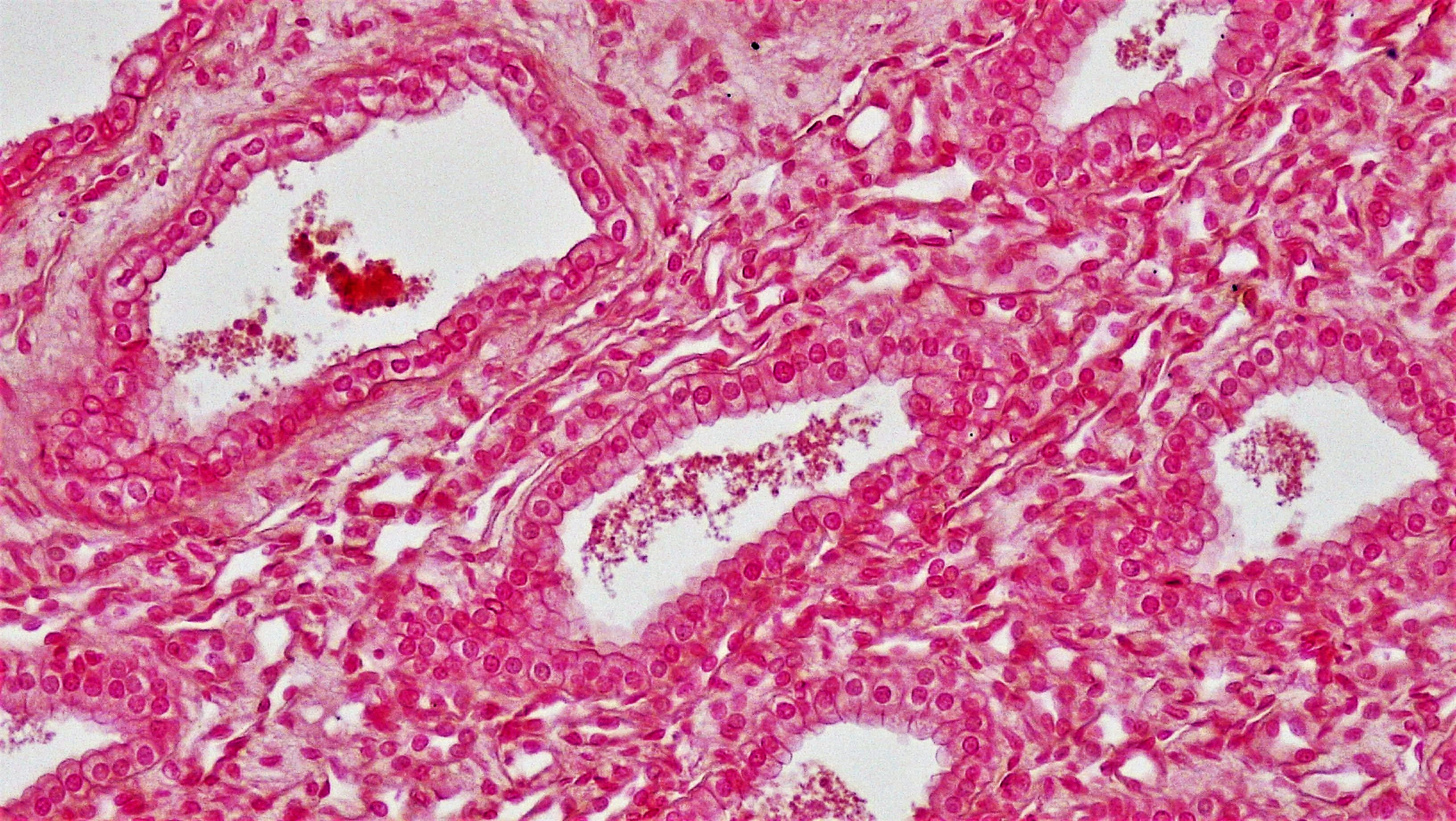
Find the repeated round and oval profiles. Compare each lumen with the ring of lining cells around it.
Berkshire Community College Bioscience Image LibraryBerkshire CC0 image source · CC0Unmodified source photographs · only the trachea source image includes a 500 μm scale bar; the cell TEM has its own 500 nm bar · no other image has a scale bar or specimen scale.
These are genuine source photographs, not constructed drawings. They support visual recognition but do not certify supervised practical performance.
The gut lining photo is not assigned to the ileum or duodenum. In separate sections, duodenal Brunner’s glands occur in the submucosa, while distal-ileum Peyer’s patches are lymphoid aggregates; this anatomical comparison is not a feature established by the photo.
Show labelled key: Answer key for alevel-body-micrographs
Animal tissues · observed micrographs
Real source photographs show a lung field, tracheal wall, artery and vein cross-sections, mammalian gut lining, kidney tubules, blood cells and a thin-section bronchiolar cell TEM.
Specimen A · mammalian bronchiolar club-cell TEM
Compare the large dense region, layered membrane profiles and rounded bodies. Which structures can you identify in this thin section?
The source identifies part of the nucleus, rough endoplasmic reticulum, and mitochondria in the cytoplasm of a mammalian bronchiolar club (Clara) cell. A 500 nm scale bar is visible; the full cell boundary is outside this frame.
Limits: The source does not identify the mammal or establish donor health status. Only part of the cell is shown; the complete cell outline and surface membrane are not present.
Louisa Howard; Dartmouth Electron Microscope FacilityClara cell lung - TEM · Mammalian lung TEM collection. Source provenance: Dartmouth Electron Microscope Facility.Wikimedia Commons source · Public domain (author released)Specimen B · human blood smear
Compare the many pale disc-shaped cells with the larger purple-stained cell near the centre. What red blood cell type and white blood cell are visible?
The numerous pale cells are erythrocytes (red blood cells). The larger purple-stained cell is a neutrophil, identified by its segmented nucleus.
Limits: This small unlabelled field contains erythrocytes and a neutrophil, not a lymphocyte. No scale bar is shown.
EchinaceapallidaBlood-neutrophil1 · Wright-stained human peripheral blood smear.Wikimedia Commons source · CC BY-SA 4.0Specimen C · neutrophil in a blood smear
Inspect the prominent purple-stained white blood cell. What shape does its dark-stained nucleus have?
It is a neutrophil. The visible nucleus is segmented into several lobes; nearby erythrocytes provide context, not a scale reference.
Limits: Small, tightly framed micrograph; only part of the surrounding smear is visible. No scale bar or specimen scale is given.
Original image: hematologist (Segmented_neutrophils.jpg); derivative work: patient-docNeutrophil in a blood smear · Derivative image; source page credits the original image and derivative work.Wikimedia Commons source · CC BY-SA 3.0Specimen D · lymphocyte in a human blood smear
Compare the prominent cell with the surrounding red blood cells. What can you observe about its dark central region and the amount of cytoplasm around it?
The cell is a human lymphocyte. It has a prominent, rounded dark nucleus and a narrow rim of cytoplasm. The source does not identify the donor’s health status.
Limits: The image does not include a scale bar. No donor health status or diagnosis is provided by the source.
El*FalafLY 24909 · Stained light micrograph; no scale bar provided.Wikimedia Commons source · CC BY 4.0Specimen E · mammalian lung field
Look for the repeated air spaces and the larger airway profile within them. Which features suggest a gas-exchange region?
The source identifies alveoli surrounding a terminal bronchiole. The open alveolar spaces and thin intervening septa show the finely divided lung tissue around an airway.
Limits: The specimen species is not stated. This field does not support a diagnosis or a measured size; no scale bar is visible.
Yale Rosen; uploaded to Wikimedia Commons by CFCFNormal lung (3660695207) · Source description: normal alveoli surrounding a terminal bronchiole; 1012 × 679 px, no scale bar.Wikimedia Commons source · CC BY-SA 2.0Specimen F · mammalian trachea cross-section
Trace the curved supporting wall and the inner lining. What combination of tissues helps identify this airway section?
This is a low-magnification mammalian trachea section: the broad hyaline-cartilage ring, inner pseudostratified ciliated columnar lining and submucosal glands support recognition. The original source image includes its own 500 μm scale bar.
Limits: The source identifies mammal, but no species. This view shows a curved section of the wall rather than a complete ring. The 500 μm scale bar is part of the unchanged source image; no extra labels or scale have been added.
MagscopeTrachea (mammal) histology cross-section, low mag · Original PNG, 1680 × 1050 px; original 500 μm scale bar retained unchanged.Wikimedia Commons source · CC BY-SA 4.0Specimen G · artery and vein cross-sections
Compare the two adjacent vessel profiles. Which wall is thicker and more circular, and which lumen appears less regularly open?
The source identifies an artery and a vein in cross-section. The artery has the thicker muscular wall and a more circular outline; the thinner-walled vein has a less regular, partly collapsed-looking lumen in this field.
Limits: The source does not state species or anatomical site. This is a small field with no scale bar; compare wall patterns only, not vessel dimensions.
FishtailBobArteryVeinCS · Source title and description identify the paired artery/vein field; 640 × 480 px, no scale bar.Wikimedia Commons source · CC BY-SA 4.0Specimen H · mammalian gut lining
Inspect the tall lining cells, their oval nuclei and one pale region in the lining. Which epithelial arrangement is represented?
The Berkshire source identifies a mammalian gut simple-columnar epithelium field. Tall cells and a pale goblet-cell region are visible. The photo is not assigned to the ileum or duodenum, so those regions cannot be distinguished from this image.
Limits: No species or specific gut region is stated; no whole bowel wall or scale bar is shown. For separate sections, the duodenum may show Brunner’s glands in the submucosa, while distal ileum may show Peyer’s patches. That anatomical comparison is not a feature identified in this photo.
Berkshire Community College Bioscience Image LibrarySimple Columnar Epithelium: Cross Section (Mammalian Gut) · Source image 27854452128; 3264 × 1840 px, unmodified local copy, no scale bar.Berkshire CC0 image source · CC0Specimen I · mammalian kidney tubules
Find the repeated round and oval profiles. Compare each lumen with the ring of lining cells around it.
The source identifies mammalian kidney tubules. Their cuboidal epithelial cells surround visible lumens. This is a real kidney-tubule field, not a whole-kidney section.
Limits: Species is not stated. The photographed field does not show a whole nephron or a clearly resolved glomerulus; no scale bar is shown.
Berkshire Community College Bioscience Image LibrarySimple Cuboidal Epithelium: Cross Section (Mammalian Kidney Tubule) · Source image 39914418360; 3264 × 1840 px, unmodified local copy, no scale bar.Berkshire CC0 image source · CC0Unmodified source photographs · only the trachea source image includes a 500 μm scale bar; the cell TEM has its own 500 nm bar · no other image has a scale bar or specimen scale.
These are genuine source photographs, not constructed drawings. They support visual recognition but do not certify supervised practical performance.
The gut lining photo is not assigned to the ileum or duodenum. In separate sections, duodenal Brunner’s glands occur in the submucosa, while distal-ileum Peyer’s patches are lymphoid aggregates; this anatomical comparison is not a feature established by the photo.
Anatomical comparison (not inferred from the source photo): OpenStax · small and large intestines.
Use the practice and labelled views with the explanation. Photographs show only the structures identified in their visibility notes; constructed models are not micrographs. - Core
Scope: Core · AS Unit 2; printed p. 26 (j, k, l)
Open revision guidance
What to know
- A typical dicotyledonous leaf has a transparent epidermis and cuticle, chloroplast-rich palisade mesophyll for light capture, and spongy mesophyll with intercellular air spaces. Veins contain xylem supplying water and phloem carrying assimilates. Stomata connect internal air spaces with the atmosphere; carbon dioxide reaches moist mesophyll surfaces and diffuses into cells for photosynthesis.
- Guard-cell ion uptake lowers their solute potential, water enters by osmosis, and increased turgor opens the pore because wall thickness and fibre arrangement make the cells curve apart. Loss of ions and water reduces turgor and closes the pore. Opening allows gas exchange but increases water loss, so stomatal behaviour balances carbon-dioxide supply with water conservation.
- For stomatal counts, obtain a teacher-approved epidermal peel or a clear surface impression, examine comparable known areas and count several fields from several leaves. State which leaf surface is sampled. If a constructed field has area 0.20 mm² and contains 18 stomata, density is 18÷0.20 = 90 stomata mm⁻². Variation within and between leaves means one field is insufficient.
- For a low-power transverse-section plan, show the cuticle, epidermal layers, palisade region, spongy region and vascular bundle in correct relative positions, rather than drawing every cell. Add labels and a scale or calculated magnification. A 30 mm drawing of a 0.15 mm-thick leaf has magnification ×200. Compare the plan with an actual leaf section and use visible features rather than copying an idealised outline.
What to do in an assessment
- Use the leaf drawing and actual micrograph together. Identify the upper epidermis and palisade before orienting a transverse section; a longitudinal vein image is not equivalent to a complete leaf cross-section.
In plain language
Leaf anatomy links light capture, internal diffusion and vascular supply. Guard cells regulate the compromise between gas exchange and water loss.
Self-check
Three equal-area fields contain 12, 15 and 18 stomata. What is the mean count, and why should the area be reported?
Show the answer
The mean is (12+15+18)÷3 = 15. The area is needed to calculate and compare stomatal density.
View diagrams
Dicot leaf section · Unlabelled practice · Schematic, simplified and not to scale. Show labelled key: Answer key for leaf-section
Dicot leaf section · Structure key · Schematic, simplified and not to scale. 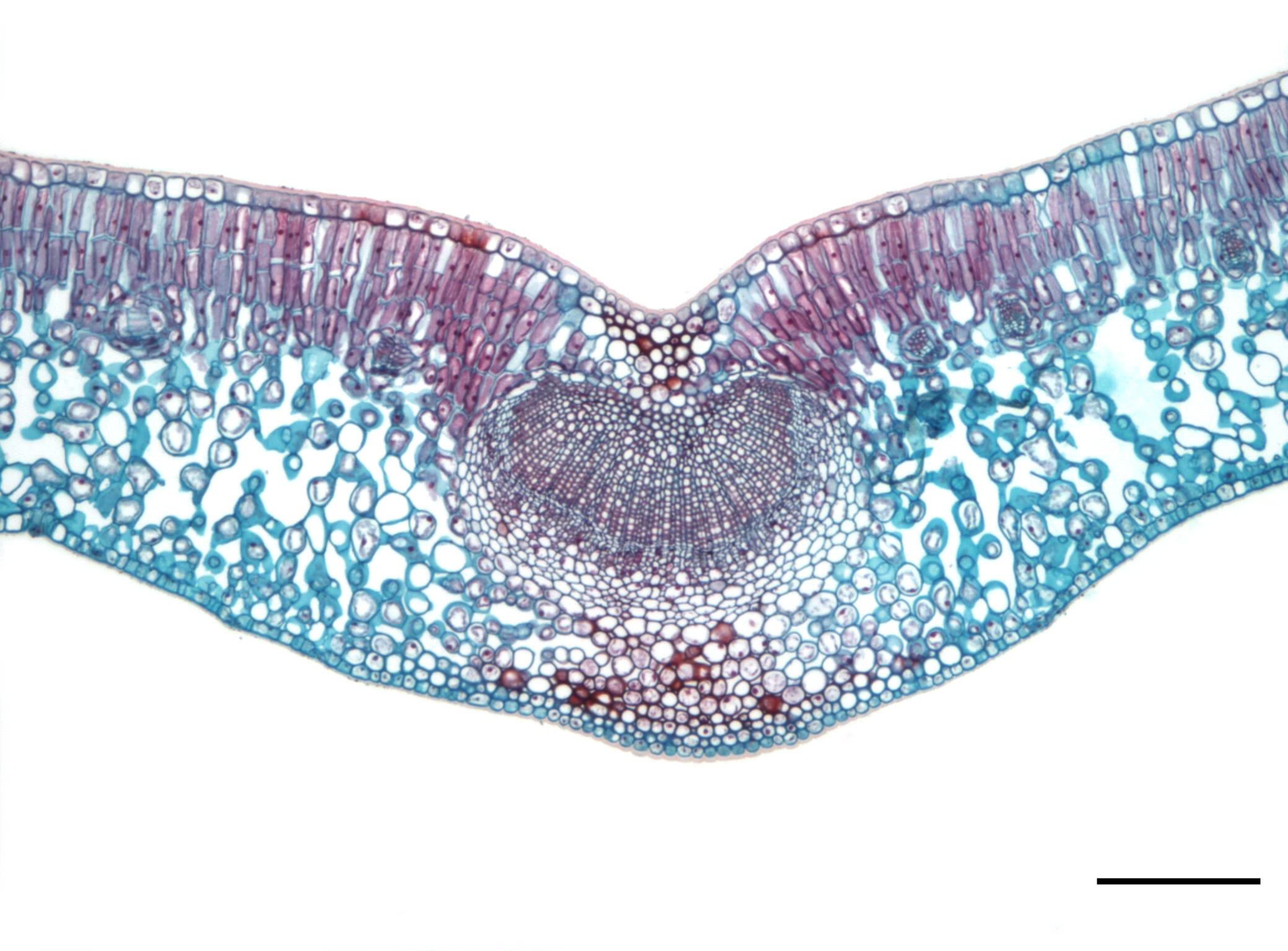
Practice question
Read the section from its more regular, column-like tissue toward the looser tissue with larger spaces. Which leaf regions can you recognise, and where is the vein?
Photograph / micrograph recognition only. Species is not identified. This is a dicot example, but not a species-specific specimen.
Photo: Dicot leaf · Jon Houseman; source credit also names Matthew FordPhotomicrograph with a 0.2 mm scale bar.Show labelled key: Answer key for leaf-micrograph
Dicot leaf cross-section
Photo key
The source identifies this as a dicot leaf in transverse section. Elongated palisade tissue lies beneath the upper surface; looser spongy tissue with air spaces is toward the lower surface; a central vein is visible. Individual xylem and phloem are not resolved clearly enough here to label.
Species is not identified. This is a dicot example, but not a species-specific specimen.
Photo: Dicot leaf · Jon Houseman; source credit also names Matthew FordPhotomicrograph with a 0.2 mm scale bar.Use the practice and labelled views with the explanation. Photographs show only the structures identified in their visibility notes; constructed models are not micrographs. - Core
Scope: Core · AS Unit 2; printed p. 28 (a, b)
Open revision guidance
What to know
- Earthworms have a closed vascular system with pumps and blood carrying respiratory gases. Insects have an open circulatory system and dorsal tube-shaped heart; haemolymph is not their main respiratory-gas transport route. Fish have a single circulation: blood travels heart → gills → body → heart. Mammals have double circulation: pulmonary circulation to lungs and systemic circulation to the body, allowing different pressures and separation of oxygenated and deoxygenated blood.
- In the human heart, venae cavae enter the right atrium; blood passes through the tricuspid valve to the right ventricle and pulmonary artery. Pulmonary veins return blood to the left atrium; the bicuspid/mitral valve leads to the left ventricle and aorta. Coronary arteries supply the heart muscle itself. Valves prevent backflow because pressure differences open or close them; they do not actively pump.
- Arteries carry blood away from the heart and have relatively thick muscular, elastic walls to withstand pulsatile pressure. Veins return blood at lower pressure, have relatively thinner walls and wider lumens, and many contain valves. Capillary walls are a thin endothelial layer, providing a short exchange distance. Arteries are not defined as oxygenated: the pulmonary artery is a counterexample.
- In a heart dissection, locate chambers, trace vessels and identify valves and the thicker left ventricular wall. Use a blunt probe where suitable and teacher-directed cuts rather than forcing scissors through unknown structures. In artery and vein sections, compare wall thickness relative to the lumen, not just absolute specimen size. Make a low-power tissue plan and calculate size using the slide's calibration or supplied scale.
What to do in an assessment
- Constructed microscopy example: an artery outer diameter spans 120 eyepiece divisions at 5 μm per division, giving 600 μm. If the drawing diameter is 60 mm, magnification is 60,000÷600 = ×100. State which diameter was measured.
In plain language
Circulatory systems differ in route and pressure. Vessel and chamber structures suit their transport roles.
Self-check
Why is the left ventricular wall thicker than the right ventricular wall?
Show the answer
It generates the higher pressure needed to drive blood around the systemic circulation, whereas the right ventricle pumps through the shorter, lower-pressure pulmonary circulation.
View diagrams
Section through the human heartSimplified schematic; not to scale. - A
- B
- C
- D
- E
- F
- G
- H
- I
- J
- K
- L
- M
- N
Show labelled key: Answer key for heart-section
Section through the human heartSimplified schematic; not to scale. - ARight atrium
- BRight ventricle
- CLeft atrium
- DLeft ventricle
- ESeptum
- FMuscular wall
- GTricuspid valve
- HBicuspid (mitral) valve
- ISemilunar valves
- JCoronary arteries
- KVena cava
- LPulmonary artery
- MPulmonary vein
- NAorta
Double circulation and major vesselsColour indicates oxygenation, not artery or vein type. Simplified schematic; not to scale. - A
- B
- C
- D
- E
- F
- G
- H
- I
- J
- K
- L
- M
- N
Show labelled key: Answer key for circulation-vessels
Double circulation and major vesselsColour indicates oxygenation, not artery or vein type. Simplified schematic; not to scale. - AHeart
- BLungs
- CPulmonary artery: heart → lungs
- DPulmonary vein: lungs → heart
- EAorta: away from heart
- FVena cava: to heart
- GGut
- HHepatic portal vein: gut → liver
- ILiver
- JHepatic artery: to liver
- KHepatic veins: from liver
- LKidney
- MRenal artery: to kidney
- NRenal vein: from kidney
Animal tissues · observed micrographs
Compare the open spaces and curved supporting band; then inspect the thicker and thinner vessel walls, tall lining cells and repeated round profiles. Which tissue patterns can you recognise from visible organisation alone?
Specimen A
Compare the large dense region, layered membrane profiles and rounded bodies. Which structures can you identify in this thin section?
Louisa Howard; Dartmouth Electron Microscope FacilityWikimedia Commons source · Public domain (author released)Specimen B
Compare the many pale disc-shaped cells with the larger purple-stained cell near the centre. What red blood cell type and white blood cell are visible?
EchinaceapallidaWikimedia Commons source · CC BY-SA 4.0Specimen C
Inspect the prominent purple-stained white blood cell. What shape does its dark-stained nucleus have?
Original image: hematologist (Segmented_neutrophils.jpg); derivative work: patient-docWikimedia Commons source · CC BY-SA 3.0Specimen D
Compare the prominent cell with the surrounding red blood cells. What can you observe about its dark central region and the amount of cytoplasm around it?
El*FalafWikimedia Commons source · CC BY 4.0Specimen E
Look for the repeated air spaces and the larger airway profile within them. Which features suggest a gas-exchange region?
Yale Rosen; uploaded to Wikimedia Commons by CFCFWikimedia Commons source · CC BY-SA 2.0Specimen F
Trace the curved supporting wall and the inner lining. What combination of tissues helps identify this airway section?
MagscopeWikimedia Commons source · CC BY-SA 4.0Specimen G
Compare the two adjacent vessel profiles. Which wall is thicker and more circular, and which lumen appears less regularly open?
FishtailBobWikimedia Commons source · CC BY-SA 4.0Specimen H
Inspect the tall lining cells, their oval nuclei and one pale region in the lining. Which epithelial arrangement is represented?
Berkshire Community College Bioscience Image LibraryBerkshire CC0 image source · CC0Specimen I
Find the repeated round and oval profiles. Compare each lumen with the ring of lining cells around it.
Berkshire Community College Bioscience Image LibraryBerkshire CC0 image source · CC0Unmodified source photographs · only the trachea source image includes a 500 μm scale bar; the cell TEM has its own 500 nm bar · no other image has a scale bar or specimen scale.
These are genuine source photographs, not constructed drawings. They support visual recognition but do not certify supervised practical performance.
The gut lining photo is not assigned to the ileum or duodenum. In separate sections, duodenal Brunner’s glands occur in the submucosa, while distal-ileum Peyer’s patches are lymphoid aggregates; this anatomical comparison is not a feature established by the photo.
Show labelled key: Answer key for alevel-body-micrographs
Animal tissues · observed micrographs
Real source photographs show a lung field, tracheal wall, artery and vein cross-sections, mammalian gut lining, kidney tubules, blood cells and a thin-section bronchiolar cell TEM.
Specimen A · mammalian bronchiolar club-cell TEM
Compare the large dense region, layered membrane profiles and rounded bodies. Which structures can you identify in this thin section?
The source identifies part of the nucleus, rough endoplasmic reticulum, and mitochondria in the cytoplasm of a mammalian bronchiolar club (Clara) cell. A 500 nm scale bar is visible; the full cell boundary is outside this frame.
Limits: The source does not identify the mammal or establish donor health status. Only part of the cell is shown; the complete cell outline and surface membrane are not present.
Louisa Howard; Dartmouth Electron Microscope FacilityClara cell lung - TEM · Mammalian lung TEM collection. Source provenance: Dartmouth Electron Microscope Facility.Wikimedia Commons source · Public domain (author released)Specimen B · human blood smear
Compare the many pale disc-shaped cells with the larger purple-stained cell near the centre. What red blood cell type and white blood cell are visible?
The numerous pale cells are erythrocytes (red blood cells). The larger purple-stained cell is a neutrophil, identified by its segmented nucleus.
Limits: This small unlabelled field contains erythrocytes and a neutrophil, not a lymphocyte. No scale bar is shown.
EchinaceapallidaBlood-neutrophil1 · Wright-stained human peripheral blood smear.Wikimedia Commons source · CC BY-SA 4.0Specimen C · neutrophil in a blood smear
Inspect the prominent purple-stained white blood cell. What shape does its dark-stained nucleus have?
It is a neutrophil. The visible nucleus is segmented into several lobes; nearby erythrocytes provide context, not a scale reference.
Limits: Small, tightly framed micrograph; only part of the surrounding smear is visible. No scale bar or specimen scale is given.
Original image: hematologist (Segmented_neutrophils.jpg); derivative work: patient-docNeutrophil in a blood smear · Derivative image; source page credits the original image and derivative work.Wikimedia Commons source · CC BY-SA 3.0Specimen D · lymphocyte in a human blood smear
Compare the prominent cell with the surrounding red blood cells. What can you observe about its dark central region and the amount of cytoplasm around it?
The cell is a human lymphocyte. It has a prominent, rounded dark nucleus and a narrow rim of cytoplasm. The source does not identify the donor’s health status.
Limits: The image does not include a scale bar. No donor health status or diagnosis is provided by the source.
El*FalafLY 24909 · Stained light micrograph; no scale bar provided.Wikimedia Commons source · CC BY 4.0Specimen E · mammalian lung field
Look for the repeated air spaces and the larger airway profile within them. Which features suggest a gas-exchange region?
The source identifies alveoli surrounding a terminal bronchiole. The open alveolar spaces and thin intervening septa show the finely divided lung tissue around an airway.
Limits: The specimen species is not stated. This field does not support a diagnosis or a measured size; no scale bar is visible.
Yale Rosen; uploaded to Wikimedia Commons by CFCFNormal lung (3660695207) · Source description: normal alveoli surrounding a terminal bronchiole; 1012 × 679 px, no scale bar.Wikimedia Commons source · CC BY-SA 2.0Specimen F · mammalian trachea cross-section
Trace the curved supporting wall and the inner lining. What combination of tissues helps identify this airway section?
This is a low-magnification mammalian trachea section: the broad hyaline-cartilage ring, inner pseudostratified ciliated columnar lining and submucosal glands support recognition. The original source image includes its own 500 μm scale bar.
Limits: The source identifies mammal, but no species. This view shows a curved section of the wall rather than a complete ring. The 500 μm scale bar is part of the unchanged source image; no extra labels or scale have been added.
MagscopeTrachea (mammal) histology cross-section, low mag · Original PNG, 1680 × 1050 px; original 500 μm scale bar retained unchanged.Wikimedia Commons source · CC BY-SA 4.0Specimen G · artery and vein cross-sections
Compare the two adjacent vessel profiles. Which wall is thicker and more circular, and which lumen appears less regularly open?
The source identifies an artery and a vein in cross-section. The artery has the thicker muscular wall and a more circular outline; the thinner-walled vein has a less regular, partly collapsed-looking lumen in this field.
Limits: The source does not state species or anatomical site. This is a small field with no scale bar; compare wall patterns only, not vessel dimensions.
FishtailBobArteryVeinCS · Source title and description identify the paired artery/vein field; 640 × 480 px, no scale bar.Wikimedia Commons source · CC BY-SA 4.0Specimen H · mammalian gut lining
Inspect the tall lining cells, their oval nuclei and one pale region in the lining. Which epithelial arrangement is represented?
The Berkshire source identifies a mammalian gut simple-columnar epithelium field. Tall cells and a pale goblet-cell region are visible. The photo is not assigned to the ileum or duodenum, so those regions cannot be distinguished from this image.
Limits: No species or specific gut region is stated; no whole bowel wall or scale bar is shown. For separate sections, the duodenum may show Brunner’s glands in the submucosa, while distal ileum may show Peyer’s patches. That anatomical comparison is not a feature identified in this photo.
Berkshire Community College Bioscience Image LibrarySimple Columnar Epithelium: Cross Section (Mammalian Gut) · Source image 27854452128; 3264 × 1840 px, unmodified local copy, no scale bar.Berkshire CC0 image source · CC0Specimen I · mammalian kidney tubules
Find the repeated round and oval profiles. Compare each lumen with the ring of lining cells around it.
The source identifies mammalian kidney tubules. Their cuboidal epithelial cells surround visible lumens. This is a real kidney-tubule field, not a whole-kidney section.
Limits: Species is not stated. The photographed field does not show a whole nephron or a clearly resolved glomerulus; no scale bar is shown.
Berkshire Community College Bioscience Image LibrarySimple Cuboidal Epithelium: Cross Section (Mammalian Kidney Tubule) · Source image 39914418360; 3264 × 1840 px, unmodified local copy, no scale bar.Berkshire CC0 image source · CC0Unmodified source photographs · only the trachea source image includes a 500 μm scale bar; the cell TEM has its own 500 nm bar · no other image has a scale bar or specimen scale.
These are genuine source photographs, not constructed drawings. They support visual recognition but do not certify supervised practical performance.
The gut lining photo is not assigned to the ileum or duodenum. In separate sections, duodenal Brunner’s glands occur in the submucosa, while distal-ileum Peyer’s patches are lymphoid aggregates; this anatomical comparison is not a feature established by the photo.
Anatomical comparison (not inferred from the source photo): OpenStax · small and large intestines.
Use the practice and labelled views with the explanation. Photographs show only the structures identified in their visibility notes; constructed models are not micrographs. - Core
Scope: Core · AS Unit 2; printed p. 28 (c)
Open revision guidance
What to know
- During diastole, ventricles relax; when atrial pressure exceeds ventricular pressure the atrioventricular valves open and filling occurs. Atrial systole completes ventricular filling. During ventricular systole, rising ventricular pressure closes the atrioventricular valves. Once ventricular pressure exceeds arterial pressure, semilunar valves open and blood is ejected. As ventricular pressure falls below arterial pressure, semilunar valves close.
- On a pressure graph, locate valve events from pressure crossings: a valve opens only when upstream pressure exceeds downstream pressure. A closed-valve interval at the start of systole allows pressure to rise before ejection. The aortic pressure remains higher than ventricular pressure through much of diastole because arterial elasticity maintains flow.
- The sinoatrial node initiates excitation in the right atrium. Excitation spreads across the atria, then passes through the atrioventricular node after a delay, allowing ventricular filling. Conducting tissue carries it towards the apex and Purkinje fibres distribute it through the ventricular walls so contraction drives blood upwards into arteries.
- An ECG records electrical activity, not pressure directly. The P wave reflects atrial depolarisation; the QRS complex ventricular depolarisation; the T wave ventricular repolarisation. Mechanical contraction follows electrical excitation. Constructed trace: successive R peaks separated by 0.80 s indicate heart rate 60÷0.80 = 75 beats min⁻¹. A trace alone is not a clinical diagnosis.
What to do in an assessment
- Align ECG events with subsequent mechanical events rather than claiming the T wave is atrial systole. If stroke volume is 70 cm³ and rate is 75 min⁻¹, cardiac output is 70×75 = 5250 cm³ min⁻¹, or 5.25 dm³ min⁻¹.
In plain language
Pressure differences control valves; electrical signals coordinate contractions. ECG waves and pressure curves describe related but distinct events.
Self-check
At a moment when ventricular pressure is below aortic pressure, can the aortic semilunar valve remain open for forward flow?
Show the answer
No. The pressure difference tends to close it, preventing blood flowing back from the aorta into the ventricle.
View diagrams
Cardiac traces and haemoglobin dissociationRead the ECG as electrical events and the pressure lines as mechanical changes. Relate valve events to the pressure differences, then explain the qualitative right shift at higher carbon dioxide.Schematic reference traces · qualitative axes · not patient records Show labelled key: Answer key for alevel-physiology-traces
Cardiac traces and haemoglobin dissociationThe ECG P wave represents atrial depolarisation; the QRS complex represents ventricular depolarisation; the T wave represents ventricular repolarisation. Ventricular systole follows the QRS: rising ventricular pressure closes the atrioventricular valves, then opens the aortic valve once it exceeds aortic pressure. Falling ventricular pressure closes the aortic valve; when it falls below atrial pressure, the atrioventricular valves open. The separate oxygen-dissociation S-curve shifts right at higher CO₂: haemoglobin has lower oxygen affinity, so at a given partial pressure saturation is lower. All traces are schematic references, not patient records or measured values.Schematic reference traces · qualitative axes · not patient records - 1P wave: atrial depolarisation
- 2QRS complex: ventricular depolarisation
- 3T wave: ventricular repolarisation
- 4Atrial pressure
- 5Ventricular pressure
- 6Aortic pressure
- 7Atrioventricular valve closes as ventricular pressure rises
- 8Aortic valve opens when ventricular pressure exceeds aortic pressure
- 9Aortic valve closes when ventricular pressure falls below aortic pressure
- 10Atrioventricular valve opens when ventricular pressure falls below atrial pressure
- 11Oxygen partial pressure and haemoglobin saturation
- 12Right shift at higher CO₂: lower oxygen affinity
Use the practice and labelled views with the explanation. Photographs show only the structures identified in their visibility notes; constructed models are not micrographs. - Core
Scope: Core · AS Unit 2; printed p. 28 (d, e, f, g, h)
Open revision guidance
What to know
- Mammalian erythrocytes are biconcave, flexible and lack a nucleus, providing space for haemoglobin and a short diffusion path. Haemoglobin binds oxygen reversibly. Its sigmoid oxygen-dissociation curve reflects cooperative binding: the first oxygen binding makes further binding easier. Read percentage saturation at a stated oxygen partial pressure, not concentration alone.
- A left-shifted curve indicates higher oxygen affinity at a given partial pressure. Fetal haemoglobin can obtain oxygen from maternal blood; haemoglobins of animals such as llama and lugworm are adapted for oxygen uptake in low-oxygen conditions. A right shift indicates lower affinity and easier unloading. Curve position, not simply a high maximum, explains the comparison.
- In active tissues, raised carbon dioxide and lower pH shift the curve right: the Bohr effect promotes oxygen unloading. Within erythrocytes, carbonic anhydrase accelerates CO₂ + H₂O ⇌ H₂CO₃; dissociation yields H⁺ and HCO₃⁻. Haemoglobin buffers H⁺, while hydrogencarbonate leaves the cell and chloride enters to maintain charge balance: the chloride shift. These processes reverse in the lungs. Some CO₂ is dissolved or bound to haemoglobin rather than all travelling as hydrogencarbonate.
- Plasma also carries nutrients, hormones, urea and heat. At the arterial end of a capillary, hydrostatic pressure drives fluid through the wall; cells and most large plasma proteins remain in blood. Tissue fluid supplies cells and receives wastes. As capillary hydrostatic pressure falls, osmotic effects favour fluid return; lymph vessels drain excess fluid and return it to circulation. Do not claim every molecule leaves solely because of blood pressure.
- In a blood smear, erythrocytes are numerous small cells, whereas leukocytes have nuclei. Compare their visible features with function. A stained smear is a thin prepared sample, not a complete view of plasma circulation.
What to do in an assessment
- Constructed curve-reading example: at one specified pO₂, haemoglobin A is 75% saturated and B 45%. A has higher affinity at that pO₂; unloading during a journey requires comparison with saturation at the starting and ending pO₂.
In plain language
Haemoglobin affinity governs oxygen loading and unloading. Blood transports gases and other materials, while tissue fluid links capillaries to cells.
Self-check
During the chloride shift in respiring tissue, which ion enters an erythrocyte as hydrogencarbonate leaves?
Show the answer
Chloride, Cl⁻, enters to help maintain electrical neutrality.
View diagrams
Practice question
Compare the many pale disc-shaped cells with the larger purple-stained cell near the centre. Which is the red blood cell type, and what kind of white blood cell is visible?
Photograph / micrograph recognition only. This small unlabelled field contains erythrocytes and a neutrophil, not a lymphocyte. No scale bar is shown.
Photo: Blood-neutrophil1 · EchinaceapallidaWright-stained human peripheral blood smear.Show labelled key: Answer key for blood-smear-micrograph
Human blood smear
Photo key
The numerous pale cells are erythrocytes (red blood cells). The larger purple-stained cell is a neutrophil, identified by its segmented nucleus.
This small unlabelled field contains erythrocytes and a neutrophil, not a lymphocyte. No scale bar is shown.
Photo: Blood-neutrophil1 · EchinaceapallidaWright-stained human peripheral blood smear.Blood cells: schematic, not a photomicrographSchematic shapes only. Actual representative photomicrographs must be supplied separately; this drawing is not a specimen. - A
- B
- C
- D
- E
- F
Show labelled key: Answer key for blood-cells
Blood cells: schematic, not a photomicrographSchematic shapes only. Actual representative photomicrographs must be supplied separately; this drawing is not a specimen. - ARed blood cell: biconcave, no nucleus
- BPhagocyte
- CPhagocyte nucleus
- DLymphocyte
- ELymphocyte nucleus
- FPlatelets
Cardiac traces and haemoglobin dissociationRead the ECG as electrical events and the pressure lines as mechanical changes. Relate valve events to the pressure differences, then explain the qualitative right shift at higher carbon dioxide.Schematic reference traces · qualitative axes · not patient records Show labelled key: Answer key for alevel-physiology-traces
Cardiac traces and haemoglobin dissociationThe ECG P wave represents atrial depolarisation; the QRS complex represents ventricular depolarisation; the T wave represents ventricular repolarisation. Ventricular systole follows the QRS: rising ventricular pressure closes the atrioventricular valves, then opens the aortic valve once it exceeds aortic pressure. Falling ventricular pressure closes the aortic valve; when it falls below atrial pressure, the atrioventricular valves open. The separate oxygen-dissociation S-curve shifts right at higher CO₂: haemoglobin has lower oxygen affinity, so at a given partial pressure saturation is lower. All traces are schematic references, not patient records or measured values.Schematic reference traces · qualitative axes · not patient records - 1P wave: atrial depolarisation
- 2QRS complex: ventricular depolarisation
- 3T wave: ventricular repolarisation
- 4Atrial pressure
- 5Ventricular pressure
- 6Aortic pressure
- 7Atrioventricular valve closes as ventricular pressure rises
- 8Aortic valve opens when ventricular pressure exceeds aortic pressure
- 9Aortic valve closes when ventricular pressure falls below aortic pressure
- 10Atrioventricular valve opens when ventricular pressure falls below atrial pressure
- 11Oxygen partial pressure and haemoglobin saturation
- 12Right shift at higher CO₂: lower oxygen affinity
Use the practice and labelled views with the explanation. Photographs show only the structures identified in their visibility notes; constructed models are not micrographs. - Core
Scope: Core · AS Unit 2; printed p. 28 (i, j, k, l, m, n)
Open revision guidance
What to know
- A dicotyledon root has epidermis with root hairs, cortex, an endodermis surrounding the vascular tissue, and central xylem with phloem between its arms. Root hairs increase contact area with soil water. Mineral uptake can lower cell solute potential, contributing to water entry by osmosis when soil water potential is higher.
- The apoplast route runs through walls and intercellular spaces; the symplast route through cytoplasm and plasmodesmata; the vacuolar route passes repeatedly across membranes and through vacuoles. The endodermal Casparian strip blocks the wall route, forcing water and ions across selective membranes before entering the stele. This helps control entry and reduces backflow.
- Mature xylem vessels are dead, hollow cells with lost or perforated end walls. Lignified walls resist collapse under tension; pits permit lateral movement. Light microscopy shows vessel position and thick walls, while electron microscopy can reveal finer wall features. Compare root and primary-stem transverse sections: dicot stem vascular bundles are typically arranged in a ring, with xylem towards the inside of each bundle.
- Evaporation from mesophyll cell walls and diffusion out through stomata lowers leaf water potential. Water is drawn from xylem, generating tension. Cohesion between water molecules transmits this pull down a continuous column; adhesion helps contact with vessel walls. This cohesion–tension mechanism does not require xylem cells to pump with ATP. A broken column can impair transport.
What to do in an assessment
- Trace one water molecule soil → root hair → cortex → selective endodermal membrane → xylem → mesophyll wall → atmosphere. Name the route and gradient at each relevant step rather than saying water is 'sucked up by roots'.
In plain language
Roots regulate entry into vascular tissue. Evaporation at leaves generates the tension that draws water through xylem.
Self-check
Why does the Casparian strip prevent unrestricted apoplastic entry into xylem?
Show the answer
It blocks movement through endodermal walls, forcing water and dissolved ions to cross selective cell membranes before reaching the vascular tissue.
View diagrams
Non-woody dicot root section · Unlabelled practice · Schematic, simplified and not to scale. Show labelled key: Answer key for dicot-root-section
Non-woody dicot root section · Structure key · Schematic, simplified and not to scale. 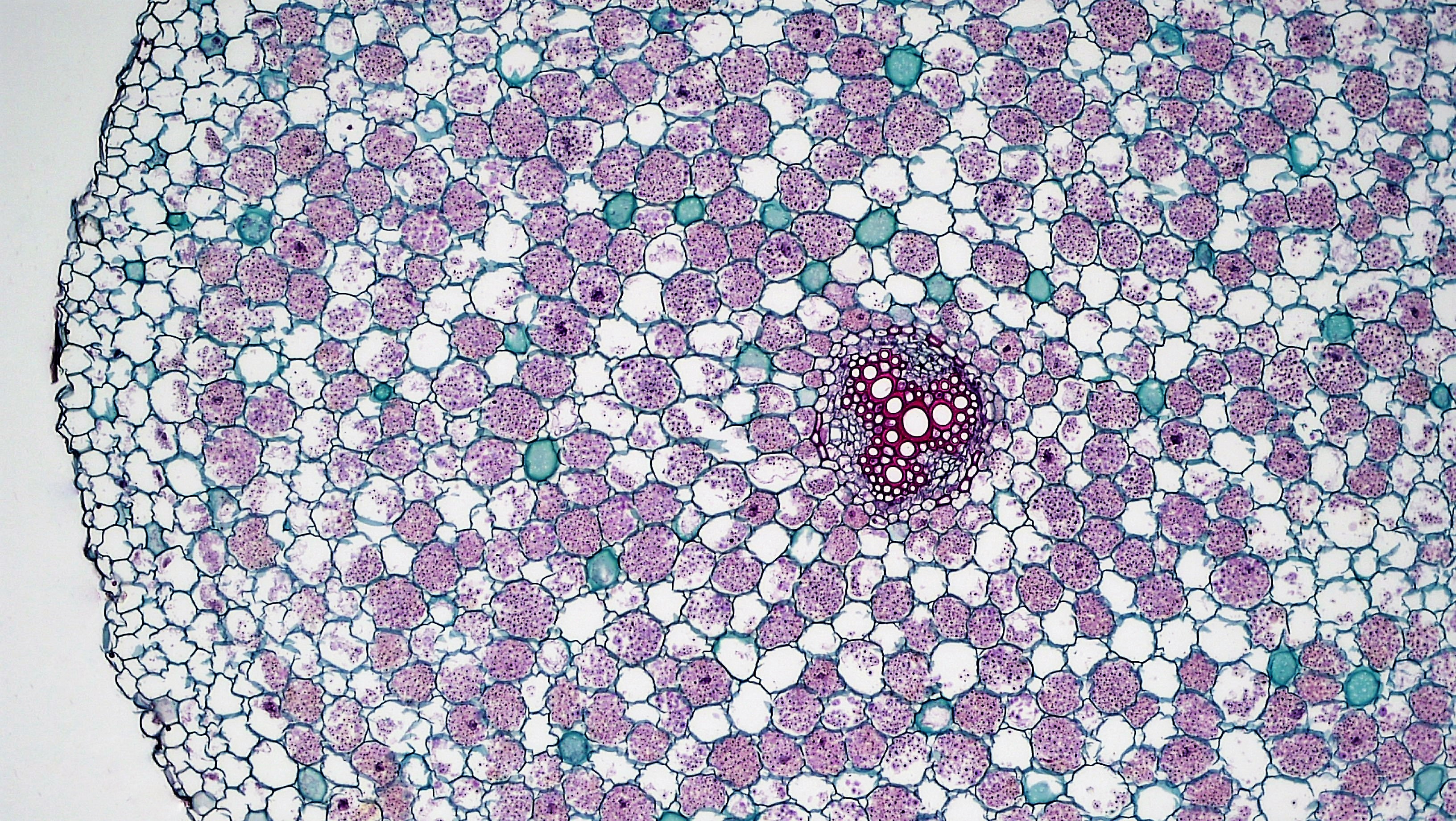
Enlarged view of the same central region
Practice question
Find the compact vascular region at the centre of the section. What arrangement can you recognise there, and how is it positioned relative to the surrounding tissue?
Photograph / micrograph recognition only. The full-frame centre is compact and the arms are easier to inspect in the enlargement below. No scale bar is shown (the source title gives 100×, not a specimen scale). This real specimen is a mature Ranunculus root; do not generalise its exact appearance to every root.
Photo: Herbaceous Dicot Root Mature Ranunculus (100x) · Berkshire Community College Bioscience Image LibrarySource page describes radial vascular bundles.Show labelled key: Answer key for root-micrograph
Mature Ranunculus root cross-section
Enlarged view of the same central region
Photo key
This is a mature Ranunculus (buttercup) root. The enlarged centre shows the vascular region: xylem forms central arms, with phloem between the arms. The photo is unlabelled; boundaries are not drawn on the specimen.
The full-frame centre is compact and the arms are easier to inspect in the enlargement below. No scale bar is shown (the source title gives 100×, not a specimen scale). This real specimen is a mature Ranunculus root; do not generalise its exact appearance to every root.
Photo: Herbaceous Dicot Root Mature Ranunculus (100x) · Berkshire Community College Bioscience Image LibrarySource page describes radial vascular bundles.Non-woody dicot stem section · Unlabelled practice · Schematic, simplified and not to scale. Show labelled key: Answer key for dicot-stem-section
Non-woody dicot stem section · Structure key · Schematic, simplified and not to scale. 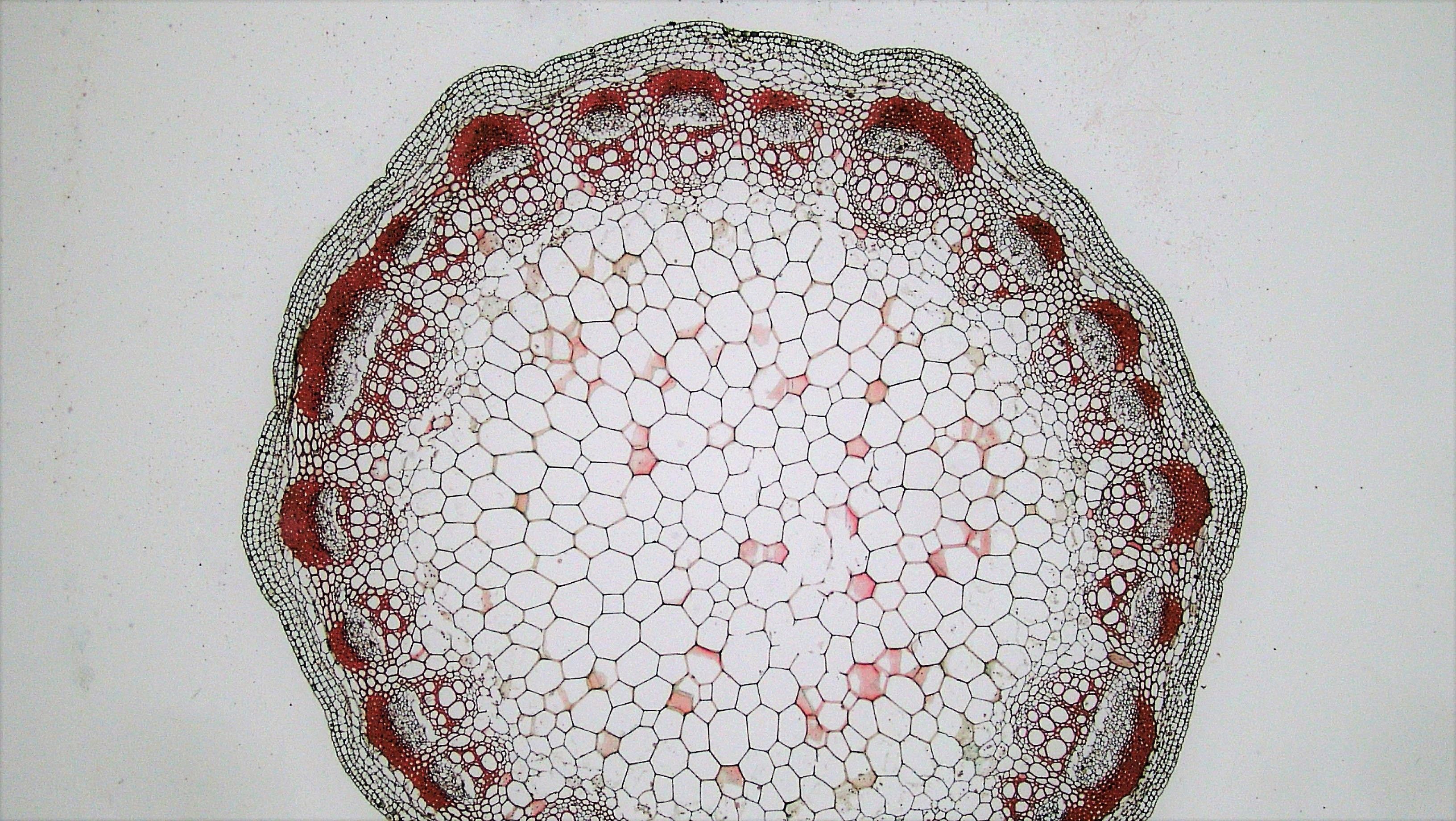
Practice question
Notice the repeated bundles around the outside of the section. What pattern do they make, and what occupies the broad middle?
Photograph / micrograph recognition only. The source identifies a young herbaceous dicot stem with primary vascular tissue. No scale bar is shown (the source title gives 40×, not a specimen scale). Individual xylem and phloem regions are not resolved well enough for a recognition label.
Photo: Herbaceous Dicot Stem Young Helianthus (40x) · Berkshire Community College Bioscience Image LibraryTransverse section of a young herbaceous dicot stem.Show labelled key: Answer key for stem-micrograph
Young Helianthus stem cross-section
Photo key
This is a young, herbaceous Helianthus (sunflower) dicot stem. Its vascular bundles form a ring near the outside, surrounding a large central pith. Individual xylem and phloem regions are too small to distinguish confidently in this unlabelled image; use a diagram for their relative positions within a bundle.
The source identifies a young herbaceous dicot stem with primary vascular tissue. No scale bar is shown (the source title gives 40×, not a specimen scale). Individual xylem and phloem regions are not resolved well enough for a recognition label.
Photo: Herbaceous Dicot Stem Young Helianthus (40x) · Berkshire Community College Bioscience Image LibraryTransverse section of a young herbaceous dicot stem.Use the practice and labelled views with the explanation. Photographs show only the structures identified in their visibility notes; constructed models are not micrographs. - Core
Scope: Core · AS Unit 2; printed p. 29 (o, p)
Open revision guidance
What to know
- Higher temperature can increase evaporation and diffusion; wind removes humid air near a leaf; higher humidity reduces the water-vapour gradient. Light often opens stomata, increasing loss. Severe water stress may close stomata, so a simple increase in temperature does not guarantee an unlimited rise in transpiration.
- A potometer measures water uptake, an approximation to transpiration rather than direct water loss. Cut and fit a leafy shoot under water, seal joints, introduce and track an air bubble in a calibrated capillary, and reset it between trials. Keep leaf area, other environmental factors and measurement time controlled; allow acclimatisation and repeat conditions.
- Constructed calculation: a capillary radius of 0.50 mm and bubble travel of 40 mm in 5 minutes gives uptake volume πr²l = π×0.50²×40 ≈ 31.4 mm³. Rate is 31.4÷5 = 6.28 mm³ min⁻¹. If comparing different shoots, divide by measured leaf area when appropriate. Leaks or air entering xylem invalidate the inference.
- Marram grass is a xerophyte: rolled leaves trap humid air, sunken stomata and hairs reduce air movement, and a thick cuticle reduces water loss. Water lily is a hydrophyte with large internal air spaces and stomata on the upper surface of floating leaves; gas exchange cannot occur efficiently through a submerged lower surface. Compare actual transverse sections and identify the features that are visible, not merely any trait associated with dry or wet habitats.
What to do in an assessment
- Change wind speed while holding light, humidity and temperature as constant as possible. Report water uptake as the measured variable, and explain why uptake is not exactly equal to transpiration in every short interval.
In plain language
Environmental gradients govern water loss. A potometer estimates uptake, while leaf anatomy shows adaptations to water availability.
Self-check
Why is an increased potometer bubble speed not, by itself, a precise direct measurement of transpiration?
Show the answer
It measures water uptake; some water may be retained or used by the plant, and leaks or changing internal water stores can affect the result.
- Core
Scope: Core · AS Unit 2; printed p. 29 (q, r)
Open revision guidance
What to know
- Phloem sieve-tube elements are living cells joined through perforated sieve plates; at maturity they have reduced organelles and no nucleus. Companion cells retain a nucleus and many mitochondria, supporting sieve-tube metabolism and loading. Plasmodesmata connect the cells. Identify sieve plates and companion-cell position using light and electron images where the scale permits.
- A source releases assimilates, for example a photosynthesising leaf; a sink uses or stores them, such as a growing root or fruit. Loading sucrose lowers sieve-tube water potential, water enters from xylem, and hydrostatic pressure rises. At sinks sucrose is removed, water potential rises and water can leave. The resulting pressure gradient drives mass flow. Different tubes can carry material towards different sinks; a source can become a sink at another stage.
- Diffusion alone is too slow to explain rapid long-distance transport. Historical cytoplasmic-strand models proposed active streaming through connected cytoplasm. Mass-flow models explain pressure-driven bulk transport, but evidence should be assessed rather than declaring every detail proven by one observation.
- Aphids insert mouthparts into phloem; cutting the body away can leave a stylet releasing sap, providing evidence for pressurised, sucrose-containing phloem. After a leaf receives labelled carbon dioxide, autoradiographs locate labelled assimilates in phloem and sinks. Such tracing identifies routes; it does not independently establish every proposed loading mechanism. Controlled comparisons and several evidence types strengthen the model.
What to do in an assessment
- Distinguish active loading, which needs metabolic energy, from bulk flow down a pressure gradient. Do not say that all translocation must be upwards because xylem flow is usually upwards.
In plain language
Phloem moves assimilates from sources to sinks. Structure and tracer evidence support a pressure-driven mass-flow explanation.
Self-check
Can a storage root be a sink in one season and a source in another?
Show the answer
Yes. It is a sink while assimilates accumulate and a source when stored reserves are mobilised to support new growth.
- Core
Scope: Core · AS Unit 2; printed p. 30 (a, b, c, d, e, f); printed p. 31 (g, h)
Open revision guidance
What to know
- Autotrophs produce organic molecules from inorganic carbon: photoautotrophs use light energy, while chemoautotrophs use energy from chemical reactions. Heterotrophs obtain organic substances from other organisms. Saprotrophic/saprobiotic fungi secrete enzymes onto material, digest externally and absorb soluble products. Parasites obtain nutrition at a host's expense. Holozoic nutrition involves ingestion and internal digestion.
- Amoeba engulfs particles into food vacuoles for intracellular digestion. Hydra has a sac-like gut with one opening for ingestion and egestion; larger animals can have a tube gut with separate openings and specialised regions. Regional specialisation provides suitable enzymes and conditions for different stages of digestion.
- Humans are omnivores with a gut processing plant and animal foods. Salivary amylase starts starch digestion near neutral pH. In the stomach, acid provides conditions for pepsin, an endopeptidase. Pancreatic secretion into the duodenum includes amylase, proteases and lipase, with bicarbonate helping neutralise acid. Bile is not an enzyme: bile salts emulsify lipid, increasing surface area for lipase.
- Maltase and other disaccharidases yield monosaccharides; endopeptidases break internal peptide bonds and exopeptidases remove terminal amino acids, with peptidases completing digestion. Lipase hydrolyses triglycerides into fatty acids and monoglycerides or glycerol, depending on the process described. The ileum has villi and microvilli providing large absorptive area, thin epithelium, blood capillaries and lacteals.
- Glucose uptake can involve sodium–glucose cotransport, supported by ATP-dependent sodium pumping; amino acids have carrier-mediated uptake. Products of lipid digestion enter epithelial cells, are reassembled and packaged for transport through lacteals. In duodenum and ileum sections, identify lumen, villi, epithelial lining and muscle layers; distinguish tissue outlines from individual microvilli that are too small for ordinary light-microscope resolution.
What to do in an assessment
- Link enzyme, substrate, products and conditions. A label 'bile digests fat' is inadequate: explain emulsification and the increased surface area available to lipase.
In plain language
Different nutritional strategies acquire organic material in different ways. A specialised gut digests and absorbs food under suitable regional conditions.
Self-check
Why does bile improve fat digestion without being a digestive enzyme?
Show the answer
Its salts emulsify fat into smaller droplets, increasing surface area for lipase; bile does not itself catalyse triglyceride hydrolysis.
View diagrams
Human digestive systemSimplified schematic; not to scale. - A
- B
- C
- D
- E
- F
- G
- H
- I
- J
- K
- L
- M
Show labelled key: Answer key for digestive-system
Human digestive systemSimplified schematic; not to scale. - AMouth
- BOesophagus
- CLiver
- DGall bladder
- EStomach
- FPancreas
- GDuodenum
- HIleum
- IColon
- JRectum
- KAnus
- LSalivary glands
- MBile duct
Digestive system: Blausen medical illustration
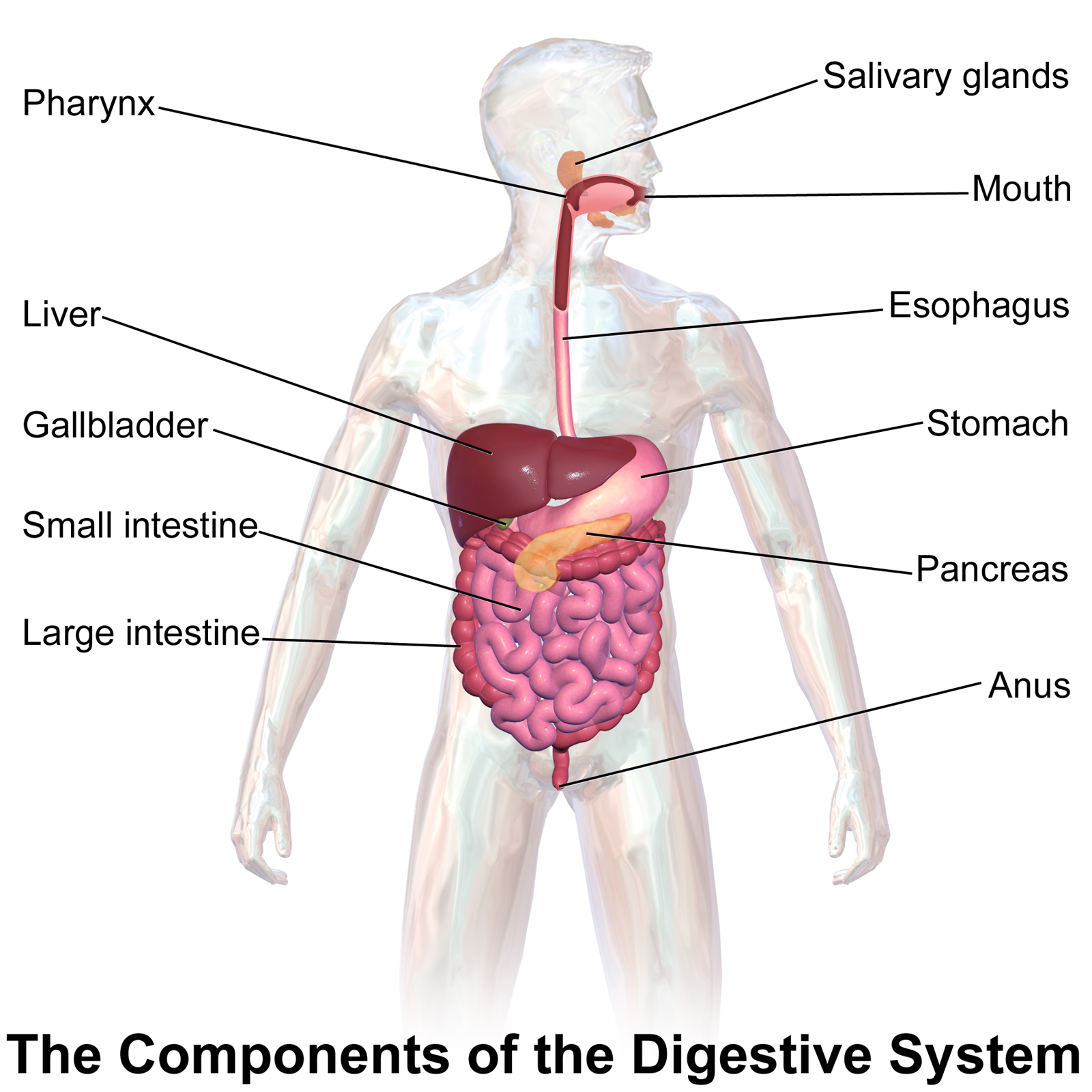
Practice question
Use the printed organ labels in this medical illustration to describe the route food follows from the mouth through the pharynx and oesophagus, stomach, small intestine and large intestine to the anus. Which organ makes bile and which stores it? This broad view does not individually label the duodenum, ileum, colon or rectum; compare it with the full digestive-system schematic for practice with those detailed labels.
Medical-illustration recognition only. Blausen medical illustration, not a photograph, patient image or clinical image. The printed labels are part of the source artwork and remain visible; this is not an unlabelled recall exercise. Duodenum, ileum, colon and rectum are not individually labelled in this illustration.
Illustration: Blausen 0316: Digestive System · BruceBlaus and Blausen.com staff (2014)3D medical illustration; original artwork includes printed organ labels.Show labelled key: Answer key for digestive-system-illustration
Digestive system: Blausen medical illustration
Illustration key
The labelled route is mouth → pharynx → oesophagus → stomach → small intestine → large intestine → anus (the rectum lies before the anus but is not individually labelled here). The liver makes bile; the gallbladder stores and concentrates it. Use the full digestive-system schematic to identify the duodenum and ileum within the small intestine and the colon and rectum within the large intestine.
Blausen medical illustration, not a photograph, patient image or clinical image. The printed labels are part of the source artwork and remain visible; this is not an unlabelled recall exercise. Duodenum, ileum, colon and rectum are not individually labelled in this illustration.
Illustration: Blausen 0316: Digestive System · BruceBlaus and Blausen.com staff (2014)3D medical illustration; original artwork includes printed organ labels.Animal tissues · observed micrographs
Compare the open spaces and curved supporting band; then inspect the thicker and thinner vessel walls, tall lining cells and repeated round profiles. Which tissue patterns can you recognise from visible organisation alone?
Specimen A
Compare the large dense region, layered membrane profiles and rounded bodies. Which structures can you identify in this thin section?
Louisa Howard; Dartmouth Electron Microscope FacilityWikimedia Commons source · Public domain (author released)Specimen B
Compare the many pale disc-shaped cells with the larger purple-stained cell near the centre. What red blood cell type and white blood cell are visible?
EchinaceapallidaWikimedia Commons source · CC BY-SA 4.0Specimen C
Inspect the prominent purple-stained white blood cell. What shape does its dark-stained nucleus have?
Original image: hematologist (Segmented_neutrophils.jpg); derivative work: patient-docWikimedia Commons source · CC BY-SA 3.0Specimen D
Compare the prominent cell with the surrounding red blood cells. What can you observe about its dark central region and the amount of cytoplasm around it?
El*FalafWikimedia Commons source · CC BY 4.0Specimen E
Look for the repeated air spaces and the larger airway profile within them. Which features suggest a gas-exchange region?
Yale Rosen; uploaded to Wikimedia Commons by CFCFWikimedia Commons source · CC BY-SA 2.0Specimen F
Trace the curved supporting wall and the inner lining. What combination of tissues helps identify this airway section?
MagscopeWikimedia Commons source · CC BY-SA 4.0Specimen G
Compare the two adjacent vessel profiles. Which wall is thicker and more circular, and which lumen appears less regularly open?
FishtailBobWikimedia Commons source · CC BY-SA 4.0Specimen H
Inspect the tall lining cells, their oval nuclei and one pale region in the lining. Which epithelial arrangement is represented?
Berkshire Community College Bioscience Image LibraryBerkshire CC0 image source · CC0Specimen I
Find the repeated round and oval profiles. Compare each lumen with the ring of lining cells around it.
Berkshire Community College Bioscience Image LibraryBerkshire CC0 image source · CC0Unmodified source photographs · only the trachea source image includes a 500 μm scale bar; the cell TEM has its own 500 nm bar · no other image has a scale bar or specimen scale.
These are genuine source photographs, not constructed drawings. They support visual recognition but do not certify supervised practical performance.
The gut lining photo is not assigned to the ileum or duodenum. In separate sections, duodenal Brunner’s glands occur in the submucosa, while distal-ileum Peyer’s patches are lymphoid aggregates; this anatomical comparison is not a feature established by the photo.
Show labelled key: Answer key for alevel-body-micrographs
Animal tissues · observed micrographs
Real source photographs show a lung field, tracheal wall, artery and vein cross-sections, mammalian gut lining, kidney tubules, blood cells and a thin-section bronchiolar cell TEM.
Specimen A · mammalian bronchiolar club-cell TEM
Compare the large dense region, layered membrane profiles and rounded bodies. Which structures can you identify in this thin section?
The source identifies part of the nucleus, rough endoplasmic reticulum, and mitochondria in the cytoplasm of a mammalian bronchiolar club (Clara) cell. A 500 nm scale bar is visible; the full cell boundary is outside this frame.
Limits: The source does not identify the mammal or establish donor health status. Only part of the cell is shown; the complete cell outline and surface membrane are not present.
Louisa Howard; Dartmouth Electron Microscope FacilityClara cell lung - TEM · Mammalian lung TEM collection. Source provenance: Dartmouth Electron Microscope Facility.Wikimedia Commons source · Public domain (author released)Specimen B · human blood smear
Compare the many pale disc-shaped cells with the larger purple-stained cell near the centre. What red blood cell type and white blood cell are visible?
The numerous pale cells are erythrocytes (red blood cells). The larger purple-stained cell is a neutrophil, identified by its segmented nucleus.
Limits: This small unlabelled field contains erythrocytes and a neutrophil, not a lymphocyte. No scale bar is shown.
EchinaceapallidaBlood-neutrophil1 · Wright-stained human peripheral blood smear.Wikimedia Commons source · CC BY-SA 4.0Specimen C · neutrophil in a blood smear
Inspect the prominent purple-stained white blood cell. What shape does its dark-stained nucleus have?
It is a neutrophil. The visible nucleus is segmented into several lobes; nearby erythrocytes provide context, not a scale reference.
Limits: Small, tightly framed micrograph; only part of the surrounding smear is visible. No scale bar or specimen scale is given.
Original image: hematologist (Segmented_neutrophils.jpg); derivative work: patient-docNeutrophil in a blood smear · Derivative image; source page credits the original image and derivative work.Wikimedia Commons source · CC BY-SA 3.0Specimen D · lymphocyte in a human blood smear
Compare the prominent cell with the surrounding red blood cells. What can you observe about its dark central region and the amount of cytoplasm around it?
The cell is a human lymphocyte. It has a prominent, rounded dark nucleus and a narrow rim of cytoplasm. The source does not identify the donor’s health status.
Limits: The image does not include a scale bar. No donor health status or diagnosis is provided by the source.
El*FalafLY 24909 · Stained light micrograph; no scale bar provided.Wikimedia Commons source · CC BY 4.0Specimen E · mammalian lung field
Look for the repeated air spaces and the larger airway profile within them. Which features suggest a gas-exchange region?
The source identifies alveoli surrounding a terminal bronchiole. The open alveolar spaces and thin intervening septa show the finely divided lung tissue around an airway.
Limits: The specimen species is not stated. This field does not support a diagnosis or a measured size; no scale bar is visible.
Yale Rosen; uploaded to Wikimedia Commons by CFCFNormal lung (3660695207) · Source description: normal alveoli surrounding a terminal bronchiole; 1012 × 679 px, no scale bar.Wikimedia Commons source · CC BY-SA 2.0Specimen F · mammalian trachea cross-section
Trace the curved supporting wall and the inner lining. What combination of tissues helps identify this airway section?
This is a low-magnification mammalian trachea section: the broad hyaline-cartilage ring, inner pseudostratified ciliated columnar lining and submucosal glands support recognition. The original source image includes its own 500 μm scale bar.
Limits: The source identifies mammal, but no species. This view shows a curved section of the wall rather than a complete ring. The 500 μm scale bar is part of the unchanged source image; no extra labels or scale have been added.
MagscopeTrachea (mammal) histology cross-section, low mag · Original PNG, 1680 × 1050 px; original 500 μm scale bar retained unchanged.Wikimedia Commons source · CC BY-SA 4.0Specimen G · artery and vein cross-sections
Compare the two adjacent vessel profiles. Which wall is thicker and more circular, and which lumen appears less regularly open?
The source identifies an artery and a vein in cross-section. The artery has the thicker muscular wall and a more circular outline; the thinner-walled vein has a less regular, partly collapsed-looking lumen in this field.
Limits: The source does not state species or anatomical site. This is a small field with no scale bar; compare wall patterns only, not vessel dimensions.
FishtailBobArteryVeinCS · Source title and description identify the paired artery/vein field; 640 × 480 px, no scale bar.Wikimedia Commons source · CC BY-SA 4.0Specimen H · mammalian gut lining
Inspect the tall lining cells, their oval nuclei and one pale region in the lining. Which epithelial arrangement is represented?
The Berkshire source identifies a mammalian gut simple-columnar epithelium field. Tall cells and a pale goblet-cell region are visible. The photo is not assigned to the ileum or duodenum, so those regions cannot be distinguished from this image.
Limits: No species or specific gut region is stated; no whole bowel wall or scale bar is shown. For separate sections, the duodenum may show Brunner’s glands in the submucosa, while distal ileum may show Peyer’s patches. That anatomical comparison is not a feature identified in this photo.
Berkshire Community College Bioscience Image LibrarySimple Columnar Epithelium: Cross Section (Mammalian Gut) · Source image 27854452128; 3264 × 1840 px, unmodified local copy, no scale bar.Berkshire CC0 image source · CC0Specimen I · mammalian kidney tubules
Find the repeated round and oval profiles. Compare each lumen with the ring of lining cells around it.
The source identifies mammalian kidney tubules. Their cuboidal epithelial cells surround visible lumens. This is a real kidney-tubule field, not a whole-kidney section.
Limits: Species is not stated. The photographed field does not show a whole nephron or a clearly resolved glomerulus; no scale bar is shown.
Berkshire Community College Bioscience Image LibrarySimple Cuboidal Epithelium: Cross Section (Mammalian Kidney Tubule) · Source image 39914418360; 3264 × 1840 px, unmodified local copy, no scale bar.Berkshire CC0 image source · CC0Unmodified source photographs · only the trachea source image includes a 500 μm scale bar; the cell TEM has its own 500 nm bar · no other image has a scale bar or specimen scale.
These are genuine source photographs, not constructed drawings. They support visual recognition but do not certify supervised practical performance.
The gut lining photo is not assigned to the ileum or duodenum. In separate sections, duodenal Brunner’s glands occur in the submucosa, while distal-ileum Peyer’s patches are lymphoid aggregates; this anatomical comparison is not a feature established by the photo.
Anatomical comparison (not inferred from the source photo): OpenStax · small and large intestines.
Use the practice and labelled views with the explanation. Photographs show only the structures identified in their visibility notes; constructed models are not micrographs. - Core
Scope: Core · AS Unit 2; printed p. 31 (i, j)
Open revision guidance
What to know
- Herbivores must process cellulose-rich material. Mammals do not make the necessary cellulase, so many depend on symbiotic microorganisms. Ruminants have a rumen supporting microbial fermentation and regurgitate cud for further chewing; microbes and partly digested food later pass through other stomach regions, including the acidic abomasum. A relatively long gut and, in some non-ruminants, enlarged hindgut fermentation regions provide time and space.
- Herbivore molars have broad grinding surfaces; incisors crop vegetation, often with a diastema between cropping and grinding teeth. Carnivores commonly have sharp canines for capture and carnassial teeth for shearing flesh, with a shorter gut relative to body size. Compare actual skulls or models by tooth shape, arrangement and likely function, not by a single absolute skull size.
- Taenia is an intestinal tapeworm: a scolex with attachment structures holds it in place, a large surface and specialised tegument allow absorption of digested nutrients, and many reproductive segments support transmission. It has no need for a human-like digestive tract. Pediculus is an external parasite with claws for attachment and piercing mouthparts for obtaining blood.
- When examining tapeworm specimens or slides, identify the scolex and repeated proglottids when visible. A section or isolated segment cannot demonstrate the entire worm's length. Both examples obtain nutrition at the host's expense, but their attachment site, feeding method and transmission differ.
What to do in an assessment
- Use the dentition model to compare cutting, tearing and grinding surfaces. Relate a ruminant's microorganisms and rumination to cellulose digestion, not merely 'herbivores have more stomachs'.
In plain language
Teeth, gut anatomy and symbionts suit diet. Parasites have specialised structures for attachment, feeding and reproduction.
Self-check
Why can a ruminant obtain nutrients from cellulose when its own cells do not produce cellulase?
Show the answer
Symbiotic microorganisms in the digestive system break down cellulose, and the animal can use fermentation products and nutrients released by digestion of the microbes.
View diagrams
Human dentitionSimplified schematic; not to scale. - A
- B
- C
- D
Show labelled key: Answer key for dentition
Human dentitionSimplified schematic; not to scale. - AIncisor
- BCanine
- CPremolar
- DMolar
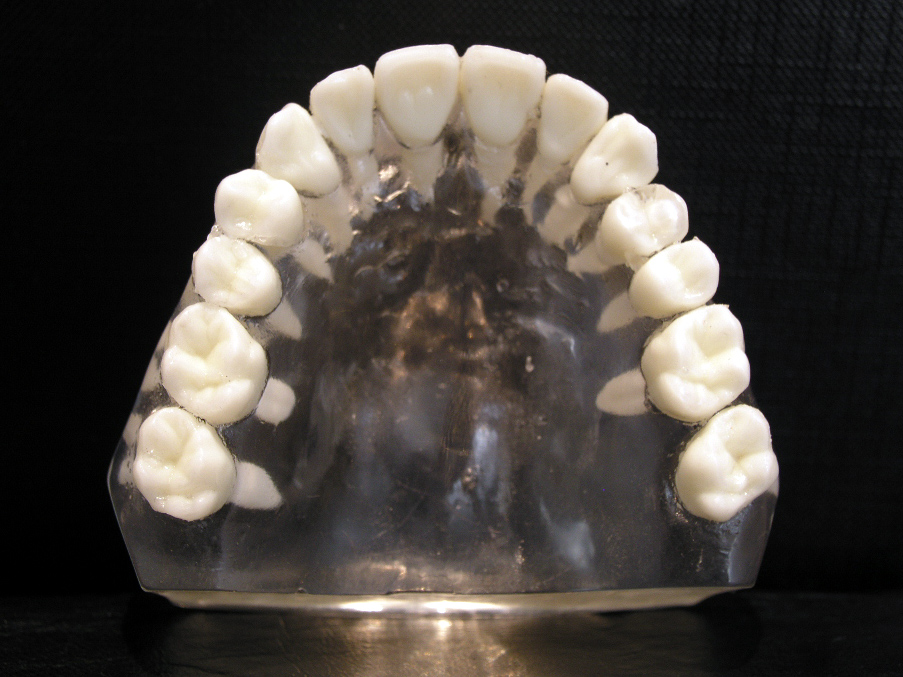
Companion photograph
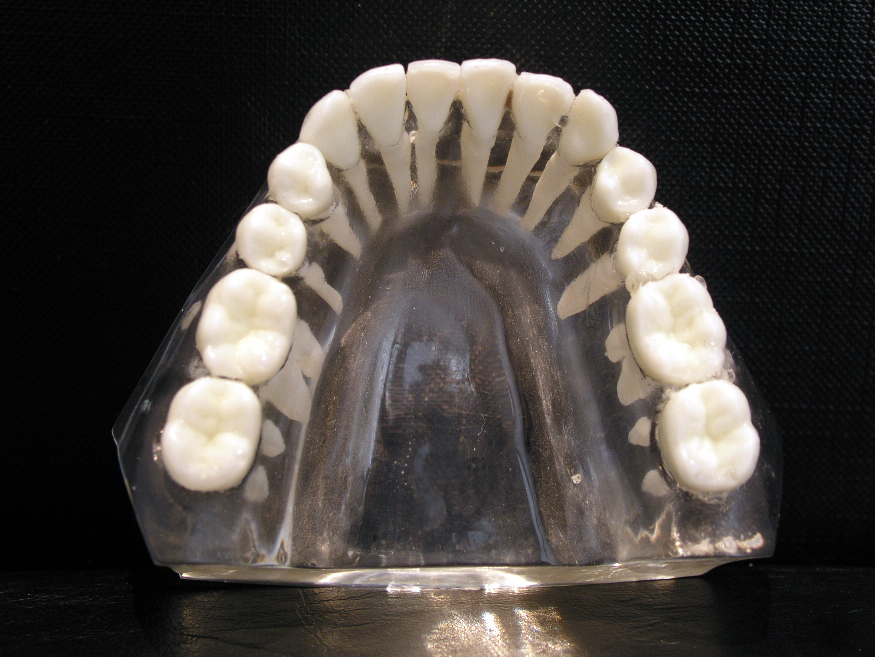
Practice question
Using the crown shapes and front-to-back positions in the upper and lower jaw models, identify the four tooth classes and describe their order around the arch.
Photograph / micrograph recognition only. These are physical models, not specimens or clinical images. Tooth-class recognition is based on visible crown form and position. No scale bar is shown.
Photo: Upper jaw · Håkan Svensson (Xauxa)Top/occlusal photograph of a physical upper-jaw teaching model.Photo: Lower jaw · Håkan Svensson (Xauxa)Top/occlusal photograph of a physical lower-jaw teaching model.Show labelled key: Answer key for dentition-model-photo
Upper and lower jaw occlusal teaching models
Lower jaw
Photo key
The front teeth are incisors; canines sit just behind them at the corners; premolars lie behind the canines; molars are farthest back. Both images are occlusal (top) views of physical teaching models, and the class names are not printed on the teeth.
These are physical models, not specimens or clinical images. Tooth-class recognition is based on visible crown form and position. No scale bar is shown.
Photo: Upper jaw · Håkan Svensson (Xauxa)Top/occlusal photograph of a physical upper-jaw teaching model.Photo: Lower jaw · Håkan Svensson (Xauxa)Top/occlusal photograph of a physical lower-jaw teaching model.Use the practice and labelled views with the explanation. Photographs show only the structures identified in their visibility notes; constructed models are not micrographs.
Topic group
A2 Unit 3: energy, environment and homeostasis
- Core
Scope: Core · A2 Unit 3; printed p. 33 (a, b, c, d)
Open revision guidance
What to know
- An electron transport chain contains carriers and associated proton-pumping machinery in a membrane. Energy released as electrons pass along the chain drives proton transfer, building an electrochemical gradient: a difference in both hydrogen-ion concentration and electrical charge. The membrane must restrict uncontrolled proton leakage.
- Protons flow back down their gradient through ATP synthase, called ATP synthetase in this specification. The enzyme couples this flow to ADP + inorganic phosphate → ATP. This is chemiosmosis. The gradient, not the electrons themselves passing through ATP synthase, drives ATP production.
- In mitochondria, protons are pumped from the matrix to the intermembrane space and return to the matrix. In chloroplasts, light-driven processes build a high proton concentration in the thylakoid lumen and protons return to the stroma. Both use membrane-separated proton gradients, although their electron sources and final electron acceptors differ. Individual carrier and pump names are not required here.
- Dehydrogenases transfer hydrogen/electrons from substrates. Artificial acceptors such as methylene blue or DCPIP change colour when reduced; tetrazolium compounds form coloured reduced products. In a teacher-directed investigation, keep substrate, enzyme preparation, indicator quantity, temperature and pH controlled, use repeats and an appropriate inactive-enzyme or no-substrate comparison. Keep conditions that affect reoxidation consistent: a colour change indicates redox activity under those conditions, not ATP production directly.
- Constructed methylene-blue endpoint times of 80 s and 40 s give relative rates 0.0125 s⁻¹ and 0.0250 s⁻¹ for the same endpoint. Compare inverse time only when the quantity of dye and other starting conditions match. Follow the centre's chemical and biological-material risk assessment.
What to do in an assessment
- Explain the sequence electron energy → proton pumping → electrochemical gradient → proton flow through ATP synthase → ATP. A membrane uncoupler can allow electron transport while reducing ATP formation by dissipating the gradient.
In plain language
Energy from electrons establishes a proton gradient. Controlled return through ATP synthase provides the immediate mechanism for ATP formation.
Self-check
Why does making the mitochondrial inner membrane freely permeable to protons reduce ATP synthesis?
Show the answer
Protons bypass ATP synthase, dissipating the electrochemical gradient that normally drives phosphorylation of ADP.
- Core
Scope: Core · A2 Unit 3; printed p. 34 (a, b); printed p. 35 (c, d, e, f, g)
Open revision guidance
What to know
- Chloroplasts are especially abundant in light-exposed photosynthetic cells such as palisade mesophyll. Thylakoid membranes contain pigments and photosystems; grana provide extensive membrane area. Pigments absorb different wavelengths, extending the range of light harvested. Chlorophyll absorbs strongly in blue and red regions and less in green; an absorption spectrum is not identical to an action spectrum measuring photosynthetic rate.
- Accessory pigments transfer excitation energy towards reaction-centre chlorophyll. Absorbed photons raise electrons to higher energy levels. In non-cyclic electron flow, Photosystem II supplies electrons to carriers linking it to Photosystem I; energy transfer contributes to proton pumping. Further excitation at Photosystem I enables reduction of NADP.
- Photolysis splits water, providing replacement electrons for Photosystem II and hydrogen ions, and releasing oxygen. Reduced NADP forms by accepting electrons and hydrogen ions on the stromal side; this helps maintain the proton difference across the thylakoid membrane. Protons return from lumen to stroma through ATP synthase, producing ATP by photophosphorylation.
- Cyclic flow uses Photosystem I: excited electrons return through carriers instead of reducing NADP. It can produce additional ATP without producing reduced NADP or oxygen from that cyclic route. Non-cyclic flow provides ATP, reduced NADP and oxygen. Chloroplasts therefore act as transducers, converting light energy into chemical forms useful for carbon fixation.
What to do in an assessment
- Keep the electron route distinct from the proton route. Water supplies electrons for Photosystem II; NADP accepts electrons near the end of non-cyclic flow. ATP synthase uses the proton gradient rather than receiving light directly.
In plain language
Photosystems convert photon energy into electron energy. Electron flow supports ATP production and reducing power for carbon fixation.
Self-check
Which products distinguish non-cyclic flow from cyclic flow through Photosystem I?
Show the answer
Non-cyclic flow produces reduced NADP and oxygen as well as ATP; cyclic flow produces ATP without those additional products.
View diagrams
Practice question
In this TEM detail, identify the organelle outline and the repeated internal membrane stacks. What scale is shown?
Photograph / micrograph recognition only. The source names Anemone only as sp.; no exact species is identified. This image does not show a whole cell, cell wall, nucleus, or broad cytoplasm. Individual membrane bilayers are not resolved.
Photo: Chloroplast in leaf of Anemone sp TEM 12000x · And3k and Caper437TEM source page gives 12,000× magnification and a 1 µm scale bar.Show labelled key: Answer key for plant-chloroplast-tem
Chloroplast TEM
Photo key
This is a chloroplast from an Anemone sp. leaf cell. The organelle outline and internal membrane stacks are visible; the scale bar is 1 µm. The image shows an organelle detail, not a whole cell.
The source names Anemone only as sp.; no exact species is identified. This image does not show a whole cell, cell wall, nucleus, or broad cytoplasm. Individual membrane bilayers are not resolved.
Photo: Chloroplast in leaf of Anemone sp TEM 12000x · And3k and Caper437TEM source page gives 12,000× magnification and a 1 µm scale bar.Use the practice and labelled views with the explanation. Photographs show only the structures identified in their visibility notes; constructed models are not micrographs. - Core
Scope: Core · A2 Unit 3; printed p. 35 (h, i, j, k, l)
Open revision guidance
What to know
- In the stroma, Rubisco catalyses the combination of carbon dioxide with five-carbon ribulose bisphosphate (RuBP). The unstable six-carbon product yields two three-carbon glycerate-3-phosphate (GP) molecules. ATP supplies energy and reduced NADP supplies reducing power for conversion of GP to triose phosphate (TP).
- Most TP is used to regenerate RuBP, requiring ATP; some provides carbon for products. For three CO₂ molecules fixed, three RuBP molecules yield six GP and then six TP. Five TP provide the 15 carbons needed to regenerate three RuBP; one net TP provides three carbons for synthesis. Fixing six CO₂ gives sufficient net carbon for a hexose, though glucose is not the first direct product.
- TP can supply carbohydrate, lipid and amino-acid synthesis. Nitrogen is needed for amino acids, nucleotides and other nitrogen-containing compounds; magnesium is part of chlorophyll. Nitrogen deficiency can reduce growth and protein production; magnesium deficiency can cause chlorosis and limit light absorption. Mineral supply must be interpreted alongside other limiting factors.
- A limiting factor is the condition restricting rate at that moment. At low light, adding CO₂ may have little effect; when light is sufficient, CO₂ or temperature may limit enzyme-controlled steps. Increasing one factor produces a plateau if another becomes limiting. Light-independent does not mean the Calvin cycle can run indefinitely without products of the light reactions.
What to do in an assessment
- Use carbon counting to check a cycle diagram. If light suddenly falls, reduced NADP and ATP supply can fall; GP conversion and RuBP regeneration are then affected, not merely the amount of oxygen released.
In plain language
Carbon fixation builds TP using ATP and reduced NADP. Regenerating RuBP keeps the cycle running, while a smaller net output supplies biomolecules.
Self-check
Why are five of six TP molecules required for RuBP regeneration after fixation of three CO₂?
Show the answer
Five three-carbon TP molecules contain 15 carbons, enough to regenerate three five-carbon RuBP molecules; one TP is the net three-carbon output.
- Core
Scope: Core · A2 Unit 3; specified practical work
Open revision guidance
What to know
- For chromatography, extract pigments using a teacher-approved solvent, place a small concentrated spot above the solvent level, and let the solvent rise through paper or a thin-layer plate. Pigments separate because their solubility in the moving phase and affinity for the stationary phase differ. Mark the solvent front promptly. Solvents may be flammable or harmful: follow ventilation, eye-protection and no-flame instructions.
- Rf = distance travelled by pigment from origin ÷ distance travelled by solvent front from origin. Constructed distances 36 mm and 60 mm give Rf = 0.60, with no unit. Compare reference values only under comparable solvent and stationary-phase conditions; a coloured band alone does not establish chemical identity.
- For rate, use a suitable aquatic plant and measure oxygen volume or a calibrated oxygen-probe response while varying light, CO₂ supply or temperature one at a time. Keep plant amount, other factors and measurement time controlled, allow acclimatisation and repeat. A heat filter or controlled bath reduces the temperature change caused by moving a lamp. Bubble counts are an approximation because bubble volume can vary.
- Constructed oxygen volumes of 1.2, 1.4 and 1.3 cm³ in 5 minutes give mean volume 1.3 cm³ and rate 0.26 cm³ min⁻¹. A light-response plateau suggests another limiting factor, not proof that the plant has stopped all respiration. Net oxygen output combines photosynthetic production and respiratory consumption; at the compensation point these balance.
- To investigate nitrogen and magnesium, grow comparable seedlings in complete nutrient solution, nitrogen-deficient solution and magnesium-deficient solution, with suitable repeats. Keep light, temperature, pH, volume and other minerals comparable; use formulations that do not accidentally omit several nutrients. Measure growth and record chlorosis over time. Initial stored nutrients can delay deficiency signs. Treat organisms ethically and retain a clear lab-book record.
What to do in an assessment
- Distinguish an absorption spectrum, chromatographic separation and a photosynthetic-rate experiment: each measures a different property. Use a complete nutrient solution as the control for mineral-omission treatments.
In plain language
Controlled investigations connect pigment chemistry, limiting factors and mineral supply with photosynthetic function.
Self-check
A pigment moves 24 mm while the solvent front moves 80 mm. What is its Rf, and can it have a value greater than 1 in a valid run?
Show the answer
Rf = 24÷80 = 0.30. It should not exceed 1 because a band cannot legitimately travel beyond the marked solvent front in that run.
- Core
Scope: Core · A2 Unit 3; printed p. 36 (a, b, c, d); printed p. 37 (e, f)
Open revision guidance
What to know
- All living cells require energy for processes such as synthesis, active transport and movement. Glycolysis in the cytoplasm phosphorylates glucose, splits the six-carbon compound into triose phosphates and oxidises them to pyruvate. For each glucose, two ATP are invested and four produced, giving two net ATP, two reduced NAD and two pyruvate. Specific intermediate names beyond those required by the specification need not be memorised.
- In aerobic respiration, pyruvate enters the mitochondrial matrix and undergoes the link reaction: carbon dioxide is released, NAD is reduced and a two-carbon acetyl group joins coenzyme A. Acetyl-CoA enters the Krebs cycle; oxidation releases further CO₂ and produces reduced NAD, reduced FAD and a small amount of ATP by substrate-level phosphorylation.
- Reduced NAD and FAD supply electrons and hydrogen to the electron transport system. Oxygen is the final electron acceptor and combines with electrons and protons to form water. Electron transfer drives the proton gradient for oxidative phosphorylation. The link reaction and Krebs cycle do not directly produce the entire ATP yield.
- Per glucose, glycolysis, link reactions and Krebs cycles together provide ten reduced NAD, two reduced FAD and four substrate-level ATP. The overall aerobic ATP budget depends on the conversion factors and assumptions supplied: using 2.5 ATP per reduced NAD and 1.5 per reduced FAD gives 25+3+4 = 32 before any stated shuttle or transport adjustment. Do not impose one universal yield on every exam question.
- Without continued oxidative phosphorylation, regeneration of NAD allows glycolysis to continue. Pyruvate is reduced to lactate in animal cells; in yeast it gives ethanol and CO₂. Fermentation gives only the two net ATP from glycolysis per glucose and leaves much chemical energy in its products. Glycerol can enter glycolytic pathways; fatty acids yield acetyl groups and reduced carriers; amino acids can be respired after deamination, with nitrogen handled as waste.
- For a yeast investigation, measure CO₂ volume over a fixed time while varying temperature or substrate concentration, keeping yeast amount, pH, oxygen conditions and other factors controlled. Use repeats and blanks without active yeast where suitable. CO₂ alone does not distinguish aerobic respiration from fermentation. Keep vessels safely vented to the collection apparatus and avoid dangerous pressure buildup.
What to do in an assessment
- A constructed anaerobic yeast trial produces 12 cm³ CO₂ in 4 minutes, giving 3.0 cm³ min⁻¹. State gas volume as the measured rate indicator rather than claiming it directly measures ATP molecules.
In plain language
Glycolysis supplies a small ATP yield; aerobic oxidation supplies reduced carriers for much greater ATP production. Anaerobic pathways regenerate NAD but give a much smaller energy return.
Self-check
If an exam model supplies 3 ATP per reduced NAD and 2 per reduced FAD, what unadjusted ATP total follows from ten reduced NAD, two reduced FAD and four substrate-level ATP?
Show the answer
10×3 + 2×2 + 4 = 38 ATP. Apply any transport or shuttle deduction stated in that question rather than treating 38 as universal.
- Core
Scope: Core · A2 Unit 3; printed p. 38 (a, b, c, d)
Open revision guidance
What to know
- Bacterial shapes include spherical cocci, rod-shaped bacilli and spiral forms. Gram-positive walls have a thick peptidoglycan layer that retains the crystal-violet–iodine complex after decolourisation; Gram-negative bacteria have thinner peptidoglycan and an outer membrane, losing the purple stain and taking up the counterstain to appear pink or red.
- A teacher-supervised Gram preparation uses a suitable smear, fixation as directed, primary stain, iodine, controlled decolourisation and counterstaining. Examine with the specified microscope setup. Over-decolourisation, an old culture or a thick smear can distort results; the stain is not an identification of a species by itself.
- Cultures require nutrients, water and suitable temperature, pH and oxygen conditions. Agar supports colonies on a solid surface; broth permits growth in liquid. Aseptic technique reduces contamination and exposure: disinfect surfaces, use sterile equipment, open containers only briefly, and follow the centre's approved inoculation, incubation and disposal procedure. Do not culture unknown samples at home, open incubated plates or invent an incubation temperature without the safety instructions.
- For fresh and stale milk, use serial dilutions and plate a measured volume of selected dilutions under the approved school protocol. A viable count estimates colony-forming units, not every individual bacterial cell: a clump can form one colony and some viable organisms may not grow in those conditions.
- Constructed count: 64 colonies from 0.10 cm³ of a 10⁻⁴ dilution gives 64÷(0.10×10⁻⁴) = 6.4×10⁶ CFU cm⁻³ in the original sample. Select countable plates using the protocol, use repeats, and include a sterile-medium control. Crowded or contaminated plates do not give reliable counts.
What to do in an assessment
- Record dilution, plated volume and units with the colony count. A larger count on stale milk supports greater culturable abundance under those test conditions, not identification of a pathogen or proof that the sample is safe to drink.
In plain language
Cell-wall structure explains the Gram stain. Safe culture methods and dilution calculations allow a defensible estimate of viable abundance.
Self-check
A 1.0 cm³ sample of a 10⁻³ dilution produces 45 colonies. What is the estimated original concentration?
Show the answer
45÷(1.0×10⁻³) = 4.5×10⁴ CFU cm⁻³, assuming a valid, representative, countable plate.
- Core
Scope: Core · A2 Unit 3; printed p. 39 (a, b); printed p. 40 (c, d, e, f, g)
Open revision guidance
What to know
- Population change over an interval is births + immigration − deaths − emigration. Constructed example: 120 individuals with 24 births, 8 immigrants, 15 deaths and 3 emigrants become 134. State the time interval before describing a rate. Population growth can be exponential when resources are abundant, but limiting resources and competition constrain it near carrying capacity.
- Density-dependent factors become more influential as density rises, including competition, disease transmission and some predation. Density-independent factors, such as an extreme frost or fire, can affect populations regardless of density. Carrying capacity can change with habitat and resource supply; a population does not inevitably sit at one permanent value.
- A habitat is where an organism lives; a community consists of interacting populations; an ecosystem includes the community and its abiotic environment. Ecosystems can be a pond, a small decaying log or a vast forest. Sunlight supplies energy to most ecosystems through photosynthetic producers; energy flow must not be confused with nutrient recycling.
- Use random quadrats to estimate abundance of suitable stationary species and a transect to investigate distribution along an environmental gradient. A belt transect samples an area along the line. Constructed mean count of 6 plants per 0.25 m² gives density 24 m⁻² and an estimate of 2400 plants across 100 m², provided the sampled area represents the whole habitat.
- For mobile organisms, mark–release–recapture can use N ≈ first marked × second sample ÷ marked recaptured, subject to assumptions: marks persist and do not affect survival, mixing occurs, and births, deaths and migration are negligible between samples. Ethical handling and suitable permission are essential. Record locations, environmental measurements, repeats and uncertainty, and avoid damaging habitats.
What to do in an assessment
- Constructed recapture: 30 marked initially, 40 in the second sample, 10 marked recaptured gives N ≈ 120. Explain how emigration or a harmful mark could bias that estimate rather than calling it an exact census.
In plain language
Population size reflects gains and losses under environmental constraints. Choose field methods to match organisms and the question.
Self-check
What happens to the simple recapture estimate if marked individuals become unusually difficult to recapture?
Show the answer
The recaptured-marked number falls, making the calculated population estimate too large, so the assumption of equal capture likelihood is violated.
- Core
Scope: Core · A2 Unit 3; printed p. 40 (h, i, j)
Open revision guidance
What to know
- Producers form the first trophic level; primary consumers feed on them, followed by further consumers. Gross primary production is the total rate of biomass or chemical-energy accumulation through photosynthesis before respiratory loss; net primary production is gross production minus producers' respiration. Only part is available to the next trophic level because material is uneaten, indigestible, excreted or used in respiration.
- Constructed energy budget: gross production 20,000 kJ m⁻² year⁻¹ minus respiratory loss 8000 gives net production 12,000. If herbivore production is 1200 in the same units, transfer efficiency relative to net producer output is 1200÷12,000×100 = 10%. State the denominator. Energy is dissipated as heat rather than recycled like carbon atoms.
- A biomass pyramid compares standing biomass at trophic levels, using comparable area and usually dry mass. It is a snapshot, not necessarily annual production; some rapidly reproducing aquatic producers can support a larger consumer standing biomass. Do not confuse a pyramid of numbers with one of biomass.
- Primary succession begins where there is no developed soil, such as bare rock. Pioneer organisms tolerate harsh conditions; their weathering and organic remains help soil form. Later plants alter light, water and organic matter, allowing different communities; a sequence of stages is a sere. Secondary succession starts where soil remains after disturbance and can proceed more quickly.
- A climax community is a relatively stable later community under prevailing conditions, but disturbance, climate and management can prevent a single permanent endpoint. In a bare-rock-to-woodland example, later woody plants may shade out some early colonists: succession is a change in conditions and competition, not every species simply accumulating.
What to do in an assessment
- Identify whether a dataset is biomass stock or a production rate before calculating transfer. Include units and explain ecological losses instead of assuming a fixed 10% for all chains.
In plain language
Only a fraction of production reaches the next trophic level. Communities change as organisms alter the conditions for later colonists.
Self-check
Why is regrowth after a forest fire often secondary rather than primary succession?
Show the answer
Soil and sometimes seeds, roots or organic matter remain, so colonisation does not begin on a surface lacking developed soil.
- Core
Scope: Core · A2 Unit 3; printed p. 40 (k, l, m, n, o, p)
Open revision guidance
What to know
- Decomposers break down organic material and recycle nutrients. Photosynthesis incorporates carbon dioxide into organic molecules; feeding transfers carbon; respiration returns CO₂. Decomposition also releases carbon, and some is stored for long periods in sediments or fossil fuels. Combustion and deforestation can increase atmospheric CO₂, while reduced photosynthetic uptake also alters the balance.
- Climate change can shift ranges, seasonal timing and suitable habitats, potentially causing extinction when movement or adaptation is insufficient. A species' observed distribution also depends on competition, food, dispersal and human land use, so a correlation with temperature alone does not prove the entire causal explanation.
- Nitrogen-fixing bacteria convert atmospheric nitrogen into biologically usable compounds. Decomposers and ammonifying organisms release ammonium from organic nitrogen. Aerobic nitrifying bacteria oxidise ammonium to nitrite and then nitrate. Plants absorb nitrate and use nitrogen to make amino acids and nucleotides; animals obtain nitrogen by feeding. Denitrifying bacteria can return nitrogen to the atmosphere under low-oxygen conditions.
- Ploughing and drainage can increase soil aeration and favour nitrification. Fertilisers can raise crop yield where nitrogen is limiting but excessive application wastes resources and risks runoff. Drainage can destroy wetland habitats and alter their carbon and water storage even when it improves agricultural aeration.
- In eutrophication, added nutrients stimulate algal growth; shading can reduce other aquatic plants, and decomposition of dead material increases microbial respiration and oxygen demand. Low dissolved oxygen can kill aerobic organisms. An algal bloom is not proof that every species died from an algal toxin: oxygen depletion and toxicity are distinct possible mechanisms.
What to do in an assessment
- Explain the sequence nutrient input → greater growth → increased dead organic material → microbial decomposition and respiration → reduced oxygen. Identify which steps need evidence in a supplied case.
In plain language
Atoms cycle through living and non-living stores. Human activity changes these cycles and can create environmental trade-offs.
Self-check
Why can heavy nutrient runoff eventually lower oxygen in a lake even though algae photosynthesise?
Show the answer
Increased biomass and its decomposition raise microbial respiration and oxygen demand; especially when photosynthesis is low, demand can exceed replenishment.
- Core
Scope: Core · A2 Unit 3; printed p. 41 (a, b, c, d, e, f)
Open revision guidance
What to know
- Species become endangered through habitat loss, overexploitation, pollution, introduced species, disease and environmental change. Small isolated populations can lose genetic diversity through drift and inbreeding, reducing resilience. Extinction removes a lineage and its gene pool; conserving headcount alone is not always enough.
- In-situ conservation protects organisms and ecological interactions in natural habitats, for example reserves and habitat corridors. Ex-situ conservation uses measures such as captive breeding, seed banks and managed collections. Breeding plans can limit inbreeding and preserve alleles, but captivity can select different traits and reintroduction needs suitable habitat and disease control.
- Deforestation can produce timber, farmland and income while destroying habitats and altering carbon storage. Overfishing can reduce breeding populations and disrupt food webs. Sustainable forestry, protected areas, catch limits, selective fishing methods and habitat restoration can reduce harm, but each must be evaluated against enforcement, livelihoods, food production and ecological evidence.
- Sustainability aims to meet needs without undermining future environmental capacity. Informed choices require reliable data, uncertainties and attention to competing values. Political decisions should use scientific evidence but also weigh social and economic consequences; science does not alone determine every ethical priority.
- Planetary boundaries describe proposed limits on major Earth-system processes within which humanity has a safer operating space, including climate, biosphere integrity and nutrient cycles. Crossing a boundary can increase risk of disruptive change; it is not a precise countdown to inevitable immediate catastrophe. Boundaries and their estimates are revised as evidence improves.
What to do in an assessment
- For a conservation proposal, give a biological benefit, a practical limitation and a supported judgement. Compare evidence quality, uncertainty and effects on local people rather than merely writing 'conservation is good'.
In plain language
Conservation protects populations, genetic diversity and ecosystems. Sustainable decisions need evidence and explicit consideration of trade-offs.
Self-check
Why might releasing many closely related captive-bred animals fail to restore a resilient wild population?
Show the answer
Their genetic diversity may be low and inbreeding risk high; unsuitable habitat, disease or poor survival after release can also prevent a lasting recovery.
- Core
Scope: Core · A2 Unit 3; printed p. 42 (a, b, c, d, e)
Open revision guidance
What to know
- Homeostasis maintains internal conditions within suitable limits despite continual change: a dynamic equilibrium, not complete constancy. Negative feedback detects a deviation and produces a response opposing it. Positive feedback amplifies a stimulus, as in contractions during birth, and needs an ending event rather than restoring a set point by itself.
- A kidney has cortex, medulla and pelvis; urine flows to the ureter. A nephron comprises a glomerulus in Bowman's capsule, proximal tubule, loop of Henle, distal tubule and connection to a collecting duct. Blood arrives via an afferent arteriole and leaves via an efferent arteriole; associated capillaries support exchanges. Distinguish tubule lumens from blood-vessel lumens in sections.
- Ultrafiltration occurs under glomerular pressure across the capillary endothelium, basement membrane and podocyte filtration slits. Water and small solutes enter the capsule, while cells and most large plasma proteins remain in blood. Selective reabsorption then returns useful substances to blood; filtration itself does not identify glucose as useful and urea as unwanted.
- Proximal-tubule cells have microvilli increasing surface area, many mitochondria supplying ATP for transport, and membrane proteins for selective movement. Sodium gradients support uptake of glucose and amino acids; water follows water-potential differences. In a healthy person nearly all filtered glucose is reabsorbed under normal conditions, while large protein loss in urine is not a normal consequence of filtering blood.
- In a teacher-supervised kidney dissection, identify capsule, cortex, medulla, pelvis and ureter, and relate gross appearance to a nephron diagram. On microscope or electron images identify glomeruli, capsules and tubules using scale and visible structure. Handle sharp instruments and ethically sourced tissue safely; a gross dissection cannot show the ultrastructure of every filtration layer.
What to do in an assessment
- Follow a small glucose molecule blood → filtrate → proximal-tubule cell → blood. Explain active transport and surface-area adaptations at reabsorption, not at every step of ultrafiltration.
In plain language
Kidneys combine pressure filtration with selective recovery and water regulation. Nephron structures suit these different processes.
Self-check
Why do proximal-tubule cells have both numerous mitochondria and a brush border?
Show the answer
Mitochondria provide ATP supporting active transport, and microvilli increase membrane surface area for reabsorption.
View diagrams
Section through a kidneySimplified schematic; not to scale. - A
- B
- C
- D
- E
- F
Show labelled key: Answer key for kidney-section
Section through a kidneySimplified schematic; not to scale. - ARenal cortex
- BRenal medulla
- CRenal pelvis
- DUreter
- ERenal artery
- FRenal vein
Human urinary systemSimplified schematic; not to scale. Blood flow: heart → aorta → renal arteries → kidneys → renal veins → vena cava → heart. - A
- B
- C
- D
- E
- F
- G
- H
- I
Show labelled key: Answer key for urinary-system
Human urinary systemSimplified schematic; not to scale. Blood flow: heart → aorta → renal arteries → kidneys → renal veins → vena cava → heart. - AKidney
- BUreter
- CUrinary bladder
- DUrethra
- EKidney
- FAorta
- GVena cava
- HRenal arteries
- IRenal veins
Nephron and its blood supplyQualitative schematic, not to scale. Water and small solutes are filtered into the capsule; blood cells and large proteins remain in blood. Glucose, needed solutes and much water are selectively reabsorbed into the peritubular capillaries. Show labelled key: Answer key for nephron-blood-supply
Nephron and its blood supplyQualitative schematic, not to scale. Water and small solutes are filtered into the capsule; blood cells and large proteins remain in blood. Glucose, needed solutes and much water are selectively reabsorbed into the peritubular capillaries. - AGlomerulus
- BBowman's capsule
- CTubule
- DCollecting duct
- EPeritubular capillary network
- FAfferent arteriole (into glomerulus)
- GEfferent arteriole (out of glomerulus)
Animal tissues · observed micrographs
Compare the open spaces and curved supporting band; then inspect the thicker and thinner vessel walls, tall lining cells and repeated round profiles. Which tissue patterns can you recognise from visible organisation alone?
Specimen A
Compare the large dense region, layered membrane profiles and rounded bodies. Which structures can you identify in this thin section?
Louisa Howard; Dartmouth Electron Microscope FacilityWikimedia Commons source · Public domain (author released)Specimen B
Compare the many pale disc-shaped cells with the larger purple-stained cell near the centre. What red blood cell type and white blood cell are visible?
EchinaceapallidaWikimedia Commons source · CC BY-SA 4.0Specimen C
Inspect the prominent purple-stained white blood cell. What shape does its dark-stained nucleus have?
Original image: hematologist (Segmented_neutrophils.jpg); derivative work: patient-docWikimedia Commons source · CC BY-SA 3.0Specimen D
Compare the prominent cell with the surrounding red blood cells. What can you observe about its dark central region and the amount of cytoplasm around it?
El*FalafWikimedia Commons source · CC BY 4.0Specimen E
Look for the repeated air spaces and the larger airway profile within them. Which features suggest a gas-exchange region?
Yale Rosen; uploaded to Wikimedia Commons by CFCFWikimedia Commons source · CC BY-SA 2.0Specimen F
Trace the curved supporting wall and the inner lining. What combination of tissues helps identify this airway section?
MagscopeWikimedia Commons source · CC BY-SA 4.0Specimen G
Compare the two adjacent vessel profiles. Which wall is thicker and more circular, and which lumen appears less regularly open?
FishtailBobWikimedia Commons source · CC BY-SA 4.0Specimen H
Inspect the tall lining cells, their oval nuclei and one pale region in the lining. Which epithelial arrangement is represented?
Berkshire Community College Bioscience Image LibraryBerkshire CC0 image source · CC0Specimen I
Find the repeated round and oval profiles. Compare each lumen with the ring of lining cells around it.
Berkshire Community College Bioscience Image LibraryBerkshire CC0 image source · CC0Unmodified source photographs · only the trachea source image includes a 500 μm scale bar; the cell TEM has its own 500 nm bar · no other image has a scale bar or specimen scale.
These are genuine source photographs, not constructed drawings. They support visual recognition but do not certify supervised practical performance.
The gut lining photo is not assigned to the ileum or duodenum. In separate sections, duodenal Brunner’s glands occur in the submucosa, while distal-ileum Peyer’s patches are lymphoid aggregates; this anatomical comparison is not a feature established by the photo.
Show labelled key: Answer key for alevel-body-micrographs
Animal tissues · observed micrographs
Real source photographs show a lung field, tracheal wall, artery and vein cross-sections, mammalian gut lining, kidney tubules, blood cells and a thin-section bronchiolar cell TEM.
Specimen A · mammalian bronchiolar club-cell TEM
Compare the large dense region, layered membrane profiles and rounded bodies. Which structures can you identify in this thin section?
The source identifies part of the nucleus, rough endoplasmic reticulum, and mitochondria in the cytoplasm of a mammalian bronchiolar club (Clara) cell. A 500 nm scale bar is visible; the full cell boundary is outside this frame.
Limits: The source does not identify the mammal or establish donor health status. Only part of the cell is shown; the complete cell outline and surface membrane are not present.
Louisa Howard; Dartmouth Electron Microscope FacilityClara cell lung - TEM · Mammalian lung TEM collection. Source provenance: Dartmouth Electron Microscope Facility.Wikimedia Commons source · Public domain (author released)Specimen B · human blood smear
Compare the many pale disc-shaped cells with the larger purple-stained cell near the centre. What red blood cell type and white blood cell are visible?
The numerous pale cells are erythrocytes (red blood cells). The larger purple-stained cell is a neutrophil, identified by its segmented nucleus.
Limits: This small unlabelled field contains erythrocytes and a neutrophil, not a lymphocyte. No scale bar is shown.
EchinaceapallidaBlood-neutrophil1 · Wright-stained human peripheral blood smear.Wikimedia Commons source · CC BY-SA 4.0Specimen C · neutrophil in a blood smear
Inspect the prominent purple-stained white blood cell. What shape does its dark-stained nucleus have?
It is a neutrophil. The visible nucleus is segmented into several lobes; nearby erythrocytes provide context, not a scale reference.
Limits: Small, tightly framed micrograph; only part of the surrounding smear is visible. No scale bar or specimen scale is given.
Original image: hematologist (Segmented_neutrophils.jpg); derivative work: patient-docNeutrophil in a blood smear · Derivative image; source page credits the original image and derivative work.Wikimedia Commons source · CC BY-SA 3.0Specimen D · lymphocyte in a human blood smear
Compare the prominent cell with the surrounding red blood cells. What can you observe about its dark central region and the amount of cytoplasm around it?
The cell is a human lymphocyte. It has a prominent, rounded dark nucleus and a narrow rim of cytoplasm. The source does not identify the donor’s health status.
Limits: The image does not include a scale bar. No donor health status or diagnosis is provided by the source.
El*FalafLY 24909 · Stained light micrograph; no scale bar provided.Wikimedia Commons source · CC BY 4.0Specimen E · mammalian lung field
Look for the repeated air spaces and the larger airway profile within them. Which features suggest a gas-exchange region?
The source identifies alveoli surrounding a terminal bronchiole. The open alveolar spaces and thin intervening septa show the finely divided lung tissue around an airway.
Limits: The specimen species is not stated. This field does not support a diagnosis or a measured size; no scale bar is visible.
Yale Rosen; uploaded to Wikimedia Commons by CFCFNormal lung (3660695207) · Source description: normal alveoli surrounding a terminal bronchiole; 1012 × 679 px, no scale bar.Wikimedia Commons source · CC BY-SA 2.0Specimen F · mammalian trachea cross-section
Trace the curved supporting wall and the inner lining. What combination of tissues helps identify this airway section?
This is a low-magnification mammalian trachea section: the broad hyaline-cartilage ring, inner pseudostratified ciliated columnar lining and submucosal glands support recognition. The original source image includes its own 500 μm scale bar.
Limits: The source identifies mammal, but no species. This view shows a curved section of the wall rather than a complete ring. The 500 μm scale bar is part of the unchanged source image; no extra labels or scale have been added.
MagscopeTrachea (mammal) histology cross-section, low mag · Original PNG, 1680 × 1050 px; original 500 μm scale bar retained unchanged.Wikimedia Commons source · CC BY-SA 4.0Specimen G · artery and vein cross-sections
Compare the two adjacent vessel profiles. Which wall is thicker and more circular, and which lumen appears less regularly open?
The source identifies an artery and a vein in cross-section. The artery has the thicker muscular wall and a more circular outline; the thinner-walled vein has a less regular, partly collapsed-looking lumen in this field.
Limits: The source does not state species or anatomical site. This is a small field with no scale bar; compare wall patterns only, not vessel dimensions.
FishtailBobArteryVeinCS · Source title and description identify the paired artery/vein field; 640 × 480 px, no scale bar.Wikimedia Commons source · CC BY-SA 4.0Specimen H · mammalian gut lining
Inspect the tall lining cells, their oval nuclei and one pale region in the lining. Which epithelial arrangement is represented?
The Berkshire source identifies a mammalian gut simple-columnar epithelium field. Tall cells and a pale goblet-cell region are visible. The photo is not assigned to the ileum or duodenum, so those regions cannot be distinguished from this image.
Limits: No species or specific gut region is stated; no whole bowel wall or scale bar is shown. For separate sections, the duodenum may show Brunner’s glands in the submucosa, while distal ileum may show Peyer’s patches. That anatomical comparison is not a feature identified in this photo.
Berkshire Community College Bioscience Image LibrarySimple Columnar Epithelium: Cross Section (Mammalian Gut) · Source image 27854452128; 3264 × 1840 px, unmodified local copy, no scale bar.Berkshire CC0 image source · CC0Specimen I · mammalian kidney tubules
Find the repeated round and oval profiles. Compare each lumen with the ring of lining cells around it.
The source identifies mammalian kidney tubules. Their cuboidal epithelial cells surround visible lumens. This is a real kidney-tubule field, not a whole-kidney section.
Limits: Species is not stated. The photographed field does not show a whole nephron or a clearly resolved glomerulus; no scale bar is shown.
Berkshire Community College Bioscience Image LibrarySimple Cuboidal Epithelium: Cross Section (Mammalian Kidney Tubule) · Source image 39914418360; 3264 × 1840 px, unmodified local copy, no scale bar.Berkshire CC0 image source · CC0Unmodified source photographs · only the trachea source image includes a 500 μm scale bar; the cell TEM has its own 500 nm bar · no other image has a scale bar or specimen scale.
These are genuine source photographs, not constructed drawings. They support visual recognition but do not certify supervised practical performance.
The gut lining photo is not assigned to the ileum or duodenum. In separate sections, duodenal Brunner’s glands occur in the submucosa, while distal-ileum Peyer’s patches are lymphoid aggregates; this anatomical comparison is not a feature established by the photo.
Anatomical comparison (not inferred from the source photo): OpenStax · small and large intestines.
Use the practice and labelled views with the explanation. Photographs show only the structures identified in their visibility notes; constructed models are not micrographs. - Core
Scope: Core · A2 Unit 3; printed p. 42 (f, g); printed p. 43 (h, i)
Open revision guidance
What to know
- Osmoreceptors in the hypothalamus detect changes in blood water potential. ADH is made in hypothalamic neurons and released from the posterior pituitary. When blood water potential falls, increased ADH makes collecting ducts more permeable by increasing aquaporins in their membranes; more water is reabsorbed into the surrounding tissue and blood, producing less, more concentrated urine.
- The loop of Henle helps establish a medullary gradient. The descending limb is relatively permeable to water, while the ascending limb transfers salts without equivalent water movement. Countercurrent organisation supports the gradient, and collecting-duct permeability determines how strongly urine can be concentrated. Desert mammals often have relatively long loops and a strong concentrating capacity.
- Ammonia is highly toxic but can be excreted into abundant water by many aquatic animals. Urea is less toxic and can be excreted with less water, as in mammals; its production follows deamination and processing of nitrogenous waste. Uric acid is poorly soluble and conserves water, for example in birds and many terrestrial arthropods, but is energetically expensive to produce.
- Kidney failure can cause retention of nitrogenous wastes and disturbed ion and water balance. Dialysis uses a partially permeable membrane and appropriately composed dialysis fluid to remove wastes and adjust concentrations while retaining cells and large proteins. It does not replace every endocrine or metabolic kidney function. Transplantation can restore more normal function but needs a suitable donor and management of rejection, often with immunosuppressants.
- Negative feedback limits an ADH response as blood water potential returns towards normal. Do not say that ADH adds water to the body or filters more water by itself: it changes recovery from filtrate.
What to do in an assessment
- Constructed regulation example: falling blood water potential leads to more ADH, increased collecting-duct permeability and a lower urine volume. State each link before concluding the response opposes the original change.
In plain language
Hormones regulate water recovery, while waste forms suit water availability. Kidney treatment has benefits and limitations.
Self-check
Why does a high ADH level generally reduce urine volume rather than increase it?
Show the answer
It increases collecting-duct water permeability, allowing more water to be reabsorbed before the remaining filtrate becomes urine.
- Core
Scope: Core · A2 Unit 3; printed p. 44 (a, b, c, d, e, f)
Open revision guidance
What to know
- A nervous response follows stimulus → receptor → sensory pathway → coordination → motor pathway → effector. Effectors include muscles and glands. A spinal reflex provides a rapid involuntary protective response and does not require a conscious decision before the action, though information can also reach the brain.
- In a spinal-cord transverse section, central grey matter contains many cell bodies and synapses; surrounding white matter contains axon tracts. Sensory fibres enter through a dorsal root, with sensory cell bodies in its ganglion; motor fibres leave through a ventral root. A spinal nerve contains both sensory and motor fibres after the roots join.
- A simple reflex pathway connects a receptor through sensory neurone, usually relay neurone, and motor neurone to an effector. The number and arrangement of synapses depend on the reflex; not every reflex is identical. Trace continuity rather than connecting a sensory root directly to a muscle without a motor route.
- A motor neurone has a cell body with nucleus and dendrites, a long axon, and terminal branches forming synapses. Myelin insulates segments of the axon and nodes of Ranvier are gaps allowing regeneration of the impulse. Dendrites and the axon are not interchangeable labels.
- Cnidarians have a relatively diffuse nerve net with less centralisation than the vertebrate nervous system. It can coordinate responses in several directions. Compare this organisation with a spinal cord and brain, where specialised pathways support more localised and complex coordination.
What to do in an assessment
- Use the neurone and reflex diagrams to label the actual route. On a spinal-cord section locate grey matter and roots from tissue arrangement; 'dorsal' and 'ventral' depend on the specimen's orientation.
In plain language
Neurones connect receptors to coordinated responses. Spinal-root organisation explains sensory entry and motor output.
Self-check
Which spinal root carries motor fibres away from the spinal cord?
Show the answer
The ventral root; sensory fibres enter through the dorsal root.
View diagrams
Motor neurone and synaptic transmissionFollow the impulse direction from dendrites and soma along the myelinated axon to its terminal, then trace transmission across the synaptic cleft.Directional teaching model · not a photorealistic specimen Show labelled key: Answer key for alevel-neural-signalling
Motor neurone and synaptic transmissionThe motor neurone has dendrites, a soma with nucleus, axon, myelin sheath segments, nodes of Ranvier and terminal boutons. At the synapse, an arriving impulse opens presynaptic calcium channels; Ca²⁺ entry promotes vesicle fusion and transmitter release. Transmitter diffuses across the cleft and binds postsynaptic receptors; it is then removed by breakdown or reuptake. The pathway is directional and schematic, not a photorealistic specimen.Directional teaching model · not a photorealistic specimen - 1Dendrites
- 2Soma and nucleus
- 3Axon
- 4Myelin sheath
- 5Node of Ranvier
- 6Terminal boutons
- 7Presynaptic Ca²⁺ entry and vesicle release
- 8Synaptic cleft
- 9Postsynaptic receptors
- 10Transmitter removal
Sensory, relay and motor neuronesSimplified schematic; not to scale. - A
- B
- C
- D
- E
- F
Show labelled key: Answer key for neurone-types
Sensory, relay and motor neuronesSimplified schematic; not to scale. - ASensory neurone
- BCell body
- CRelay neurone
- DMotor neurone
- EDendrites
- FAxon
A reflex arc through the spinal cordSchematic, not to scale. The nerve impulse crosses two synaptic gaps; axons do not form an uninterrupted path across either gap. Show labelled key: Answer key for reflex-arc
A reflex arc through the spinal cordSchematic, not to scale. The nerve impulse crosses two synaptic gaps; axons do not form an uninterrupted path across either gap. - AReceptor
- BSensory neurone
- CRelay neurone
- DSpinal cord
- EMotor neurone
- FEffector
- GSynapses (two gaps)
Use the practice and labelled views with the explanation. Photographs show only the structures identified in their visibility notes; constructed models are not micrographs. - Core
Scope: Core · A2 Unit 3; printed p. 44 (g, h, i); printed p. 45 (j, k, l)
Open revision guidance
What to know
- At rest, selective permeability and ion gradients make the inside of an axon negative relative to the outside. Sodium–potassium pumps maintain gradients over time; the immediate action-potential phases depend on voltage-gated channels. A threshold depolarisation opens sodium channels, sodium enters and further depolarisation occurs. Sodium channels then inactivate and potassium channels permit potassium to leave, repolarising the membrane, sometimes with a brief hyperpolarisation.
- Local currents depolarise the next membrane region. Refractory periods prevent immediate re-excitation and support forward propagation. An individual action potential is all-or-nothing; stronger stimulation is usually represented by greater impulse frequency rather than larger action-potential peaks.
- Myelin allows saltatory conduction between nodes, increasing speed; larger axon diameter reduces resistance to local current and can increase speed. Temperature can also affect channel kinetics. Constructed trace measurements: a signal travels 0.12 m between recording positions in 0.003 s, giving speed 40 m s⁻¹. Read time units carefully before calculation.
- At a chemical synapse, an impulse opens presynaptic calcium channels. Calcium entry triggers vesicle fusion and transmitter release into the cleft. Transmitter diffuses and binds postsynaptic receptors, changing ion permeability; sufficient depolarisation can trigger a new impulse. Removal by breakdown, reuptake or diffusion ends the signal. Transmission is normally one-way because release machinery and receptors have different positions.
- Organophosphates can inhibit acetylcholinesterase, prolonging acetylcholine action and disrupting signalling. Psychoactive drugs can mimic transmitters, block receptors or alter release or reuptake; the effect depends on the particular pathway. Do not claim all such chemicals have the same effect or are safe experiments for students.
What to do in an assessment
- On an oscilloscope trace identify resting level, depolarisation, repolarisation and any hyperpolarisation; distinguish amplitude from frequency. Explain a drug's target first, then its effect on synaptic transmission.
In plain language
Channel changes generate impulses; transmitter release carries a signal across a synapse. Different targets explain different chemical effects.
Self-check
Why can inhibition of acetylcholinesterase cause prolonged stimulation at an acetylcholine synapse?
Show the answer
Acetylcholine is not broken down normally, so it persists in the cleft and continues activating suitable postsynaptic receptors.
View diagrams
Action potential reference traceTrace the membrane-potential change over time. Identify each phase and the interval in which a second action potential cannot be initiated normally.Schematic reference trace · qualitative axes · no experimental numbers Show labelled key: Answer key for alevel-action-potential
Action potential reference traceAt rest, the membrane is at its resting potential. Depolarisation is the rapid rise in potential; repolarisation is the fall toward rest; a brief hyperpolarisation follows before resting potential is restored. The refractory interval spans the action potential and recovery: it prevents immediate re-excitation, with a relative refractory period during recovery. The curve is qualitative, not experimental data or a numerical record.Schematic reference trace · qualitative axes · no experimental numbers - 1Resting potential
- 2Depolarisation
- 3Repolarisation
- 4Hyperpolarisation
- 5Refractory interval
Motor neurone and synaptic transmissionFollow the impulse direction from dendrites and soma along the myelinated axon to its terminal, then trace transmission across the synaptic cleft.Directional teaching model · not a photorealistic specimen Show labelled key: Answer key for alevel-neural-signalling
Motor neurone and synaptic transmissionThe motor neurone has dendrites, a soma with nucleus, axon, myelin sheath segments, nodes of Ranvier and terminal boutons. At the synapse, an arriving impulse opens presynaptic calcium channels; Ca²⁺ entry promotes vesicle fusion and transmitter release. Transmitter diffuses across the cleft and binds postsynaptic receptors; it is then removed by breakdown or reuptake. The pathway is directional and schematic, not a photorealistic specimen.Directional teaching model · not a photorealistic specimen - 1Dendrites
- 2Soma and nucleus
- 3Axon
- 4Myelin sheath
- 5Node of Ranvier
- 6Terminal boutons
- 7Presynaptic Ca²⁺ entry and vesicle release
- 8Synaptic cleft
- 9Postsynaptic receptors
- 10Transmitter removal
Use the practice and labelled views with the explanation. Photographs show only the structures identified in their visibility notes; constructed models are not micrographs.
Topic group
A2 Unit 4: reproduction, inheritance and applications
- Core
Scope: Core · A2 Unit 4; printed p. 47 (a, b)
Open revision guidance
What to know
- In males, seminiferous tubules in the testes produce sperm; supporting Sertoli cells nourish developing cells and interstitial Leydig cells produce testosterone. Sperm mature in the epididymis, travel through the sperm duct and urethra, and receive fluid from accessory glands. The penis delivers semen during intercourse. On a testis section, identify tubule boundaries, stages of developing germ cells and the lumen rather than calling every round profile a whole testis.
- In females, ovaries contain follicles with developing oocytes. An ovulated secondary oocyte enters the oviduct, where fertilisation normally occurs; the uterus provides a thick vascular endometrium for implantation, and the cervix opens into the vagina. On ovary sections, distinguish follicles containing an oocyte and supporting cells from a corpus luteum after ovulation.
- Spermatogenesis includes mitotic production of precursor cells, meiosis producing haploid spermatids, and differentiation into spermatozoa. A sperm has an acrosome containing enzymes, a haploid nucleus, a mitochondria-rich midpiece and a flagellum. Oogenesis divides cytoplasm unequally: a secondary oocyte and polar bodies form; the ovulated oocyte normally completes meiosis II only after fertilisation.
- During fertilisation, sperm interactions with the oocyte's coverings allow membrane fusion; a cortical reaction changes the coverings and helps prevent entry by additional sperm. The haploid genetic contributions form a diploid zygote. Cleavage produces an embryo that travels to the uterus; the blastocyst implants in the endometrium. Implantation and fertilisation are different events and normally occur at different sites.
What to do in an assessment
- Compare gametes by chromosome set, cytoplasm, motility and specialised structures. Identify follicles and seminiferous tubules from their internal organisation in a histological section, not merely from the overall colour.
In plain language
Reproductive organs make and transport specialised haploid gametes. Fertilisation restores a diploid genome before implantation.
Self-check
Why is an ovulated human cell called a secondary oocyte rather than necessarily a completed ovum?
Show the answer
It has completed meiosis I but is normally arrested in meiosis II, which finishes following fertilisation.
View diagrams
Male reproductive system. Simplified schematic showing testes held in the scrotum, sperm ducts, prostate, urethra and penis. Anatomical orientation is front-facing. Simplified schematic, not to scale. Use genuine photomicrographs separately where specimen recognition is required.
Show labelled key: Answer key for male-reproduction
Male reproductive system. Simplified schematic showing testes held in the scrotum, sperm ducts, prostate, urethra and penis. Anatomical orientation is front-facing. - Sperm duct / Sberm-ddwythell
- Prostate gland / Chwarren brostad
- Urethra / Wrethra
- Penis / Pidyn
- Testis / Ceilliau
- Scrotum / Ceillgwd
Simplified schematic, not to scale. Use genuine photomicrographs separately where specimen recognition is required.
Female reproductive system. Simplified front-facing schematic showing ovaries, oviducts, uterus, cervix and vagina. Simplified schematic, not to scale. Use genuine photomicrographs separately where specimen recognition is required.
Show labelled key: Answer key for female-reproduction
Female reproductive system. Simplified front-facing schematic showing ovaries, oviducts, uterus, cervix and vagina. - Ovary / Ofari
- Oviduct / Dwythell wy
- Uterus / Croth
- Cervix / Ceg y groth
- Vagina / Fagina
Simplified schematic, not to scale. Use genuine photomicrographs separately where specimen recognition is required.
Reproductive structures and seed reservesUse the numbered anchors to identify the tissues and compartments. Follow orientation from tubule wall to lumen and compare the embryo and reserve tissues in each seed.Constructed reference drawings · orientations shown · not micrographs Show labelled key: Answer key for alevel-reproductive-reference
Reproductive structures and seed reservesThe seminiferous tubule is shown from its outer wall toward the lumen: spermatogonia and primary spermatocytes are diploid (2n); spermatids and spermatozoa are haploid (n). An ovarian follicle contains a secondary oocyte (n) surrounded by granulosa cells; after ovulation, follicular cells form the corpus luteum. Anther wall and pollen mother cells are diploid (2n); pollen grains are haploid (n). A mature broad-bean seed stores most reserve in its two diploid cotyledons; its embryo is diploid. Maize retains triploid endosperm (3n); the embryo and scutellum are diploid (2n). These are constructed orientation diagrams, not micrographs or practical certification.Constructed reference drawings · orientations shown · not micrographs - 1Seminiferous tubule: outer wall
- 2Spermatogonia (2n) near the tubule wall
- 3Primary spermatocytes (2n)
- 4Spermatids and spermatozoa (n) toward the lumen
- 5Ovarian follicle: secondary oocyte (n)
- 6Follicle antrum and granulosa layer
- 7Corpus luteum after ovulation
- 8Anther transverse section: pollen sacs
- 9Pollen grains (n)
- 10Anther wall (2n); pollen mother cells are also (2n)
- 11Broad bean: cotyledons (2n) store most reserve
- 12Broad bean embryo (2n)
- 13Maize persistent endosperm (3n)
- 14Maize embryo and scutellum (2n)
- 15Seed coat / fused outer covering
Use the practice and labelled views with the explanation. Photographs show only the structures identified in their visibility notes; constructed models are not micrographs. - Core
Scope: Core · A2 Unit 4; printed p. 47 (c, d)
Open revision guidance
What to know
- FSH stimulates ovarian follicle development and oestrogen production. Rising oestrogen helps rebuild the endometrium and usually inhibits FSH; sustained high oestrogen near mid-cycle produces positive feedback contributing to the LH surge. LH triggers ovulation and formation of the corpus luteum. Do not describe the feedback direction as identical throughout the cycle.
- The corpus luteum secretes progesterone and oestrogen, maintaining the endometrium and inhibiting further FSH/LH secretion. If implantation does not occur, the corpus luteum degenerates, hormone levels fall and menstruation occurs. The new rise in FSH supports another cycle. Cycle length and precise timing vary, so a 28-day teaching model is not a universal timetable.
- After implantation, embryonic/trophoblast tissue produces hCG, maintaining the corpus luteum initially. The placenta later supplies progesterone and oestrogen. Maternal and fetal blood are normally separated by a placental barrier: oxygen and nutrients pass towards the fetus, while CO₂ and wastes pass towards the mother. Chorionic villi provide exchange area; the umbilical vein carries relatively oxygenated blood towards the fetus and umbilical arteries carry blood towards the placenta.
- At birth, stretching of the cervix supports oxytocin release, strengthening uterine contractions and further stretching: positive feedback that ends with delivery. After birth, prolactin supports milk production, while oxytocin causes milk ejection by contraction of cells around milk-producing structures. Suckling stimulates these responses. Milk production and ejection are related but different processes.
- The placenta is not an absolute barrier to every pathogen or chemical. Exchange and endocrine support are both important, and the maternal and fetal circulations must not be drawn as one freely mixing blood pool.
What to do in an assessment
- Read a cycle graph by following the order FSH/follicle growth → oestrogen rise → LH surge → ovulation → progesterone rise. Explain a falling progesterone level using corpus-luteum behaviour rather than assuming LH causes menstruation directly.
In plain language
Feedback coordinates follicle growth, ovulation and endometrial support. Placental hormones, oxytocin and prolactin support pregnancy, birth and feeding.
Self-check
Which hormone mainly supports milk production, and which causes milk ejection?
Show the answer
Prolactin supports production; oxytocin causes ejection.
View diagrams
Fetus and supporting structures. Simplified schematic showing fetus, placenta, umbilical cord, amniotic sac and amniotic fluid. Maternal and fetal blood remain separate; this diagram does not show blood mixing. Simplified schematic, not to scale. Use genuine photomicrographs separately where specimen recognition is required.
Show labelled key: Answer key for fetal-support
Fetus and supporting structures. Simplified schematic showing fetus, placenta, umbilical cord, amniotic sac and amniotic fluid. Maternal and fetal blood remain separate; this diagram does not show blood mixing. - Placenta / Brych
- Umbilical cord / Llinyn bogail
- Amniotic sac / Sach amniotig
- Amniotic fluid / Hylif amniotig
- Fetus / Ffetws
Simplified schematic, not to scale. Use genuine photomicrographs separately where specimen recognition is required.
Selected endocrine glandsOvaries and testes are shown in separate anatomical examples. Simplified schematic; not to scale. - A
- B
- C
- D
Show labelled key: Answer key for endocrine-glands
Selected endocrine glandsOvaries and testes are shown in separate anatomical examples. Simplified schematic; not to scale. - AAdrenal glands
- BPancreas
- CTestes
- DOvaries
Use the practice and labelled views with the explanation. Photographs show only the structures identified in their visibility notes; constructed models are not micrographs. - Core
Scope: Core · A2 Unit 4; printed p. 48 (a, b, c, d)
Open revision guidance
What to know
- A flower's stamens comprise anther and filament; its carpel includes stigma, style and ovary containing ovules. Insect-pollinated flowers often have conspicuous petals, scent or nectar, sticky pollen and a stigma positioned to contact visitors. Wind-pollinated flowers often have exposed anthers, abundant light pollen and feathery exposed stigmas. These are functional comparisons, not rules that every species has identical anatomy.
- In an anther, diploid pollen mother cells undergo meiosis to form haploid microspores, which develop into pollen grains. In an ovule, meiosis produces a haploid megaspore that develops into the embryo sac. Compare prepared anther and ovary sections: locate pollen sacs or ovules, supporting tissue and developing reproductive cells, using the specimen's stage and orientation.
- Self-pollination transfers pollen to a stigma of the same plant; cross-pollination transfers it between different plants of the same species. Cross-pollination can increase genetic mixing; self-pollination can ensure reproduction when compatible partners or pollinators are scarce. Pollination is transfer of pollen, not fusion of gametes.
- A pollen tube grows through the style towards an ovule. The male gametophyte supplies two male nuclei: one fuses with the egg nucleus to form the diploid zygote, and the other fuses with the two polar nuclei to form typically triploid endosperm. This double fertilisation links embryo formation with nutritive tissue.
- Dissect teacher-selected wind- and insect-pollinated flowers to compare structures and record observations safely. For a low-power anther plan, show tissue outlines and pollen-sac positions in proportion; do not invent visible chromosome detail. If a 20 mm drawing represents a 0.50 mm-wide anther, drawing magnification is ×40. State the measured dimension.
What to do in an assessment
- Identify the two separate fusion events and count chromosome sets. A model with haploid number n = 5 gives a zygote with 10 chromosomes and typically an endosperm nucleus with 15.
In plain language
Flower structure supports pollen transfer. Double fertilisation produces an embryo and nutritive endosperm with different ploidies.
Self-check
Why is endosperm commonly triploid while the zygote is diploid?
Show the answer
Endosperm forms from one haploid male nucleus plus two haploid polar nuclei; the zygote forms from one male nucleus and one egg nucleus.
View diagrams
Flower structure. Simplified flower showing the stamen and carpel structures, petals and sepals. Simplified schematic, not to scale. Use genuine photomicrographs separately where specimen recognition is required.
Show labelled key: Answer key for flower-structure
Flower structure. Simplified flower showing the stamen and carpel structures, petals and sepals. - Anther / Blwrïan
- Filament / Ffilament
- Stigma / Stigma
- Style / Arddull
- Ovary / Ofari
- Ovule / Ofwl
- Petal / Petal
- Sepal / Sepal
Simplified schematic, not to scale. Use genuine photomicrographs separately where specimen recognition is required.
Typical pollination adaptations. A comparison of typical wind-pollinated and insect-pollinated flower features and pollen. Patterns vary among species. Simplified schematic, not to scale. Use genuine photomicrographs separately where specimen recognition is required.
Show labelled key: Answer key for pollination-comparison
Typical pollination adaptations. A comparison of typical wind-pollinated and insect-pollinated flower features and pollen. Patterns vary among species. - Exposed, dangling anthers / Blwrïau agored, yn hongian
- Feathery exposed stigma / Stigma pluog agored
- Small, light pollen grains / Grawn paill bach, ysgafn
- Anthers within the flower / Blwrïau o fewn y blodyn
- Sticky stigma / Stigma gludiog
- Larger, sticky or spiky pollen / Paill mwy, gludiog neu bigog
Simplified schematic, not to scale. Use genuine photomicrographs separately where specimen recognition is required.
Reproductive structures and seed reservesUse the numbered anchors to identify the tissues and compartments. Follow orientation from tubule wall to lumen and compare the embryo and reserve tissues in each seed.Constructed reference drawings · orientations shown · not micrographs Show labelled key: Answer key for alevel-reproductive-reference
Reproductive structures and seed reservesThe seminiferous tubule is shown from its outer wall toward the lumen: spermatogonia and primary spermatocytes are diploid (2n); spermatids and spermatozoa are haploid (n). An ovarian follicle contains a secondary oocyte (n) surrounded by granulosa cells; after ovulation, follicular cells form the corpus luteum. Anther wall and pollen mother cells are diploid (2n); pollen grains are haploid (n). A mature broad-bean seed stores most reserve in its two diploid cotyledons; its embryo is diploid. Maize retains triploid endosperm (3n); the embryo and scutellum are diploid (2n). These are constructed orientation diagrams, not micrographs or practical certification.Constructed reference drawings · orientations shown · not micrographs - 1Seminiferous tubule: outer wall
- 2Spermatogonia (2n) near the tubule wall
- 3Primary spermatocytes (2n)
- 4Spermatids and spermatozoa (n) toward the lumen
- 5Ovarian follicle: secondary oocyte (n)
- 6Follicle antrum and granulosa layer
- 7Corpus luteum after ovulation
- 8Anther transverse section: pollen sacs
- 9Pollen grains (n)
- 10Anther wall (2n); pollen mother cells are also (2n)
- 11Broad bean: cotyledons (2n) store most reserve
- 12Broad bean embryo (2n)
- 13Maize persistent endosperm (3n)
- 14Maize embryo and scutellum (2n)
- 15Seed coat / fused outer covering
Use the practice and labelled views with the explanation. Photographs show only the structures identified in their visibility notes; constructed models are not micrographs. - Core
Scope: Core · A2 Unit 4; printed p. 48 (e, f, g)
Open revision guidance
What to know
- After fertilisation the ovule develops into a seed: the embryo contains radicle and plumule, and integuments form the testa. The ovary develops into a fruit. A broad-bean seed has two cotyledons storing reserves, an embryo axis, testa, hilum and micropyle. Maize is a one-seeded fruit with seed coat and fruit wall closely fused; its single cotyledon, the scutellum, helps absorb reserves from a substantial endosperm.
- In Vicia faba germination, water uptake activates metabolism and swells the seed, oxygen supports respiration, and a suitable temperature allows enzyme activity. The radicle emerges and grows into the root; the shoot develops from the plumule. Broad bean has hypogeal germination, with cotyledons remaining below ground. Stored reserves support early growth before photosynthesis can meet demand.
- Gibberellin promotes mobilisation of reserves. In cereal grains such as maize, gibberellin from the embryo stimulates the aleurone layer to produce enzymes including amylase, which hydrolyses stored starch; soluble products reach the growing embryo through the scutellum. Do not apply every cereal-grain detail unchanged to a bean cotyledon.
- In a teacher-directed starch-agar investigation, place suitable germinating seed material on starch-containing agar under controlled conditions. After a fixed time, iodine reveals remaining starch as blue-black; a clear zone supports starch hydrolysis by released enzymes. Use a non-germinating or appropriately inactivated comparison and keep seed size, contact area, time and temperature comparable. Zone size is influenced by enzyme diffusion and substrate distribution, so it is not an exact enzyme concentration.
What to do in an assessment
- Compare broad bean and maize by cotyledon number, main reserve location and seed/fruit covering. Use observed seed features to label testa, embryo and reserve tissue, and distinguish radicle from plumule.
In plain language
Seed anatomy stores and protects the embryo. Germination mobilises reserves, with hormonal stimulation linking development to enzyme production.
Self-check
What does a clear region after iodine is applied to starch agar around a germinating seed support?
Show the answer
Starch has been hydrolysed in that region, consistent with enzyme activity from the seed under the test conditions.
- Core
Scope: Core · A2 Unit 4; printed p. 50 (a, b)
Open revision guidance
What to know
- Alleles are alternative forms of the same gene. Genotype is an allele combination; phenotype is the expressed characteristic, influenced by genotype and sometimes environment. A dominant allele is expressed in a heterozygote; recessive does not mean rare, weak or less useful.
- Constructed complete-dominance cross: Aa × Aa produces gametes A and a from each parent. The four equally likely combinations are AA, Aa, aA and aa, giving genotype ratio 1:2:1 and phenotype ratio 3 dominant:1 recessive. This prediction assumes the stated simple model and equally viable outcomes; a small family need not exactly match the ratio.
- With codominance both alleles contribute recognisable expression in a heterozygote. In a constructed red/white flower model, CᴿCᵂ × CᴿCᵂ gives 1 CᴿCᴿ : 2 CᴿCᵂ : 1 CᵂCᵂ. The heterozygote expresses both contributions; do not automatically call a blended intermediate codominance.
- To distinguish a dominant homozygote from a heterozygote, a test cross with a homozygous recessive can be informative. AA × aa predicts all Aa, while Aa × aa predicts 1 Aa:1 aa. A limited sample still leaves uncertainty; showing one expected gamete type is not enough for a complete genetic diagram.
What to do in an assessment
- State symbols and parental genotypes, show gametes, combine them, then give genotype and phenotype outcomes. Use multiplication for independent probabilities: two specified independent 1/2 events have joint probability 1/4.
In plain language
Genetic diagrams follow allele segregation into gametes. Codominance changes the relationship between genotype and phenotype.
Self-check
In Aa × aa, what is the probability of a recessive aa offspring under the simple Mendelian model?
Show the answer
1/2: the first parent contributes a with probability 1/2 and the second always contributes a.
View diagrams
Completed model: cover the interpretation and predict each offspring class from the displayed gametes. The example and any data are constructed for teaching. Show labelled key: Answer key for codominance-worked-cross
Answer key: AB, A, B and O each have probability 1/4; Iᴬ and Iᴮ are codominant, while i is recessive. The example and any data are constructed for teaching. Use the practice and labelled views with the explanation. Photographs show only the structures identified in their visibility notes; constructed models are not micrographs. - Core
Scope: Core · A2 Unit 4; printed p. 50 (c)
Open revision guidance
What to know
- For independent gene assortment, AaBb can make AB, Ab, aB and ab gametes with equal probability. Crossing two such parents with complete dominance at both loci yields the familiar 9 A_B_ : 3 A_bb : 3 aaB_ : 1 aabb phenotype ratio. This requires independent assortment and the stated dominance relationships, not just two genes appearing in the question.
- A full 4×4 Punnett grid combines the four gamete types from each parent. For a test cross AaBb × aabb, independent assortment predicts four phenotype classes in a 1:1:1:1 ratio. Always identify which cross is being performed before choosing a memorised ratio.
- Linked genes are on the same chromosome. In the arrangement AB/ab, parental gametes are AB and ab; crossing over can produce Ab and aB recombinants. Complete linkage gives only parental types in this simplified model, while partial linkage produces more parental than recombinant offspring.
- Constructed test-cross data: AB-type 42, ab-type 38, Ab-type 12, aB-type 8. Recombinants total 20 out of 100, giving 20% recombination. The heterozygote's arrangement matters: Ab/aB has different parental combinations. A observed ratio differing from 1:1:1:1 alone requires statistical and biological assessment before asserting linkage.
What to do in an assessment
- Use the independent and linked worked grids to follow gametes. Do not confuse dominance, which relates alleles at one locus, with linkage, which concerns chromosome positions of different loci.
In plain language
Independent assortment predicts equal gamete types; linkage favours parental allele combinations unless crossing over separates them.
Self-check
In an AB/ab test cross, which gamete types are recombinant?
Show the answer
Ab and aB; AB and ab match the parental chromosome arrangements.
View diagrams
Completed model: read each gamete combination, then check how the phenotype groups produce the ratio. The example and any data are constructed for teaching. Show labelled key: Answer key for dihybrid-worked-cross
Answer key: 9 A_B_, 3 A_bb, 3 aaB_ and 1 aabb, assuming complete dominance and independent assortment. The example and any data are constructed for teaching. Completed illustrative sample: identify parental and recombinant classes, then compare recombinant frequency with 50%. The example and any data are constructed for teaching. Show labelled key: Answer key for autosomal-linkage-worked-cross
Answer key: AB and ab are parental (84/100); Ab and aB are recombinant (16/100). The 16% frequency supports linkage in this sample. The example and any data are constructed for teaching. Use the practice and labelled views with the explanation. Photographs show only the structures identified in their visibility notes; constructed models are not micrographs. - Core
Scope: Core · A2 Unit 4; printed p. 50 (d)
Open revision guidance
What to know
- Chi-squared compares categorical observed counts with counts expected under a null hypothesis. For a simple Mendelian investigation, the null states that differences from the predicted ratio can be explained by chance sampling. Use χ² = Σ[(O−E)²/E], not percentages substituted for actual counts.
- Constructed monohybrid outcomes are 78 dominant and 22 recessive out of 100; a 3:1 model expects 75 and 25. χ² = 9/75 + 9/25 = 0.48. With two categories and no fitted parameters, degrees of freedom are 1. A supplied 5% critical value of 3.84 exceeds 0.48, so do not reject the null hypothesis at that level.
- This result does not prove the model true or show the differences are definitely caused by chance. It means the data do not provide sufficient evidence against that model at the chosen threshold. If χ² exceeds the critical value, consider alternative inheritance and possible sampling or recording problems.
- A classroom segregation investigation can use an approved organism dataset or a clearly labelled simulation with random allele draws. Define categories before collecting results, keep draws independent and use enough observations for suitable expected frequencies; very small expected counts undermine the approximation. Do not fit a ratio after seeing the data and then call it an independent hypothesis.
What to do in an assessment
- Give null hypothesis, expected counts, each contribution, total, degrees of freedom, critical comparison and a contextual conclusion. Explain the experiment's limitations separately from the calculation.
In plain language
A statistical test distinguishes a plausible sampling difference from evidence against a predicted categorical ratio.
Self-check
For observed 54:46 and expected 50:50, what is χ²?
Show the answer
(54−50)²/50 + (46−50)²/50 = 16/50 + 16/50 = 0.64.
- Core
Scope: Core · A2 Unit 4; printed p. 50 (e, f); printed p. 51 (g, h)
Open revision guidance
What to know
- Haemophilia and Duchenne muscular dystrophy illustrate X-linked recessive inheritance. In the simplified model, a male with XʰY expresses the allele because he has no second X allele at that locus. A heterozygous XᴴXʰ female is a carrier, although expression can vary through X-inactivation. Fathers pass their X chromosome to daughters and Y to sons, so an X-linked allele is not transmitted directly from father to son.
- Worked cross XᴴXʰ × XᴴY gives daughters XᴴXᴴ or XᴴXʰ, and sons XᴴY or XʰY, each equally likely in the simplified model. Half the sons are affected, while the probability of an affected son among all offspring is 1/4 if sexes are equally likely. State which denominator is requested.
- A gene mutation changes a DNA sequence. Sickle-cell disease illustrates a base substitution in the beta-globin gene that changes an amino acid and alters haemoglobin behaviour, potentially producing sickled erythrocytes and impaired circulation. A chromosome mutation changes chromosome number or structure; most Down syndrome involves an extra chromosome 21 from nondisjunction, rather than one substituted base.
- Mutagens increase mutation rates; carcinogens increase cancer risk through mechanisms that may include DNA damage. Proto-oncogenes normally regulate growth, but activating changes can produce oncogenes supporting uncontrolled division. Not every mutation is harmful or cancer-causing.
- Epigenetics concerns changes in gene expression not caused by a change in the DNA base sequence, for example DNA methylation and histone modifications that alter access to genes. Some effects persist through cell division. Do not equate every environmental influence with an inherited DNA mutation.
What to do in an assessment
- Separate gene-level, chromosome-level and expression-level changes. For pedigrees, use the pattern to test possible inheritance and acknowledge when limited family data cannot establish a unique model.
In plain language
Chromosome location affects inheritance patterns. Sequence, chromosome and epigenetic changes alter biology through different mechanisms.
Self-check
Can an affected father pass an X-linked recessive allele directly to a son in the standard XX/XY model?
Show the answer
No. He passes his Y chromosome to a son; the son's X chromosome comes from the mother.
View diagrams
Completed model: read each chromosome genotype before grouping outcomes by sex and phenotype. The example and any data are constructed for teaching. Show labelled key: Answer key for sex-linkage-worked-cross
Answer key: 1/4 of all offspring are affected sons; 1/2 of sons are affected and 1/2 of daughters are carriers. The example and any data are constructed for teaching. Use the practice and labelled views with the explanation. Photographs show only the structures identified in their visibility notes; constructed models are not micrographs. - Core
Scope: Core · A2 Unit 4; printed p. 52 (c:1, b, c:2, d, e, f); printed p. 53 (k)
Open revision guidance
What to know
- Genetic and environmental factors both produce variation. Continuous variation, such as height, spans a range and commonly involves many genes plus environment; discontinuous categories, such as ABO blood groups, have distinct alternatives. A trait can be heritable, environmentally influenced or both; a continuous distribution does not mean genes are irrelevant.
- Intraspecific competition is between members of one species; interspecific competition is between species. Competition for food, breeding sites and other resources affects survival and reproductive success. Climate and human activity also provide selective pressures. A trait is advantageous only in its relevant context, not because an organism intends to improve.
- The gene pool contains the population's alleles. Natural selection changes allele frequencies when heritable differences cause different reproductive success. Genetic drift is chance change, especially influential in small populations; it can remove an allele without making the population better adapted.
- Darwin's explanation connects heritable variation, production of more offspring than can survive, competition, differential reproductive success and accumulation of advantageous inherited traits over generations. Existing species can descend with modification from ancestral species. Individuals do not evolve new alleles by trying harder during their lives.
- Constructed example: 40 A alleles among 100 total copies give frequency 0.40. If after a population bottleneck only 8 A copies remain among 40 total, frequency is 0.20; the change might result from random survival unless evidence connects genotype with survival.
What to do in an assessment
- A selection answer needs variation, inheritance, the environmental pressure, differential reproduction and a population-level consequence. A phrase such as 'the species adapted because it needed to' omits the mechanism.
In plain language
Variation has several causes. Selection is non-random differential reproduction, whereas drift changes allele frequencies by chance.
Self-check
Does an allele becoming more common after a bottleneck necessarily show natural selection?
Show the answer
No. Chance sampling during the bottleneck can produce genetic drift; genotype-dependent survival or reproduction needs supporting evidence.
- Core
Scope: Core · A2 Unit 4; printed p. 52 (g); printed p. 53 (h, i, j)
Open revision guidance
What to know
- For a locus with two alleles, p + q = 1. Under Hardy–Weinberg conditions, genotype frequencies are p² for one homozygote, 2pq for the heterozygote and q² for the other homozygote. Conditions include a large population, random mating, no selection, negligible mutation and no migration at that locus.
- Worked recessive phenotype frequency 0.04 gives q² = 0.04, q = 0.20 and p = 0.80. Heterozygote frequency is 2×0.80×0.20 = 0.32. In 500 individuals, expected heterozygotes are 160. Do not identify recessive phenotype frequency directly as q or use the model without considering its assumptions.
- Isolation reduces gene flow and allows populations to diverge through mutation, selection and drift. Geographic separation is one mechanism; behavioural differences, different breeding seasons, incompatible anatomy and other barriers can prevent mating even without a physical barrier.
- Speciation involves sufficient reproductive isolation that populations form distinct evolutionary lineages. Hybrid sterility can block gene flow even when mating and fertilisation occur; a sterile hybrid is a post-fertilisation barrier. Differences in appearance alone do not establish that populations cannot exchange genes.
What to do in an assessment
- Show the square-root step when calculating allele frequency from a recessive phenotype. In an isolation question distinguish the barrier to gene flow from the processes causing genetic divergence after isolation.
In plain language
Hardy–Weinberg is a conditional population model. Barriers to gene flow help explain how diverging populations can become separate species.
Self-check
If q = 0.30 in a Hardy–Weinberg population, what are the three genotype frequencies?
Show the answer
p = 0.70; p² = 0.49, 2pq = 0.42 and q² = 0.09. They sum to 1.
- Core
Scope: Core · A2 Unit 4; specified practical work
Open revision guidance
What to know
- Choose a measurable continuous variable, such as leaf length in one species, and define two independent groups before sampling. Use comparable measurement methods, random or representative selection and enough independent observations. Several leaves from one plant are not automatically independent biological replicates.
- Calculate group means and spread. For the independent-group form supplied as t = |x̄₁−x̄₂|/√(s₁²/n₁+s₂²/n₂), constructed means of 50 and 46 mm, SDs of 3 and 3 mm, and n₁=n₂=10 give t = 4/√1.8 ≈ 2.98. Use the formula and degrees-of-freedom rule actually supplied; pooled and unequal-variance versions have different assumptions.
- For this equal-size, equal-variance teaching example, df = 10+10−2 = 18. A supplied two-tailed 5% critical value of 2.101 is below 2.98, so reject a null of equal population means under the test's assumptions. The result does not prove that a particular environmental cause created the difference.
- Consider independence, distribution, sample size and variance assumptions. Outliers need investigation, not automatic deletion to reach significance. Record raw lengths with units, plot an appropriate frequency distribution, retain the sampling method and explain possible confounding such as age or location.
What to do in an assessment
- Use a t-test for an appropriate comparison of quantitative means, not counts in Mendelian phenotype categories. State null hypothesis and conclusion in terms of the sampled variable and populations.
In plain language
A meaningful mean comparison combines representative sampling, spread, the correct test and a cautious biological conclusion.
Self-check
Does a statistically significant difference in leaf length between two sites prove that temperature caused it?
Show the answer
No. Other differences, such as soil, light, genotype or age, may confound the comparison; statistical evidence of a difference is not proof of its cause.
- Core
Scope: Core · A2 Unit 4; printed p. 54 (a, b, c, h, i)
Open revision guidance
What to know
- The Human Genome Project produced a reference sequence and supported identification of genes and variation. The UK 100,000 Genomes Project extended genomic analysis towards people with rare disease and cancer and linked research with clinical interpretation. A genome sequence is not a guaranteed prediction of every trait or disease.
- Embryo screening can identify selected genetic variants, including those associated with cystic fibrosis, Huntington's disease or thalassaemia. Ethical questions include consent, embryo selection, disability perspectives, access, privacy and the limits of a test. A risk-related variant is not always a diagnosis, and genetic findings may affect relatives who have not chosen testing.
- Sequencing Anopheles gambiae and Plasmodium genomes helps identify potential targets for controlling malaria, for example insecticide resistance, parasite pathways or vaccine research. A sequence by itself does not automatically deliver an effective, safe control method; functional studies and trials are needed.
- Genomics can support diagnosis, stratified treatment and prediction of some drug responses, but interpretation requires validation and attention to uncertainty, confidentiality and equitable access. Treat research findings and proven clinical interventions as different levels of evidence.
- Stem cells can self-renew and generate specialised cell types. Their potential to replace damaged tissues is balanced against risks such as inappropriate differentiation, tumours, immune rejection and unproven treatments. Embryonic and adult sources raise different practical and ethical questions; discuss benefits and limitations rather than declaring all stem cells interchangeable.
What to do in an assessment
- For an ethical evaluation, identify affected people, distinguish scientific uncertainty from values, give a benefit and risk, and reach a reasoned judgement. Avoid implying genetic screening guarantees a disease-free child.
In plain language
Genomics expands information and possible treatment choices. Its use needs validated interpretation, consent and ethical evaluation.
Self-check
Why does sequencing a malaria parasite not immediately establish a successful treatment?
Show the answer
A sequence suggests possible targets, but their function, drug effectiveness, toxicity and clinical benefit still require experimental and trial evidence.
- Core
Scope: Core · A2 Unit 4; printed p. 54 (d, e, f, g)
Open revision guidance
What to know
- PCR amplifies a selected DNA region using template, primers, nucleotides and a heat-stable DNA polymerase. Repeated cycles separate strands, allow primers to bind and extend new strands. Under an ideal doubling model, 5 starting target copies after 6 cycles give 5×2⁶ = 320; real amplification eventually departs from ideal doubling.
- Gel electrophoresis separates DNA fragments as negatively charged DNA moves towards the positive electrode through a gel; smaller fragments generally move further in a given run. Variable DNA regions can produce a genetic fingerprint for comparison. Match corresponding bands across lanes and consider contamination, mixed samples, limited loci and statistical context before claiming identity.
- Recombinant-DNA production can isolate or prepare a desired sequence, cut DNA and a plasmid using compatible restriction-enzyme sites, and join them with DNA ligase. Transform bacteria and select appropriate recombinants using suitable markers. Human insulin production uses an appropriate gene construct, commonly prepared without introns for bacterial expression, and requires harvesting and processing the product.
- GM crops receive DNA conferring a selected characteristic. The specification names GM tomatoes as a disease-resistance example and GM soya as a desired-characteristic example. In a supplied tomato case, explain how expression of the introduced resistance gene can reduce disease damage; do not substitute delayed softening and call that pathogen resistance. Herbicide-tolerant soya illustrates a different trait: surviving a particular weed-control treatment is not resistance to every disease. Evaluate the specific gene and evidence, yield, pesticide use, ecological effects, gene flow, selection for resistant weeds or pests, ownership and access, not a blanket claim that all GM crops have one risk profile.
- Gene therapy aims to add, replace or modify genetic function; approaches to muscular dystrophy face challenges of delivery, gene size, immune response, target-cell coverage and persistence. Somatic treatment does not automatically change alleles inherited by future children. Potential benefit must be compared with evidence and risks rather than assuming every delivery attempt is a cure.
What to do in an assessment
- In the constructed gel model, locate the wells and direction of migration before matching bands. PCR makes copies of a target; electrophoresis separates fragments; neither is itself a whole-genome diagnosis.
In plain language
DNA can be copied, separated, recombined and introduced into cells. Applications depend on method, controls and evidence of useful expression.
Self-check
Why must a bacterial insulin-expression construct avoid relying on normal human intron splicing?
Show the answer
Bacteria lack the normal eukaryotic splice machinery, so an appropriate intron-free coding sequence or equivalent construct is needed.
View diagrams
Completed hypothetical model: compare the two bands in each profile and calculate Rf from migration distance ÷ dye-front distance. The example and any data are constructed for teaching. Show labelled key: Answer key for gel-fingerprint-interpretation
Answer key: profiles Sample A and Reference match at this model locus. That supports consistency, but does not prove identity. The example and any data are constructed for teaching. Use the practice and labelled views with the explanation. Photographs show only the structures identified in their visibility notes; constructed models are not micrographs.
Topic group
Unit 4 option: immunology and disease
- Core
Scope: Core · A2 Unit 4 option: Immunology and Disease · A2 Unit 4; printed p. 55 (a, b, d)
Open revision guidance
What to know
- A pathogen causes disease; an infectious disease can be transmitted between hosts. A carrier harbours and may transmit a pathogen without obvious disease; a reservoir is a population or environment maintaining it. A vector transfers a pathogen between hosts, as a mosquito does for malaria. Endemic disease persists in a region, an epidemic exceeds the expected occurrence, and a pandemic extends across many countries or continents.
- An antigen is a molecule or structure recognised by the immune system; an antibody is a specific binding protein produced by B-cell-derived plasma cells. Antigenic types differ in recognised antigens. A vaccine stimulates protective immune responses; an antibiotic acts against susceptible bacteria, not every kind of pathogen. Resistance means reduced susceptibility to a treatment; a toxin is a harmful product or substance.
- The body can host bacteria, fungi, parasites and viruses. Many resident microorganisms do not cause disease in normal conditions; host relationships and pathogenicity can change with tissue location or immune status. Do not treat every microorganism found on skin as the cause of an infection.
- Viruses attach to suitable host receptors, introduce their genetic material, use host machinery to replicate and make proteins, assemble particles and leave by processes such as lysis or budding. Cell damage, altered function and immune responses can cause disease. Tissue tropism reflects receptor access and cellular conditions; a virus cannot replicate independently on an ordinary nutrient agar plate.
What to do in an assessment
- Use the exact term in context: the mosquito is a vector, Plasmodium the pathogen, and an infected human can form part of a reservoir. Carrier and vector are not interchangeable.
In plain language
Transmission depends on a pathogen, suitable hosts and a route. Viral dependence on host cells links reproduction with pathogenicity.
Self-check
Why will an antibiotic targeting bacterial peptidoglycan synthesis not directly stop influenza-virus replication?
Show the answer
Influenza viruses have no peptidoglycan cell wall and replicate using host-cell machinery; the antibiotic's bacterial target is absent.
- Core
Scope: Core · A2 Unit 4 option: Immunology and Disease · A2 Unit 4; printed p. 55 (c)
Open revision guidance
What to know
- Cholera is caused by Vibrio cholerae bacteria, commonly acquired through faecally contaminated water or food. It affects intestinal function: toxin-driven ion and water loss causes severe watery diarrhoea and dehydration. Safe water, sanitation and hygiene interrupt transmission; oral cholera vaccination can support relevant programmes. Rehydration is central to treatment, with other treatment directed by clinicians.
- Tuberculosis is caused by Mycobacterium tuberculosis, commonly spread through inhaled airborne particles from an infectious person. Lung tissue is often affected, though other organs can be involved. Ventilation, identifying and managing infectious cases and appropriate public-health measures reduce spread. BCG is a protective vaccine with limitations; treatment uses a prolonged combination of appropriate antibiotics, not one casual dose.
- Smallpox was caused by variola virus, spreading through close respiratory contact and contact with infectious material, with systemic illness and characteristic skin lesions. Isolation, surveillance and vaccination, including ring vaccination, contributed to eradication. It is a historical example: do not imply that smallpox is now routinely circulating or that all students need routine vaccination.
- Influenza viruses infect respiratory tissues and spread through respiratory particles and contaminated contact. Hygiene, ventilation and appropriate isolation reduce spread; vaccines target selected strains, while antigenic change can reduce protection and require updated formulations. Management may include supportive care and indicated antivirals; antibiotics do not treat the virus itself.
- Malaria is caused by Plasmodium protoctistan parasites transmitted by infected female Anopheles mosquitoes. Parasites develop in the liver and erythrocytes; blood-stage cycles damage red cells and contribute to fever and illness. Insecticide-treated nets, reducing vector exposure, vector control and appropriate medicines help prevention and control. Vaccines can contribute to approved programmes but are not a replacement for all other measures. Treatment depends on species, resistance and clinical assessment.
- These are biological comparisons, not personal treatment instructions or a 2027 vaccination schedule. For each disease, keep organism type, infection source, affected tissue, route, prevention, control and treatment as distinct headings.
What to do in an assessment
- A water-supply intervention is directly relevant to cholera transmission but not the mosquito stage of malaria. In an unfamiliar outbreak question, connect the intervention to the stated transmission route.
In plain language
Different pathogens and routes require different control measures. Similar symptoms do not establish the same cause or treatment.
Self-check
Which specified disease has a mosquito vector and includes infection of liver cells and erythrocytes?
Show the answer
Malaria, caused by Plasmodium and transmitted by infected female Anopheles mosquitoes.
- Core
Scope: Core · A2 Unit 4 option: Immunology and Disease · A2 Unit 4; printed p. 56 (a, b, c)
Open revision guidance
What to know
- Bactericidal antibiotics kill susceptible bacteria; bacteriostatic antibiotics inhibit growth, allowing other defences to contribute to clearance. Broad-spectrum drugs act against a relatively wide range of bacteria; narrow-spectrum drugs target a smaller range. Neither label means a medicine is appropriate for every infection.
- Penicillin interferes with bacterial cell-wall synthesis, particularly peptidoglycan cross-linking, making actively growing susceptible cells vulnerable. Tetracycline acts on bacterial ribosomes, inhibiting protein synthesis. These targets differ from one another and from viral reproduction.
- Gram-negative bacteria have an outer membrane outside their thin peptidoglycan layer. It can restrict entry of some antibiotics and other harmful agents, and additional mechanisms such as drug-inactivating enzymes or efflux can contribute to resistance. The Gram stain alone does not predict susceptibility to every antibiotic.
- Resistance can arise through mutation or acquired genes. When an antibiotic removes susceptible bacteria, resistant survivors can reproduce and spread their alleles or mobile genetic elements. Overuse and inappropriate use increase selection pressure; the antibiotic does not deliberately induce the useful mutation because bacteria need it.
- Responsible control depends on appropriate prescribing, susceptibility evidence where needed, infection prevention and following clinical instructions. Do not convert a classroom evolutionary explanation into advice to choose or stop a personal medicine.
What to do in an assessment
- Describe variation or acquisition first, then selection and reproduction. Distinguish a resistant bacterium from a person becoming 'immune to antibiotics'.
In plain language
Antibiotics act at specific bacterial targets. Selection explains why resistant populations can spread when treatment is misused.
Self-check
Why can a population become more resistant after treatment even if the antibiotic did not create a new resistance mutation?
Show the answer
Resistant variants or acquired resistance genes may already be present; treatment selects survivors that reproduce and become a larger fraction of the population.
- Core
Scope: Core · A2 Unit 4 option: Immunology and Disease · A2 Unit 4; printed p. 56 (a:2, b:2, c:2, d, e)
Open revision guidance
What to know
- Intact skin, resident flora and underlying connective tissues provide barriers; clotting seals damage, tears wash surfaces and contain antimicrobial substances, and mucus traps material that cilia move away. Local inflammation can increase blood flow and recruit immune cells. These defences are not all antigen-specific.
- Phagocytes recognise and engulf suitable targets into vesicles, then use lysosomal contents to digest them. Some present antigen fragments to helper T cells. Exposure to foreign antigens activates selected lymphocytes rather than instructing every lymphocyte to make one identical antibody.
- In a humoral response, an appropriately activated B cell proliferates; plasma cells secrete antibodies with antigen-specific binding sites and memory cells remain. Antibodies can neutralise toxins or viral attachment and help other defences remove targets. They do not universally destroy every pathogen by directly entering it.
- In cell-mediated immunity, T cells recognise appropriate antigen presentation. Helper T cells coordinate responses; cytotoxic T cells can kill infected or abnormal cells by contact-dependent mechanisms. This is important when pathogens are inside cells and for some cancerous cells. Humoral and cell-mediated responses cooperate rather than forming completely isolated systems.
- Memory cells allow a quicker, stronger response on later exposure to the same recognised antigen. A secondary response is specific: immunity to one antigenic type does not automatically give complete immunity to a different type.
What to do in an assessment
- Separate barrier, phagocyte, B-cell/plasma-cell and T-cell roles. In a response diagram, show which cell secretes antibodies and which interacts with an infected host cell.
In plain language
General defences reduce entry and spread; specific lymphocytes recognise antigens and establish targeted responses and memory.
Self-check
Which cells secrete large amounts of antibody, and how are they related to B lymphocytes?
Show the answer
Plasma cells secrete antibodies; they differentiate from activated B lymphocytes.
- Core
Scope: Core · A2 Unit 4 option: Immunology and Disease · A2 Unit 4; printed p. 56 (f, g, h, i, j)
Open revision guidance
What to know
- Active immunity results from the person's own response to antigen and can produce memory; it may arise naturally through infection or artificially through vaccination. Passive immunity transfers antibodies, naturally through maternal transfer or artificially through antibody preparations. It can act rapidly but is temporary because the recipient has not produced the same immune memory.
- A vaccine presents antigen safely enough to stimulate protection without the full disease caused by the target pathogen. Rubella vaccination illustrates artificial active immunity. Booster doses can strengthen or renew responses; vaccination does not guarantee that every recipient responds identically.
- Injection of antibodies can provide emergency passive protection, illustrated by immunoglobulin used in suitable rabies-exposure management. In that example, passive antibodies and active vaccination can have complementary roles under medical supervision. Antibodies are not themselves a vaccine and do not provide lifelong memory simply because they were injected.
- Programme effectiveness depends on immune response, coverage, access, duration of protection, pathogen variation and transmission patterns. Reducing spread can protect vulnerable people through population immunity, but the required coverage and resulting protection differ between diseases. Do not assume one numerical threshold applies to all infections.
- Ethical evaluation considers benefits, adverse-effect evidence, informed consent, access, public protection, individual choice and fair allocation. Trials need appropriate oversight and protection of participants. A reasoned judgement should distinguish credible evidence from unsupported claims and acknowledge uncertainty.
What to do in an assessment
- Classify immunity using two separate questions: did the person produce the response, and was exposure natural or medical? Then explain speed, memory and duration.
In plain language
Active immunity builds a response and memory; passive immunity transfers short-term protection. Vaccination decisions combine biology, evidence and ethics.
Self-check
Why can transferred antibodies protect immediately but usually less durably than an effective active response?
Show the answer
They are already available to bind targets but are gradually removed; the transfer does not itself generate the recipient's long-lived memory response.
Topic group
Unit 4 option: human musculoskeletal anatomy
- Core
Scope: Core · A2 Unit 4 option: Human Musculoskeletal Anatomy · A2 Unit 4; printed p. 57 (a, b, c, d, e, f, g)
Open revision guidance
What to know
- Cartilage contains chondrocytes in a supporting matrix. Hyaline cartilage has a smooth, glassy matrix and supports structures such as articular surfaces; elastic cartilage contains elastic fibres for flexibility, for example in the outer ear; fibrocartilage contains abundant collagen for tensile strength and compression resistance, as in intervertebral discs.
- The specification describes compact-bone matrix as approximately 30% organic, mainly collagen, and 70% inorganic, chiefly hydroxyapatite containing calcium and phosphate. Collagen provides tensile strength and some flexibility; mineral provides hardness and resistance to compression. These are approximate composition figures, not proportions of osteoblasts and osteoclasts.
- Bone is remodelled: osteoblasts form new matrix and support mineral deposition, while osteoclasts resorb bone. Osteocytes are mature cells embedded in matrix that maintain and sense their surroundings. A Haversian system or osteon has concentric lamellae around a central canal containing blood vessels and nerves, with lacunae and canaliculi connecting cells to supplies.
- Rickets in children and osteomalacia in adults involve poor mineralisation, associated with inadequate vitamin D or calcium and other possible causes. Rickets can deform growing bones; osteomalacia can cause bone pain, muscle weakness and fragile bones. Treating an identified deficiency and its cause can restore mineralisation, under clinical supervision.
- Osteoporosis involves reduced bone mass and increased fragility. Age, falling oestrogen and some medicines can increase risk; vertebral, hip or wrist fractures can occur after relatively minor stresses. Prevention and management can include suitable weight-bearing activity, adequate nutrition, fall prevention and medicines that reduce bone resorption when clinically indicated. It is not merely an absence of collagen.
- Brittle bone disease commonly involves inherited defects affecting type-I collagen. Recurrent fractures, deformity and sometimes short stature can result. Management can include fracture care, physiotherapy, supported mobility and specialist orthopaedic or drug treatment; giving calcium alone does not repair the inherited collagen defect.
- Distinguish nutritional, loss-of-mass and inherited-matrix disorders rather than proposing one universal treatment. These comparisons explain mechanisms; personal symptoms, supplements and treatment choices require clinical assessment.
What to do in an assessment
- Label the osteon canal, lamellae, lacunae and canaliculi and connect each to support or exchange. Explain why removing mineral affects stiffness while damaging collagen affects tensile properties.
In plain language
Cartilage types suit different mechanical demands. Bone combines collagen and mineral and is continually remodelled.
Self-check
Why is an inherited collagen defect not adequately explained as 'too little calcium in the diet'?
Show the answer
It affects the organic matrix's structure and mechanical properties; a dietary calcium shortage is a different mechanism and does not repair the defective collagen gene.
- Core
Scope: Core · A2 Unit 4 option: Human Musculoskeletal Anatomy · A2 Unit 4; printed p. 57 (h); printed p. 58 (i, j, k, l)
Open revision guidance
What to know
- A skeletal muscle contains bundles of long multinucleate fibres. Each fibre contains myofibrils with repeating sarcomeres between Z lines. Thin actin filaments attach towards the Z lines; thick myosin filaments have projecting heads. Alternating regions produce the striated appearance. Sarcoplasmic reticulum stores calcium, and transverse tubules help carry excitation into the fibre.
- Calcium binds troponin, changing the position of tropomyosin so myosin-binding sites on actin become available. Myosin heads bind actin, make a power stroke and pull thin filaments towards the sarcomere centre. ATP binding allows detachment; ATP hydrolysis resets the head for another cycle. The filaments slide past one another rather than themselves shortening.
- As a sarcomere shortens, Z lines move closer and the I band and H zone narrow while the A-band length stays approximately constant. ATP also supports calcium pumping back into storage so the fibre can relax; lack of ATP does not simply mean relaxed, detached heads.
- Slow-twitch fibres typically have abundant mitochondria, myoglobin and capillary supply and resist fatigue during sustained aerobic activity. Fast-twitch fibres can develop force rapidly and often rely more heavily on rapid anaerobic ATP supply, though fibre types are more varied than a strict two-category model.
- Phosphocreatine, also called creatine phosphate, rapidly transfers phosphate to ADP to buffer ATP supply. Glycogen supplies glucose for ATP generation; under high demand, glycolysis and lactate formation regenerate NAD. Lactate accumulation accompanies intense activity but is not the sole explanation of every kind of fatigue.
- Actin and myosin are the contractile proteins using ATP; they are not the main immediate fuel molecules being consumed at each contraction. Amino acids can contribute to respiration after deamination, but stored carbohydrate and other metabolic fuels provide ATP. Keep fuel oxidation, ATP use and protein mechanics distinct.
What to do in an assessment
- On a sarcomere diagram, identify Z lines, actin, myosin, overlap, A band and I band before predicting contraction changes. Explain the roles of calcium, ATP binding and ATP hydrolysis as separate steps.
In plain language
Calcium exposes binding sites and ATP supports cross-bridge cycling. Sliding filaments shorten the sarcomere without shortening the filaments themselves.
Self-check
Which sarcomere band stays approximately constant in length during contraction, and why?
Show the answer
The A band, because it represents the length of the thick myosin filaments, which do not shorten.
View diagrams
Sarcomere: relaxed and contractedCompare the Z lines, actin and myosin in both states. Check which band stays the same, which regions shorten, and how calcium exposes actin-binding sites.Schematic sliding-filament model · lengths are unchanged Show labelled key: Answer key for alevel-sarcomere
Sarcomere: relaxed and contractedA sarcomere runs from Z line to Z line. Thin actin and thick myosin filaments slide past one another; neither filament shortens. The A band (myosin length) remains unchanged. The I bands and H zone become narrower as overlap increases. Calcium binds troponin, shifting tropomyosin away from actin-binding sites. Myosin binds and performs a power stroke; ATP binding detaches myosin, and ATP hydrolysis re-cocks the head. The drawings are schematic and not to scale.Schematic sliding-filament model · lengths are unchanged - 1Z lines: sarcomere boundaries
- 2Thin actin filaments
- 3Thick myosin filament
- 4A band: full myosin length
- 5I band: thin filaments only
- 6H zone: myosin without actin overlap
- 7Troponin binds calcium
- 8Tropomyosin moves to expose actin sites
- 9ATP supports myosin detachment and re-cocking
Real tissue micrographs
Study each image before opening the key. Describe the arrangement of cells, visible nuclei, fibres and surrounding material; compare the features you can actually see.
Specimen A Describe the cell lining and compare the darker nuclei with the paler region.
Specimen B Look for the relationship between darker cell profiles and the fibrous-looking background.
Specimen C Follow the outlines of individual fibres. Are repeated transverse bands visible?
Specimen D Compare the repeated bands across the fibres with the fibre outlines in the previous image.
Courtesy: Department of Histology, Jagiellonian University Medical College · uploader: Reytan · CC BY-SA 3.0Wikimedia Commons sourceCC BY-SA 3.0These are real source photographs, not constructed drawings. They support visual recognition but do not certify supervised practical slide-identification skills. None has a scale bar; do not infer magnification or physical dimensions. Show labelled key: Answer key for alevel-tissue-micrographs
Real tissue micrographs
Four unmodified tissue photographs show features useful for comparing epithelial, connective and muscle tissues.
Simple columnar epithelium A mammalian gut micrograph with a columnar lining at left, oval nuclei and a pale goblet-cell region. The supplied crop does not establish a particular gut region or species. Individual microvilli and basement-membrane molecular structure are not resolved here.
Fibrocartilage Fibrocartilage is a specialised connective tissue. The photograph shows a blue fibrous matrix and darker cell profiles in lacunae; this is not a generic epithelium or smooth muscle.
Smooth muscle · teased whole mount This is a teased smooth-muscle whole mount, not an intact organ section. The pink fibres are thin and tapered, with occasional bulges; no transverse striations are visible. Do not assume every nucleus is clearly resolved.
Skeletal muscle · longitudinal section The longitudinal section shows parallel skeletal-muscle fibres with clear transverse striations and paler inter-fibre tissue. There is no scale bar, so the image cannot support a magnification or physical-dimension estimate.
Courtesy: Department of Histology, Jagiellonian University Medical College · uploader: Reytan · CC BY-SA 3.0Wikimedia Commons sourceCC BY-SA 3.0These are real source photographs, not constructed drawings. They support visual recognition but do not certify supervised practical slide-identification skills. None has a scale bar; do not infer magnification or physical dimensions. Use the practice and labelled views with the explanation. Photographs show only the structures identified in their visibility notes; constructed models are not micrographs. - Core
Scope: Core · A2 Unit 4 option: Human Musculoskeletal Anatomy · A2 Unit 4; printed p. 58 (a, b, c, d, e)
Open revision guidance
What to know
- The axial skeleton includes skull, vertebral column and rib cage. The appendicular skeleton includes pectoral and pelvic girdles and the limbs. The skeleton supports the body, protects organs, provides muscle attachments and levers, stores mineral and contains marrow producing blood cells. Bone is living tissue, not merely an inert frame.
- A typical vertebra has a body supporting load, an arch enclosing the vertebral foramen, and processes for articulation and attachment. Cervical vertebrae support and allow movement of the head and neck, with transverse foramina characteristic of the region; thoracic vertebrae articulate with ribs; lumbar vertebrae have large bodies suited to supporting greater load. Specialised first and second cervical vertebrae differ from the general model.
- Fractures include closed and open injuries, displaced fractures, comminuted breaks with several fragments, incomplete greenstick fractures more common in children, and stress fractures from repeated loading. Trauma, reduced bone strength and repeated stress provide different causal contexts; visible skin damage alone does not reveal every detail of a fracture.
- Postural conditions include excessive lateral spinal curvature in scoliosis and exaggerated kyphosis or lordosis. Some scoliosis has no identified cause; developmental or neuromuscular conditions can also contribute. Osteoporotic vertebral compression can increase kyphosis, while altered muscle support or load can contribute to excessive lordosis. They are not all caused by careless sitting. Management depends on cause and severity: physiotherapy can support strength and mobility, a brace can be appropriate for some growing patients, and severe structural problems may need specialist surgery. Treating underlying bone disease differs from simply changing a chair.
What to do in an assessment
- Relate vertebral features to load, rib articulation or movement rather than memorising a list detached from function. Distinguish an anatomical teaching comparison from advice to diagnose or treat a personal injury.
In plain language
Different skeletal regions support and protect different structures. Fracture and postural conditions have multiple mechanisms and require appropriate assessment.
Self-check
Why do lumbar vertebrae generally have larger bodies than cervical vertebrae?
Show the answer
They support a greater load from the body above, so a larger body helps distribute and withstand that load.
View diagrams
Skeleton, vertebrae and synovial joints
Use the numbered anchors to identify the bones, vertebral regions and joint features. Compare the joint outlines and describe the movement each permits.
Diagram A
- 1
- 2
- 3
- 4
- 5
- 6
- 7
- 8
- 9
- 10
- 11
Diagram B
- 12
- 13
- 14
- 15
Diagram C
- 16
- 17
- 18
- 19
- 20
- 21
- 22
- 23
Reference note: Constructed reference diagram · simplified and not to scale · not a specimen photograph or a clinical image. Show labelled key: Answer key for alevel-skeleton-joints
Skeleton, vertebrae and synovial joints
Axial and appendicular skeleton · typical vertebrae · synovial joints
Diagram A
- 1Axial skeleton: skull (cranium and mandible).
- 2Axial skeleton: vertebral column, including cervical, thoracic and lumbar regions.
- 3Axial skeleton: ribs and sternum form the thoracic cage.
- 4Appendicular pectoral girdle: clavicles and scapulae.
- 5Forelimb / upper limb: humerus.
- 6Forelimb / upper limb: radius and ulna.
- 7Hand: carpals, metacarpals and phalanges.
- 8Appendicular pelvic girdle: paired hip bones.
- 9Hindlimb / lower limb: femur and patella.
- 10Hindlimb / lower limb: tibia and fibula.
- 11Foot: tarsals, metatarsals and phalanges.
Diagram B
- 12Typical vertebra: centrum (body), vertebral foramen, neural arch and processes.
- 13Typical cervical vertebra: small body and transverse foramina; many have a bifid spinous process. C1 and C2 are specialised exceptions.
- 14Typical thoracic vertebra: rib-articulating costal facets and a relatively long spinous process.
- 15Typical lumbar vertebra: large centrum and short, broad processes for weight-bearing and muscle attachment.
Diagram C
- 16Articular cartilage covers the opposing ends of the bones.
- 17Joint cavity contains synovial fluid.
- 18Synovial membrane lines the inside of the capsule, except across the articular cartilage.
- 19Fibrous joint capsule encloses the synovial cavity.
- 20Ligament joins bone to bone and reinforces the joint.
- 21Hinge joint: mainly flexion and extension, for example the elbow.
- 22Ball-and-socket joint: movement in several axes, for example the hip or shoulder.
- 23Gliding joint: small sliding movements between adjacent carpal bones.
Reference note: Constructed reference diagram · simplified and not to scale · not a specimen photograph or a clinical image. Use the practice and labelled views with the explanation. Photographs show only the structures identified in their visibility notes; constructed models are not micrographs. - Core
Scope: Core · A2 Unit 4 option: Human Musculoskeletal Anatomy · A2 Unit 4; printed p. 58 (a:2, b:2, c:2, d:2, e:2, f)
Open revision guidance
What to know
- Joint types allow different movement: fused joints such as many skull sutures allow little movement; gliding joints allow limited sliding; hinge joints such as the elbow mainly flex and extend; ball-and-socket joints such as the hip allow movement in several planes.
- A synovial joint has articular cartilage covering bone ends, a capsule and ligaments stabilising the joint, and a synovial membrane producing fluid for lubrication and nourishment of avascular cartilage. Tendons connect muscles to bones; ligaments connect bones to bones. They are not interchangeable labels.
- At the elbow, biceps contraction with reduced triceps activity flexes the forearm; triceps contraction with reduced biceps activity extends it. Muscles pull through tendons and act antagonistically because they cannot actively push a bone in the opposite direction.
- In a first-class lever the fulcrum lies between effort and load, as in head balance at the neck; in a second-class lever the load lies between fulcrum and effort, as when rising onto the toes; in a third-class lever effort lies between fulcrum and load, as in biceps-driven elbow flexion. Identify the actual force positions, not merely which bone is long.
- Osteoarthritis involves degeneration and other changes in joint tissues, often including articular cartilage; pain and restricted movement can result. Rheumatoid arthritis is an autoimmune inflammatory disease affecting synovial joints and potentially other tissues. Management differs and may involve activity/physiotherapy, pain control, specialist disease-modifying treatment or surgery according to condition; these are biological comparisons, not individual treatment instructions.
What to do in an assessment
- Draw fulcrum, effort and load on a specific example. Compare arthritis mechanisms before discussing consequences; both can hurt but are not the same disease process.
In plain language
Joint structures permit and control movement. Antagonistic muscles use skeletal levers, while distinct disease mechanisms can disrupt joints.
Self-check
In biceps-driven elbow flexion, why is the forearm commonly modelled as a third-class lever?
Show the answer
The biceps applies effort between the elbow fulcrum and the load farther along the forearm or in the hand.
View diagrams
Skeleton, vertebrae and synovial joints
Use the numbered anchors to identify the bones, vertebral regions and joint features. Compare the joint outlines and describe the movement each permits.
Diagram A
- 1
- 2
- 3
- 4
- 5
- 6
- 7
- 8
- 9
- 10
- 11
Diagram B
- 12
- 13
- 14
- 15
Diagram C
- 16
- 17
- 18
- 19
- 20
- 21
- 22
- 23
Reference note: Constructed reference diagram · simplified and not to scale · not a specimen photograph or a clinical image. Show labelled key: Answer key for alevel-skeleton-joints
Skeleton, vertebrae and synovial joints
Axial and appendicular skeleton · typical vertebrae · synovial joints
Diagram A
- 1Axial skeleton: skull (cranium and mandible).
- 2Axial skeleton: vertebral column, including cervical, thoracic and lumbar regions.
- 3Axial skeleton: ribs and sternum form the thoracic cage.
- 4Appendicular pectoral girdle: clavicles and scapulae.
- 5Forelimb / upper limb: humerus.
- 6Forelimb / upper limb: radius and ulna.
- 7Hand: carpals, metacarpals and phalanges.
- 8Appendicular pelvic girdle: paired hip bones.
- 9Hindlimb / lower limb: femur and patella.
- 10Hindlimb / lower limb: tibia and fibula.
- 11Foot: tarsals, metatarsals and phalanges.
Diagram B
- 12Typical vertebra: centrum (body), vertebral foramen, neural arch and processes.
- 13Typical cervical vertebra: small body and transverse foramina; many have a bifid spinous process. C1 and C2 are specialised exceptions.
- 14Typical thoracic vertebra: rib-articulating costal facets and a relatively long spinous process.
- 15Typical lumbar vertebra: large centrum and short, broad processes for weight-bearing and muscle attachment.
Diagram C
- 16Articular cartilage covers the opposing ends of the bones.
- 17Joint cavity contains synovial fluid.
- 18Synovial membrane lines the inside of the capsule, except across the articular cartilage.
- 19Fibrous joint capsule encloses the synovial cavity.
- 20Ligament joins bone to bone and reinforces the joint.
- 21Hinge joint: mainly flexion and extension, for example the elbow.
- 22Ball-and-socket joint: movement in several axes, for example the hip or shoulder.
- 23Gliding joint: small sliding movements between adjacent carpal bones.
Reference note: Constructed reference diagram · simplified and not to scale · not a specimen photograph or a clinical image. Use the practice and labelled views with the explanation. Photographs show only the structures identified in their visibility notes; constructed models are not micrographs.
Topic group
Unit 4 option: neurobiology and behaviour
- Core
Scope: Core · A2 Unit 4 option: Neurobiology and Behaviour · A2 Unit 4; printed p. 59 (a, b, c, d, e, f, g)
Open revision guidance
What to know
- The cerebrum forms the large paired hemispheres supporting perception, voluntary action and complex processing. The cerebellum lies behind and below, coordinating movement, balance and motor learning. The medulla oblongata connects with the spinal cord and participates in vital automatic functions. The hypothalamus lies beneath the thalamic region and links neural sensing with endocrine and homeostatic responses; the hippocampus in the medial temporal region supports formation of certain memories.
- The sympathetic and parasympathetic divisions adjust involuntary functions, often with complementary effects: sympathetic activity can increase heart rate and prepare for activity, whereas parasympathetic activity supports resting regulation. Their effects depend on the organ; they are not universally one stimulating and one inhibiting every process.
- The hypothalamus regulates pituitary signalling and contains centres concerned with conditions such as temperature and water balance. This links nervous information with hormone release, rather than making the pituitary itself the primary detector of every stimulus.
- Sensory cortical areas process incoming information and motor areas contribute to voluntary movement. Sensory and motor homunculi depict disproportionate cortical representation: hands, lips and face can occupy large regions because of fine sensory or motor control, not because their physical size is largest.
- Language comprehension and speech production involve interacting cortical networks, conventionally illustrated by temporal and frontal language areas often prominent in the dominant hemisphere. Damage can affect comprehension or production differently; localisation is informative but a complex ability is not stored in one isolated point.
What to do in an assessment
- On a brain model, distinguish cerebrum, cerebellum, medulla, hypothalamus and hippocampus by position before discussing function. Interpret a homunculus as a map of representation, not normal body proportions.
In plain language
Brain regions and networks coordinate sensation, action, memory and homeostasis. Cortical representation reflects processing demands.
Self-check
Why do hands have a large representation in many motor-cortex maps despite being a small fraction of body mass?
Show the answer
They require complex fine control and extensive innervation, so cortical representation reflects control demands rather than mass.
View diagrams
Brain regions and cortical body maps
Identify the numbered regions in the side-view model. Compare the two uneven cortical strips and explain what kind of body map they represent.
Diagram A
- 1
- 2
- 3
- 4
- 5
- 6
Diagram B
- 7
- 8
Reference note: Constructed teaching simplification · not a micrograph, scan or clinical image · not to scale and not medical advice. Show labelled key: Answer key for alevel-brain-reference
Brain regions and cortical body maps
Constructed side-view brain schematic · projected medial-temporal inset · motor and sensory homunculus concept
Diagram A
- 1Cerebrum: largest region; the two cerebral hemispheres form most of the upper brain.
- 2Cerebellum: posterior and inferior to the cerebrum.
- 3Medulla oblongata: lower brainstem, continuous with the spinal cord.
- 4Hypothalamus: at the base of the forebrain, above the pituitary stalk.
- 5Pituitary gland: hangs below the hypothalamus from its stalk.
- 6Hippocampus: a paired, curved structure deep within the medial temporal lobe of the cerebrum, below the cortical surface, not in the medulla. In this side-view schematic, anchor 6 is a projected location inset, not a true midline section; it indicates approximate position and depth and is not to scale.
Diagram B
- 7Motor homunculus: a somatotopic map on the precentral motor cortex.
- 8Sensory homunculus: a neighbouring somatotopic map on the postcentral cortex. In both concepts, the broad sequence runs from foot and leg medially through trunk and hand to face and tongue laterally; hand and face areas are disproportionately represented.
Reference note: Constructed teaching simplification · not a micrograph, scan or clinical image · not to scale and not medical advice. Use the practice and labelled views with the explanation. Photographs show only the structures identified in their visibility notes; constructed models are not micrographs. - Core
Scope: Core · A2 Unit 4 option: Neurobiology and Behaviour · A2 Unit 4; printed p. 60 (a, b, c, d, e)
Open revision guidance
What to know
- CT uses X-rays to produce cross-sectional structural images. fMRI commonly detects blood-oxygenation changes associated with neural activity; it is an indirect activity measure rather than a photograph of individual impulses. PET uses a radioactive tracer to investigate functions such as metabolism. EEG records electrical potentials at the scalp, giving useful timing but less precise localisation of deep sources.
- Compare methods by the question addressed, spatial and temporal resolution, invasiveness or exposure, cost and limitations. A coloured fMRI region is not proof that only that region participates in a task; correlations and analysis choices matter. Avoid treating a brain scan as a simple definitive explanation of a person's behaviour.
- Brain development involves cell differentiation, connection formation, selective strengthening and pruning. There are critical or sensitive periods when some experiences have particularly strong effects, for example in aspects of vision and language acquisition. This does not imply that adults cannot learn or that all abilities share one fixed cutoff age.
- Neuroplasticity comprises changes in connections and pathways responding to experience, environment, injury or disease. Reorganisation can support learning or partial compensation, but recovery is not guaranteed after every injury. Training effects need suitable comparison groups and evidence.
- Gene expression influences proteins involved in brain development and signalling, and environmental experiences can modify expression without altering every DNA sequence. Childhood expression changes can affect later susceptibility to mental illness, but predisposition is not certainty and a complex disorder should not be reduced to one gene or one childhood event.
What to do in an assessment
- Choose a study method using the required information. Distinguish an association between childhood exposure and later illness from evidence that a specific gene-expression mechanism caused every case.
In plain language
Different techniques reveal different aspects of the brain. Development, experience and gene regulation shape networks without making outcomes inevitable.
Self-check
Why is an fMRI activation signal described as indirect evidence of neural activity?
Show the answer
It measures associated blood-oxygenation changes rather than directly recording individual neurons' action potentials.
- Core
Scope: Core · A2 Unit 4 option: Neurobiology and Behaviour · A2 Unit 4; printed p. 60 (a:2, b:2, c:2)
Open revision guidance
What to know
- Innate behaviour can occur without prior learning, such as a protective escape reflex. A taxis is directed movement towards or away from a stimulus; a kinesis changes activity or turning without specifying movement direction. Woodlice can alter movement with humidity, reducing time spent in dry conditions; random movement changes can lead to accumulation in favourable conditions without a directed taxis.
- Habituation is a reduced response to a repeated harmless stimulus, not fatigue of the effector. Imprinting involves learning associated with a sensitive early period and can have lasting recognition or following effects. Classical conditioning associates a previously neutral cue with a stimulus that already produces a response.
- Operant conditioning changes the likelihood of an action through its consequences, such as reward or avoidance of an unpleasant outcome. Distinguish an animal acting to obtain a consequence from a reflex becoming associated with a preceding cue.
- Primates can learn through imitation and solve some problems by insight, relating parts of a situation without every step being acquired by repeated trial. Claims of insight require careful observation: simpler learning or previous experience may explain apparent sudden success.
What to do in an assessment
- In a constructed woodlouse chamber test, measure movement speed or turning with humidity controlled and avoid overheating or prolonged drying. Do not infer directional attraction from final chamber counts alone.
In plain language
Innate mechanisms and several forms of learning produce different behavioural patterns. The mechanism needs evidence, not just a label.
Self-check
An organism moves faster in dry air without choosing a specific direction. Is this necessarily a taxis?
Show the answer
No. A non-directional change in movement rate is a kinesis; taxis requires movement direction related to the stimulus.
- Core
Scope: Core · A2 Unit 4 option: Neurobiology and Behaviour · A2 Unit 4; printed p. 60 (d:2, e:2, f, g, h)
Open revision guidance
What to know
- Social groups can improve predator detection, defence, cooperative care and access to resources, but also increase competition, disease transmission and conspicuousness. Benefits and costs depend on ecology and group size, not a universal rule that solitary animals are less successful.
- Some social insects have castes with specialised reproductive or worker roles. Chemical signals such as pheromones and stereotyped innate responses coordinate individuals. Different species have different caste arrangements; a worker role is not necessarily the result of the same developmental mechanism in every insect.
- Vertebrate dominance hierarchies can regulate access to resources and mating, reducing repeated severe conflict once relationships are established. Recognition of individuals and learning contribute; hierarchies can change and do not eliminate all competition.
- Territorial behaviour can defend food, shelter or breeding sites, but defence uses energy and can risk injury. Courtship supports mate recognition and coordination and can reveal traits affecting mating success. Sexual selection favours traits that increase mating success through competition or mate choice, even when a trait has survival costs.
- An elaborate display becoming common is not proof that it improves camouflage. Evaluate its effect on reproduction and distinguish sexual selection from a survival advantage in the physical environment.
What to do in an assessment
- For each social behaviour, give a specific fitness benefit and a cost. Link territorial and courtship behaviour to reproductive success rather than claiming they exist only to help the species as a whole.
In plain language
Social and reproductive behaviours have context-dependent costs and benefits. Sexual selection can favour traits through mating success.
Self-check
How can a conspicuous courtship trait spread despite increasing predation risk?
Show the answer
If its advantage in mating success produces enough additional surviving offspring to outweigh its survival cost, selection can favour it.
Topic group
Practical preparation, maths and assessment
- Core
Scope: Core · Appendices A–D and assessment arrangements; specified practical work; associated specified practical or unlettered clause
Open revision guidance
What to know
- Begin with a biological question and a testable prediction, such as whether increasing temperature changes an enzyme's initial rate. Identify the independent variable, measured dependent variable and controls, and explain the biological mechanism behind the prediction. A2 questions may require connections across earlier units, such as linking enzyme activity, respiration and ecological limits.
- Follow the supplied method safely, identify hazards and reduce risk through appropriate equipment and supervision. Use suitable ranges and measurement intervals, allow equilibration and use a control where it distinguishes the proposed mechanism. WJEC's general student practical guidance recommends usually at least five independent-variable values and repeated readings; adapt the range to the actual investigation or supplied assessment method. Repeats estimate variation; changing two variables at once prevents a simple causal interpretation.
- Keep a dated lab book with method, apparatus, actual observations, raw results and units, changes to the procedure and conclusions. Do not replace inconvenient observations with the expected answer. Put units in table headings and use consistent decimal places justified by the instrument, with zero recorded appropriately. WJEC's general guidance uses time to the nearest second where suitable. Retain raw data even when a spreadsheet calculates means, graphs or statistics; identify and investigate anomalous readings rather than silently removing them.
- Evaluate random variation, systematic error and limitations of the design separately. More repeats improve estimation of random variation but do not remove a wrongly calibrated instrument's bias. Accuracy is closeness to a reference or true value; precision concerns agreement of repeated measurements. A narrow spread does not guarantee accuracy.
- Constructed example: a balance consistently reads 0.20 g too high. Ten repeated readings can be tightly clustered and still biased. Zero or calibrate the balance and check a reference mass; do not simply increase the repeat count and claim the bias is fixed.
- Research using suitable textbooks, official specifications and credible scientific sources; cite author or organisation, title, date and source location. Check whether a claim is supported by the cited evidence. Use ICT for recording or modelling only with a clear understanding of inputs, units, assumptions and limitations. A simulation is not a substitute for the specified supervised practical.
- Specified practicals must be undertaken and recorded through the course; reading this guide cannot certify completion or safe performance. Topic overview examples are contexts, not automatically an additional assessed list, while practical, theoretical, industrial and environmental applications can require transfer of the actual assessed knowledge.
What to do in an assessment
- Write an evaluation as limitation → effect on result or inference → feasible improvement. 'Human error' without a mechanism is not a useful explanation.
In plain language
A defensible investigation connects a question, safe method, honest records, analysis and a conclusion limited by the evidence.
Self-check
Why do many repeats not correct a systematic thermometer error of +2°C?
Show the answer
They can reduce uncertainty in the mean but every reading remains biased; calibration against a suitable reference is needed.
- Core
Scope: Core · Appendices A–D and assessment arrangements; specified practical work; associated specified practical or unlettered clause
Open revision guidance
What to know
- Match apparatus to quantity and required precision: a suitable balance for mass, timer for time, pipette or measuring cylinder for volume, thermometer or probe for temperature, ruler or calibrated microscope for length, and calibrated pH meter or suitable indicator for pH. Read scales consistently, avoid parallax and record instrument resolution.
- A colorimeter compares light absorbance or transmission under specified wavelength and blank conditions; it does not identify a molecule merely because a sample is coloured. A potometer estimates water uptake from movement in a calibrated tube and is not a direct measurement of every molecule transpired. Both need calibration and control of relevant variables.
- Serial dilution uses measured transfers and thorough mixing at each stage. A 1 cm³ transfer into 9 cm³ diluent gives a tenfold dilution; three such steps give 10⁻³ of the original concentration. Use a clean appropriate transfer for each step and do not confuse the dilution factor with the amount later plated.
- For microscopy start at low power to locate a specimen, focus as instructed and use higher power appropriately. Calibrate the eyepiece graticule against a stage micrometer for each objective. Scientific drawings use clear proportional outlines, a title, scale or magnification and labels; draw what is observed, distinguishing a tissue plan from individual-cell detail.
- Qualitative food tests identify classes of biomolecules under their specified conditions. Chromatography and electrophoresis separate substances by different properties. Use the food-test, pigment and DNA lessons for actual reagents, results, Rf or migration interpretation; no single positive test proves a whole food's composition.
- Use organisms ethically to measure responses and physiological functions, limiting stress and damage. Microbiology requires approved aseptic handling of agar and broth; dissection requires safe tools and ethically sourced animal or plant material. Field sampling needs representative placement, permissions where appropriate and minimal habitat disturbance.
- Appendix B maps these techniques to the specified course practicals, including water-potential and enzyme work, colorimetry, microscopy plans, pigments, milk cultures, germinating seeds, fieldwork and dissections. It is a mapping of real practice, not a second online practical certificate.
What to do in an assessment
- Give both why apparatus is suitable and what its output means. Use method-specific lessons to interpret a calibrated observation rather than claiming the instrument measures a different biological process directly.
In plain language
Equipment, calibration and ethical technique determine what an observation can legitimately show.
Self-check
After four successive 1:10 dilutions, what fraction of the original concentration remains?
Show the answer
10⁻⁴, or 0.0001 of the original, assuming accurate transfers and mixing.
- Core
Scope: Core · Appendices A–D and assessment arrangements; specified practical work; associated specified practical or unlettered clause
Open revision guidance
What to know
- Convert units before substitution: 1 mm = 1000 µm and 1 µm = 1000 nm. A 24 mm image representing 6.0 µm has magnification 24,000÷6.0 = ×4000. Magnification is dimensionless. A typical bacterial size is of order micrometres, so an answer of metres should prompt a unit check.
- Area and volume conversions require powers of the linear factor. Since 1 cm = 10 mm, 1 cm² = 100 mm² and 1 cm³ = 1000 mm³. Thus 2500 mm³ = 2.5 cm³, not 250 cm³. Also 1 dm³ = 1000 cm³. Convert all volumes to matching units before calculating a concentration or cardiac output.
- Standard form is a×10ⁿ with 1≤a<10: 0.00032 = 3.2×10⁻⁴. Keep calculator exponent signs correct. A 20% reduction leaves 0.80 of the original value; a subsequent 20% increase gives 0.96 of the original, not a return to 1. Ratios and percentages need a stated reference quantity.
- Estimate before calculating to detect impossible outputs. Use enough working digits and round the final answer to precision justified by the measurements: 2.34 cm divided by 0.70 s gives about 3.3 cm s⁻¹ to two significant figures. Significant figures and decimal places are different.
- Use = for equality, < and > for less/greater, << and >> for much less/greater, ∝ for proportionality and ~ for an approximate relationship or value in context. If cardiac output Q = stroke volume V × heart rate f, then f = Q/V. With Q = 4.8 dm³ min⁻¹ and V = 0.060 dm³, f = 80 min⁻¹. Check that the volume units match.
- For a cuboid of sides a,b,c, surface area is 2(ab+ac+bc) and volume abc. For a closed cylinder, area is 2πr²+2πrh and volume πr²h; circumference is 2πr. For a sphere, area is 4πr² and volume 4πr³/3. Do not substitute diameter for radius.
- Constructed cubic cells of side 2 µm and 4 µm have surface-area:volume ratios 24:8 = 3 µm⁻¹ and 96:64 = 1.5 µm⁻¹. Doubling linear size multiplies area by four and volume by eight. A smaller ratio can constrain exchange relative to cellular demand.
- Calculator powers and exponential functions support growth models and PCR calculations. Mathematical skills printed in bold in Appendix C are assessed only in A2; the examples do not limit all possible contexts. This full A-level guide is not a claim that every listed calculation belongs in an AS paper.
What to do in an assessment
- Write the equation, rearrange symbolically, convert units, substitute and check scale. State whether an area includes cylinder ends when a biological model uses only the curved surface.
In plain language
Consistent units and correctly rearranged equations make calculations reliable. Geometry explains the consequences of size.
Self-check
What is the surface-area:volume ratio of a cube of side 5 µm?
Show the answer
Area = 6×25 = 150 µm² and volume = 125 µm³, so the ratio is 1.2 µm⁻¹.
- Core
Scope: Core · Appendices A–D and assessment arrangements; specified practical work; associated specified practical or unlettered clause
Open revision guidance
What to know
- For constructed lengths 2, 3, 3 and 8 mm, mean is 16÷4 = 4 mm, median is 3 mm and mode is 3 mm. Range is 8−2 = 6 mm. The high value changes the mean more than the median; retain and investigate it rather than deleting it automatically.
- Sample standard deviation s = √[Σ(x−x̄)²/(n−1)]. For 2, 4 and 6 mm, mean is 4 mm, squared deviations total 8 mm², and s = √(8/2) = 2 mm. SD uses all deviations, whereas range depends only on extremes; nevertheless SD can also be affected by an outlier. State what error bars represent rather than assuming all show the same uncertainty.
- Random sampling reduces selection bias but does not guarantee a perfectly representative small sample. Stratified sampling can represent distinct habitat areas; a transect addresses a gradient rather than estimating every area in the same way. Use Simpson's index, density and recapture methods in their biological lessons with their assumptions.
- Use bars for discrete categories and histograms for continuous grouped measurements, with adjoining intervals. With unequal class widths, frequency density = frequency/class width so area represents frequency. In constructed leaf-length classes 0–10 mm with 5 observations and 10–30 mm with 10 observations, both densities are 0.5 mm⁻¹, though the second bar is twice as wide.
- For independent events multiply probabilities; for mutually exclusive alternatives add them. A carrier cross with a 1/4 affected probability does not imply every group of four children contains one affected child. Use chi-squared for suitable categorical observed/expected counts and a suitable t-test for quantitative mean comparisons, following the worked genetic and variation lessons.
- A correlation coefficient summarises an association. For rank data without tied ranks, Spearman's rₛ = 1−6Σd²/[n(n²−1)]. Constructed five paired ranks with Σd² = 4 give rₛ = 1−24/120 = 0.80. Use the supplied method, handle ties as instructed and compare with a supplied critical table when significance is asked. Positive correlation does not prove causation; confounding or reverse causation may explain it.
- Distinguish measurement uncertainty from percentage error relative to a known reference. If a 20.0 mm length has uncertainty ±0.5 mm, percentage uncertainty is 2.5%. For a difference between two independently read endpoints each assigned ±0.5 mm, a conservative absolute uncertainty is ±1.0 mm; over 20 mm this is 5%. Use the uncertainty convention specified by the apparatus or question.
What to do in an assessment
- Choose the summary, graph and statistical test by the kind of data and sampling design. A significant association or mean difference is not by itself proof of a causal mechanism.
In plain language
Data summaries and tests need appropriate sampling, units and assumptions. Uncertainty limits the strength of a conclusion.
Self-check
Using n = 4 and Σd² = 2 without tied ranks, what is Spearman's coefficient?
Show the answer
1−(6×2)/(4×(16−1)) = 1−12/60 = 0.80.
- Core
Scope: Core · Appendices A–D and assessment arrangements; specified practical work; associated specified practical or unlettered clause
Open revision guidance
What to know
- Place the independent variable on the horizontal axis and the dependent variable on the vertical, label quantities and units and choose scales using the data range. Use a line or curve for a meaningful continuous relationship, a scatter diagram for paired association and the categorical or distribution formats in the data lesson. Do not connect unrelated categories to imply continuity.
- For assessed practical graphs, follow the supplied instructions and WJEC's general student guidance: use suitable linear scales, mark the starting axis value, spread the plotted data over at least half of each usable axis, and plot accurately. The guidance advises ruler-drawn point-to-point lines through point centres for most such graphs, no extrapolation beyond the data, and range bars showing minimum to maximum repeated readings. Range bars are not standard-deviation bars. A question asking for a best-fit relationship or a tangent has its own purpose; use that specified construction rather than assuming every graph should be drawn identically.
- For a linear relationship y = mx+c, m is gradient and c the y-intercept. Constructed product volumes 2 cm³ at 0 min and 14 cm³ at 4 min give m = (14−2)/(4−0) = 3 cm³ min⁻¹ and c = 2 cm³. Thus y = 3x+2 with x in minutes and y in cm³. An intercept can represent a starting quantity, background or another contextual value; it is not always an experimental error.
- For a curved product-time graph, a secant gives an average rate between two times. To estimate an instantaneous rate, draw a tangent at the specified point and calculate its gradient using two widely separated points on that tangent, not two nearby raw curve points. If a tangent crosses 4 cm³ at 1 min and 10 cm³ at 3 min, its slope is 3 cm³ min⁻¹.
- An x-intercept on a net-photosynthesis-versus-light graph can indicate the compensation point where net gas exchange is zero. An oxygen-dissociation curve relates partial pressure to haemoglobin saturation; ECG and nerve traces relate electrical variables to time. Read what each axis measures before translating the trace into a biological explanation.
- A base-10 logarithmic axis spaces 10, 100 and 1000 equally because each step multiplies by ten. log₁₀(1000) = 3. An exponential model N = N₀×2ᵗ with N₀ = 20 and t = 5 doublings gives 640; log₁₀N = log₁₀20 + t log₁₀2 is linear against t. Do not read equal vertical gaps on a log scale as equal absolute increases.
- Data loggers and software can collect and plot readings, but check sampling interval, calibration, smoothing and units. A fit should not hide outliers or extend beyond a range without acknowledging extrapolation. Translate between a table, equation and graph by checking that each represents the same variables and assumptions.
What to do in an assessment
- For a rate, show Δy/Δx and its units. If a curve levels off, explain the limiting mechanism supported by the biological context rather than writing only that the graph is flat.
In plain language
Graph format and scale affect interpretation. Gradients give rates, while logarithms reveal multiplicative change.
Self-check
A tangent rises from 5 cm³ to 17 cm³ while time goes from 2 to 6 min. What rate does it estimate?
Show the answer
(17−5)/(6−2) = 3 cm³ min⁻¹ at the curve point where the tangent was drawn.
- Core
Scope: Core · Appendices A–D and assessment arrangements; specified practical work; associated specified practical or unlettered clause
Open revision guidance
What to know
- A model simplifies a system to explain or predict it: membrane models, genetic crosses and ecological energy budgets each omit some details. State the relevant assumptions and test predictions against evidence. Meselson–Stahl's density results distinguish replication models because their predicted band patterns differ; a convenient drawing alone is not validation.
- Scientific explanations change with new methods and evidence. Molecular phylogenies can revise classifications derived mainly from visible traits; phloem tracer and aphid experiments can test transport explanations. A revised model is not proof that science never provides reliable knowledge: it shows how claims can be refined.
- Peer review examines methods, reasoning and reporting; independent replication and transparent data help validate knowledge. Peer review does not guarantee every conclusion is correct. Consider conflicts of interest, sample design, statistical uncertainty and whether a source's conclusion follows from its actual results.
- Applications such as recombinant insulin, screening, gene therapy and conservation can provide benefits and risks. Evaluate the particular method and evidence rather than assuming a promising laboratory result is a safe, effective treatment. Human research needs consent and oversight; organism studies need ethical handling and justified harm minimisation.
- Society uses evidence in decisions such as vaccination, habitat protection or GM-crop regulation, but decisions also involve values, cost, fairness and livelihoods. Distinguish empirical claims that can be tested from ethical priorities. Explain a trade-off and give a reasoned conclusion, acknowledging uncertainty rather than substituting an unsupported slogan.
What to do in an assessment
- Build an argument with claim → evidence → biological reasoning → limitation → justified conclusion. The specification's listed examples illustrate these skills but do not restrict assessment to those examples.
In plain language
Scientific knowledge depends on testable models and critical evidence. Applications require both factual and ethical judgement.
Self-check
Does publication after peer review establish that a treatment works in every patient?
Show the answer
No. Study design, replication, population limits, benefit–risk evidence and clinical validation still matter.
- Core
Scope: Core · Appendices A–D and assessment arrangements; specified practical work; associated specified practical or unlettered clause
Open revision guidance
What to know
- This is the WJEC full A-level Biology route, English cash-in code 1400QS, not an Eduqas qualification or the standalone AS award. There are two AS units and three A2 units. Units 1 and 2 each have a 90-minute, 80-mark written paper and contribute 20% of the full A level; within the standalone AS, each is 50%.
- Units 3 and 4 each have a two-hour, 90-mark written paper and contribute 25%. Unit 4 Section A is 70 marks including an extended response; Section B is 20 marks on one of Immunology and Disease, Human Musculoskeletal Anatomy, or Neurobiology and Behaviour. Choose your actual taught option in the guide; you do not need to study all three options for that section.
- Unit 5 is a separate 50-mark practical examination contributing 10%, with a 20-mark experimental task and 30-mark practical-analysis task. It is not a practical endorsement or an NEA. Written papers also assess practical knowledge, so Unit 5's separate assessment does not remove practical preparation from Units 1–4.
- AO1 concerns knowledge and understanding, AO2 application in theoretical, practical, qualitative and quantitative contexts, and AO3 analysis, interpretation, evaluation, judgement and refinement of investigations. Approximate full-A-level totals are AO1 30%, AO2 45% and AO3 25%. Units 1/2 each contribute 7% AO1, 9% AO2 and 4% AO3; Units 3/4 each contribute 6.7%, 10.8% and 7.5%; Unit 5 contributes 2.6%, 5.4% and 2.0%.
- Within AS alone, the corresponding contributions of each AS unit are 17.5%, 22.5% and 10%. Across each full-A-level series, mathematical assessment is at least 10% and practical-skill assessment at least 15%. Organise answers coherently with accurate scientific conventions and vocabulary; recall alone is not sufficient for application and evaluation.
What to do in an assessment
- Use the official specification and your centre's entry details to confirm the route and option. Treat annual arrangements as separate notices, not as facts invented from a previous year's task.
In plain language
The full A level combines four written units and a distinct practical examination. Options and assessment objectives change what preparation is needed.
Self-check
Does the 10% Unit 5 weighting mean the written papers contain no practical-skill questions?
Show the answer
No. Practical knowledge and application are also assessed in written examinations, and the overall practical-skill assessment is at least 15%.
- Core
Scope: Core · Appendices A–D and assessment arrangements; specified practical work; associated specified practical or unlettered clause
Open revision guidance
What to know
- Unit 5 assesses individual performance under controlled conditions in the spring term of the second year. The experimental task lasts 120 minutes and supplies apparatus and a method. WJEC sets two versions for specified dates, but each learner undertakes only one; your centre manages sessions and prevents communication between those assessed and those waiting.
- WJEC provides centres with planning and administration instructions. The experimental task is externally marked, with some direct practical-skill marks awarded by teachers. The separate practical-analysis task lasts 60 minutes on the specified date and time, supplies experimental data and includes theoretical microscope skills; it is externally marked.
- The prescribed main topic areas are issued in the Instructions to Teachers/Exams Officers early in the spring term. Centres must share those areas with learners when received, and the list is placed on the qualification website. Ask your centre for the notice applicable to your assessment year; do not infer a 2027 task or a secure method from older notices.
- Preparation means undertaking the specified supervised practical work, maintaining your lab book, using equipment competently and practising data analysis, microscopy, uncertainty and evaluation. Online teaching and ticks show your revision progress only; they do not certify that you have performed the experimental task or earned practical marks.
- For a supplied-method question, follow the stated method and justify appropriate recording or evaluation using its actual conditions. Do not replace an assessed procedure with an imagined investigation or share secure task details.
What to do in an assessment
- Keep the practical-performance boundary separate from written-method revision. Use the annual public topic notice when available and the centre's instructions for arrangements.
In plain language
Unit 5 combines a controlled experiment with a separate data-analysis task. General preparation is useful but cannot replace supervised assessment.
Self-check
Can completing this guide demonstrate that you have passed Unit 5's directly assessed practical skills?
Show the answer
No. Those skills and marks require the supervised assessment and authorised centre/WJEC procedures.
Previous revision ticks
These are your ticks from the earlier guide. They do not count towards the new lessons, and the old content is not current teaching.
Earlier topic checklist
These earlier topic ticks are separate from the reviewed points above and do not count towards that progress.
Biology topic list
Tick each item off as you revise. Ticks are saved on this device only.
These ticks keep your earlier topic checklist. They do not count towards the new reviewed requirements above. Its numbering may be internal; use the linked references above for the exact reviewed source requirements.
Year 12
Year 13
How OmniStudy helps you revise
- Answer exam-style questions on any topic below and get marked in seconds, with feedback on how to win more marks.
- Flashcards, quizzes and revision games generated for every topic.
- Practise real past papers with mark schemes.
- A study planner with an exam countdown, built around your weakest topics.
- Everything works in English and Welsh.
This guide is also available in Welsh (Cymraeg): Welsh (Cymraeg) guide
Ready to start?
Free to start. Pick your subject, answer a question, and see your first mark in minutes.
Start revising free